Resultant Forces – GCSE Physics
Introduction
- Force is a push or pull acting on a body.
- A body needs Force to change its state of motion.
- There are number of Forces acting on a body at a same time, so instead of analyzing multiple forces individually, we use the Resultant Force to predict Motion.
- The Resultant Force is the single Force that replaces multiple forces acting on an object, producing the same effect.
Real-life Scenario:


What is Free Body Diagram?
- A Free Body Diagram is a simplified visual representation of an object to visualize the forces acting on a single object (or body).
- It helps analyze the effects of External Forces.
Examples:

Characteristics:
- The arrow points in the direction that the force is acting.
- The length of the arrow shows how strong the force is:

Common Forces in Free Body Diagrams:
- Weight
- Tension
- Friction
- Air Resistance/Drag
What is Resultant Force Equation?
- Resultant Force is the Vector sum of all the individual forces acting on an object.
- It is also called a net force which represent the combined effect of all other forces.
- SI Unit of Force: Newton(N)
Equation 1:
- If F1, F2, F3,….are the forces acting on a body, the Resultant Force FR is calculated using the formula with positive and negative signs used for pair of opposite forces,

- Where F1, F2, F3, . . . are the Linear Forces acting of the body.
Equation 2:
- If F1 and F2 are the forces perpendicular to each other then their Resultant Force is,

- This consequence can also be calculated geometrically using other methods.
How to Calculate Resultant Force?
Method #1:
- If force acts on a same direction, then the Resultant force is,

Method #2:
- If force acts on a opposite direction, then the Resultant force is,

Solved Example: Method 1
Problem: If Person A pushes a car in the East direction with a Force of 200 N, and Person B also pushes the car in the same direction with a Force of 300 N, what will be the Resultant Force?
Solution:
Step #1: Given
- Person A applies Force F1 : 200N
- Person B applies Force F2 : 300N
Step #2: Then the Resultant Force will be:


Final Answer: 500N
Solved Example: Method 2
Problem: If Person A pushes a box to the Left with a Force of 200 N, and Person B pushes the same box to the Right with a Force of 300 N, what is the Resultant Force on the box?
Solution:
Step #1: Given
- Person A applies Force F1 : 200N
- Person B applies Force F2 : 300N
Step #2: Then the Resultant Force will be:


Final Answer: 100N
What are Balanced and Unbalanced Force?
Balanced Force:
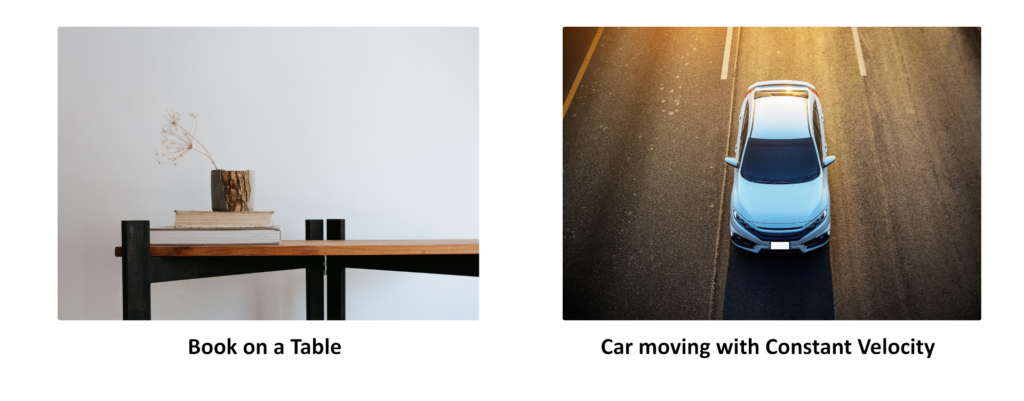
- Forces acting on an object are equal in Magnitude but opposite in Direction.
- They cancel each other out, so the Resultant Force is Zero.

Characteristics:
- No change in Motion.
- Object or Body remains at rest or continues at Constant Velocity.
Examples:

Unbalanced Force:
- Forces acting on an object are not equal in Unbalanced Force.
- They do not cancel each other out, so the Resultant Force is non-zero.
Characteristics:
- Change in Motion.
- Object or Body accelerates (speed up, speed down or change direction).
Examples:


Frequently Asked Questions
Solution:
A Resultant Force is the overall force acting on an object after all individual Forces are combined.
Solution:
- Add Forces in the same direction
- Subtract it they act in opposite directions. This gives the net force.
Solution:
- Resultant force = Larger Force – Smaller Force (if opposite)
- Resultant force = Sum of Forces fil same direction
Solution:
A drawing that shows the size and direction of each force using arrows.
Solution:
When the Resultant Force is not zero this causes movement or change.
Solution:
The object is Balanced. It either stays still or keeps moving at Constant Speed.
Solution:
A Rocket producing 13,000 N thrust and 5,000 N weight then,
Resultant Force is,
FR = FL (Larger Force) – FS (Smaller Force)
FR = 13,000 – 5000 = 8,000 N upwards
Vectors and Scalars – GCSE Physics
Introduction
- Motion is defined as the change in the position of an object with respect to time.
- Scalar and Vector Quantities are used to describe the motion of an object.
- Scalars are quantities defined by magnitude alone, such as Speed or Temperature, while Vectors are characterized by both Magnitude and Direction, like Velocity and Force.
Scalar Quantities in Real Life:
- Speed in Transportation
- Temperature in Weather Forecasting
- Energy Consumption
Vector Quantities in Real Life:
- Force in Engineering
- Navigation and Aviation
- Sports and Physics
What are Scalar Quantities
- A scalar quantity is a physical measurement that has only Magnitude (size or amount) and no Direction.
- They can be described completely by a single number with a unit.
Examples:
- Mass: It is Scalar Quantity that measure the amount of matter in an object

- Distance: The total length of the path traveled by an object, regardless of its direction.

- Speed: How fast an object moves.

- Temperature: Measures the average kinetic energy of particles in a substance.

What are Vector Quantities
- A vector quantity is a physical measurement that has both Magnitude and Direction.
- They can be described by a single number with a unit and Direction.
Examples:
- Force: It is a Vector Quantity that describes a push or pull acting on an object

- Weight: It is the force exerted on an object due to gravity.

- Velocity: It is the rate of change of an object’s displacement

- Momentum: It is a vector quantity that describes the quantity of motion of an object.

Scalars vs Vectors: What’s the Difference


Real-World Examples
Weather:
- Scalar: Temperature (“It’s 39°C outside”) – only Magnitude
- Vector: Wind (“20 km/h from the Northwest”) – needs both Speed and Direction

Shopping:
- Scalar: Grocery bill (“£45.60”) – just an amount
- Vector: Walking in a store (“Move 10 meters to aisle 3, then turn right”) – requires Direction

Construction:
- Scalar: Amount of concrete (“50 cubic meters”) – quantity alone
- Vector: Crane operation (“Lift 200 kg upward while moving east at 1 m/s”) – Direction essential

Common Misunderstandings
Speed ≠ Velocity:
- Speed is scalar (e.g. 20 m/s)
- Velocity is vector (e.g. 20 m/s North).

Distance ≠ Displacement:
- Distance = Total journey
- Displacement = Straight-line from start to finish.

Frequently Asked Questions
Solution:
Mass is a scalar quantity. It tells us how much matter is in an object, but it does not have a direction.
Solution:
Energy is a scalar. Like mass, it only has Magnitude and no Direction.
Solution:
Power is a scalar quantity. It measures how quickly energy is transferred or used, without any direction.
Solution:
Time is a scalar. It moves forward, but in physics, we measure it without direction.
Solution:
Speed is a scalar. It shows how fast something is moving. If you include direction, it becomes velocity, which is a vector.
Decimal Recurring to Fraction - GCSE Maths
Introduction
- A Recurring Decimal is denoted with a dot over the number and is any decimal in which the digits repeat themselves.

Types of Recurring Decimals
Pure Recurring Decimals:
- Decimal where all the digits after the decimal point repeat indefinitely.
Examples:
- 0.333…
- 0.7474….
- 0.4545….
- 0.98549854….
Mixed Recurring Decimals:
- After the decimal point, some digits do not repeat, and a sequence of digits starts repeating indefinitely after the non-repeating part.
Examples:
- 0.23434….
- 0.165858….
- 0.2358989….
- 0.7852222….
How to Convert Recurring Decimals to Fractions (Type 1)
Type 1: Converting Pure Recurring Decimals to Fraction:
Step#1: Take your term as x.
Step#2: Multiply both sides by 10n (where n is the number of repeating digits).
- Multiply 10 for 1 Recurring Decimal.
Example:
For 0.333…, there is only 1 digit repeat, so multiply by
101 = 10
So, 10x = 3.333…
- Multiply 100 for 2 Recurring Decimal.
Example:
For 0.2929…, there is 2 digits repeat, so multiply by
102 = 100
So, 100x = 29.2929…
- Multiply 1000 for 3 Recurring Decimal.
Example:
For 0.816816…, there is 3 digits repeat, so multiply by
103 =1000
So, 1000x = 816.816816…
Step#3: Subtract original equation from new equation to eliminate the repeating part.
Step#4: Solve for x and simplify fraction, if possible.
How to Convert Recurring Decimals to Fractions (Type 2)
Type 2: Converting Mixed Recurring Decimals to Fraction:
Step#1: Take your term as x.
Step#2: Multiply both sides by 10 (where m is the number of non-repeating digits).

Step #3: Multiply both sides by 10n (where n is the number of repeating digits) to shift the Decimal.
Step#4: Subtract original equation from new equation to eliminate the repeating part.
Step#5: Solve for x and simplify fraction, if possible.
Solved Example
Problem: Convert 0.12323… into Fraction.
Solution:
Step #1: Let x = 0.12323…
Step #2: Multiply both side by 101 =10 to move the non-repeating part:

Step #3: Multiply both sides by 102 =100 to shift the Decimal:

Step #4: Subtract the original equation from this new equation:

Step #5: Solve for x:

Final Answer: 61/495
Why it is important to convert Recurring Decimals into Fraction?
- Converting recurring decimals into fractions is important because recurring decimals are approximations of fractions, but fractions provide an exact representation of the number.
Examples:
- A recipe might call for 1/3 cup of flour, which is more practical than 0.3333… cups.

- If a bank offers an interest rate of 0.3333… it’s easier to express it as 1/3 to simplify calculations.

- In Chemistry, Mole ratios in reactions often involve fractions (e.g., 0.1666… moles = 1/6 mole).

Three Additional Solved Examples
Solved Example 1
Problem: Convert 0.333… into Fraction.
Solution:
Step #1: Let x = 0.333…
Step #2: Multiply both side by 10:

Step #3: Subtract the original equation from this new equation:

Step #4: Solve for x:

Final Answer: 1/3
Solved Example 2
Problem: Convert 0.181818… into Fraction.
Solution:
Step #1: Let x = 0.1818…
Step #2: Multiply both side by 100:

Step #3: Subtract the original equation from this new equation:

Step #4: Solve for x:

Final Answer: 2/11
Solved Example 3
Problem: Convert 0.6333… into Fraction
Solution:
Step #1: Let x = 0.6333…
Step #2: Multiply both side by 101 =10 to move the non-repeating part:

Step #3: Multiply both sides by 102 =100 to shift the Decimal:

Step #4: Subtract the original equation from this new equation:

Step #5: Solve for x:

Final Answer: 19/30
Practice Questions and Answers on Decimal Recurring to Fraction
Question 1: Convert the Pure Recurring Decimal 0.121212… to a fraction.
Question 2: Convert the Pure Recurring Decimal 0.2222… to a fraction.
Question 3: Convert the Pure Recurring Decimal 0.090909… to a fraction.
Question 4: Convert the Pure Recurring Decimal 0.142142… to a fraction.
Question 5: Convert 0.479479… form of Pure Recurring decimal to a fraction.
Question 6: Convert the Mixed Recurring Decimal 2.333… to a fraction.
Question 7: Converting the Mixed Recurring Decimal 0.10909… to a fraction.
Question 8: Converting the Mixed Recurring Decimal 0.5666… to a fraction.
Question 9: Convert the Mixed Recurring Decimal 2.272727… to a fraction.
Question 10: Convert the Pure Recurring Decimal 0.5555… to a fraction.
Solutions
Question 1:
Solution:
Step#1: Let x = 0.1212…
Step#2: Multiply both sides by 100
100x = 12.1212…
Step#3: Subtract the original equation
100x − x = 12.1212… − 0.1212…
99x = 12
Step#4: Solve for x
x = 12 ÷ 99
= 4 ÷ 33
Answer: 4/33
Question 2:
Solution:
Step#1: Let x = 0.2222…
Step#2: Multiply both sides by 10
10x = 2.222…
Step#3: Subtract the original equation
10x − x = 2.222… − 0.222…
9x = 2
Step#4: Solve for x
x = 2 ÷ 9
Answer: 2/9
Question 3:
Solution:
Step#1: Let x = 0.090909…
Step#2: Multiply both sides by 100
100x = 9.0909…
Step#3: Subtract the original equation
100x − x = 9.0909… − 0.0909…
99x = 9
Step#4: Solve for x
x = 9 ÷ 99
= 1 ÷ 11
Answer: 1/11
Question 4:
Solution:
Step#1: Let x = 0.142142…
Step#2: Multiply both sides by 1000
1000x = 142.142142…
Step#3: Subtract the original equation
1000x − x = 142.142142… − 0.142142…
999x = 142
Step#4: Solve for x
x = 142 ÷ 999
Answer: 142/999
Question 5:
Solution:
Step#1: Let x = 0.479479…
Step#2: Multiply both sides by 1000
1000x = 479.479479…
Step#3: Subtract the original equation
1000x − x = 479.479479… − 0.479479…
999x = 479
Step#4: Solve for x
x = 479 ÷ 999
Answer: 479/999
Question 6:
Solution:
Step#1: Let x = 2.333…
Step#2: Multiply both sides by 10
10x = 23.333…
Step#3: Subtract the original equation
10x − x = 23.333… − 2.333…
9x = 21
Step#4: Solve for x
x = 21 ÷ 9 = 7 ÷ 3
Answer: 7/3
Question 7:
Solution:
Step#1: Let x = 0.10909…
Step#2: Multiply both sides by 10
10x = 1.0909…
Step#3: Multiply both sides again by 100
1000x = 109.0909…
Step#4: Subtract
1000x − 10x = 109.0909… − 1.0909…
990x = 108
Step#5: Solve for x
x = 108 ÷ 990
= 6 ÷ 55
Answer: 6/55
Question 8:
Solution:
Step#1: Let x = 0.5666…
Step#2: Multiply both sides by 10
10x = 5.666…
Step#3: Multiply both sides again by 10
100x = 56.666…
Step#4: Subtract
100x − 10x = 56.666… − 5.666…
90x = 51
Step#5: Solve for x
x = 51 ÷ 90 = 17 ÷ 30
Answer: 17/30
Question 9:
Solution:
Step#1: Let x = 2.2727…
Step#2: Multiply both sides by 100
100x = 227.2727…
Step#3: Subtract
100x − x = 227.2727… − 2.2727…
99x = 225
Step#4: Solve for x
x = 225 ÷ 99 = 25 ÷ 11
Answer: 25/11
Question 10:
Solution:
Step#1: Let x = 0.555…
Step#2: Multiply both sides by 10
10x = 5.555…
Step#3: Subtract the original equation
10x − x = 5.555… − 0.555…
9x = 5
Step#4: Solve for x
x = 5 ÷ 9
Answer: 5/9
Table of Content
- Introduction
- Types of Recurring Decimals
- How to convert Recurring Decimals to Fractions (Type 1)
- How to convert Recurring Decimals to Fractions (Type 2)
- Why it is important to convert Recurring Decimals into Fraction?
- Three Additional Solved Examples
- Practice Questions and Answers on Decimal Recurring to Fraction
Decimal Recurring to Fraction Worksheet - GCSE Maths
Reverse Percentages – GCSE Maths
Reverse Percentage also known as “Reverse Percent“ is a mathematical operation that involves finding the original value or quantity from which a percentage was calculated.
What are Reverse Percentages?
- Reverse percentage is a mathematical concept which is used to find or determine the original value before the Percentage Increase or Decrease.
- Start with the final amount after a percentage change and work backward to find the original number.
- If you know the final value after a percentage change, reverse percentages help you find the original value before the change.
Formula used in Reverse Percentages:

Solved Example
Problem: A TV now costs £300 after a 25% increase. What was its original price?
Solution:
Step #1: Given:
- New value = £300
- Percentage increased = 25%
Step #2: Applying the formula:

Step #3: Put the values in formula:

Step #4: Simplify the denominator:

Step #5: The final value is:

The original price of TV was £240.
Final Answer: £240
How Reverse Percentage is Different From Original Percentage?

Original Percentages:
- It is use when we know the original number or value and want to calculate a percentage of it.
- If original price of shirt is £100 then after 20% increase, the new price will be £120.
Reverse Percentages:
- It is use when we know the final value after a percentage change and want to find the original value.
- After a 20 % increase, the new price of a shirt is £120 then the original price of a shirt was £100.
Steps to Solve Reverse Percentages
Step#1: Understand the Question
- Check the new value is increased or decreased after the change of original value:
- If the final value is after a percentage increase, the formula is:

- If the final value is after a percentage decrease, the formula is:

Step#2: Work out what percentage you now have.
Step#3: Solve the equation
- We know the original equivalent percentage for all the process is 100%.
- Use this to find the 1% of original price or value.
Step#4: Now multiply the 1% with 100% to get the original value or price.
Note: To solve this easily, we should also know the concept of Original Percentages.
Three Additional Solved Examples
Solved Example 1
Problem: A jacket costs £60 after a 20% discount. What was the original price?
Solution:
Step #1: Given:
- New value = £60
- Percentage increased = 20%
Step #2: Applying the formula:

Step #3: Put the values in formula:

Step #4: Simplify the denominator:

Step #5: The final value is:

The original price of jacket was £75.
Final Answer: £75
Solved Example 2
Problem: A product costs £120 including 20% VAT. What was the price before tax?
Solution:
Step #1: Given:
- New value = £120
- Percentage increased = 20%
Step #2: Applying the formula:

Step #3: Put the values in formula:

Step #4: Simplify the denominator:

Step #5: The final value is:

The original price of product was £100.
Final Answer: £100
Solved Example 3
Problem: A house increased in value by 15% and is now worth £230,000. What was its original price?
Solution:
Step #1: Given:
- New value = £230,000
- Percentage increased = 15%
Step #2: Applying the formula:

Step #3: Put the values in formula:

Step #4: Simplify the denominator:

Step #5: The final value is:

The original price of house was £200,000.
Final Answer: £200,000
Practice Questions and Answers on Reverse Percentages
Question 1: A shirt is on sale for £60 after a 20% discount. What was the original price?
Question 2: After a 15% increase, the price of a phone is £345. What was the original price?
Question 3: A house is now valued at £110,000 after a 10% decrease. What was the original price?
Question 4: The price of a book is £25 after a 30% increase. What was the original price?
Question 5: A laptop is now £850 after a 25% discount. What was the original price?
Question 6: A company’s revenue is £1,27,500after a 12.5% decrease due to economic downturn. What was the original revenue before the decrease?
Question 7: A car’s price increased by 18% and is now valued at £4,720. What was the original price before the increase?
Question 8: A company reduced its workforce by 22%, leaving 4,290 employees. How many employees did the company originally have?
Question 9: The price of gold increased by 27%, and the new price is £1,397 per ounce. What was the original price?
Question 10: A business made £315,800 in profit after a 19.5% loss compared to the previous year. What was the previous year’s profit?
Solutions
Question 1:
Solution:
Step#1: Given
• New value = £60
• Percentage decreased = 20%
Step#2: Applying the formula
Original Value = Final Value ÷ (1 ± Percentage ÷ 100)
Step#3: Put the values in the formula
Original Value = 60 ÷ (1 − 20 ÷ 100)
Step#4: Simplify the denominator
= 1 − 20 ÷ 100 = 1 − 0.2
= 0.8
Step#5: The final value is
Original Value = 60 ÷ 0.8
= 60 × 10 ÷ 8
= 600 ÷ 8 = 75
The original price of the shirt was £75
Question 2:
Solution:
Step#1: Given
• New value = £345
• Percentage increased = 15%
Step#2: Applying the formula
Original Value = Final Value ÷ (1 ± Percentage ÷ 100)
Step#3: Put the values in the formula
Original Value = 345 ÷ (1 + 15 ÷ 100)
Step#4: Simplify the denominator
= 1 + 15 ÷ 100 = 1 + 0.15
= 1.15
Step#5: The final value is
Original Value = 345 ÷ 1.15
= 345 × 100 ÷ 115
= 34500 ÷ 115 = 300
The original price of the phone was £300
Question 3:
Solution:
Step#1: Given
• New value = £110,000
• Percentage decreased = 10%
Step#2: Applying the formula
Original Value = Final Value ÷ (1 ± Percentage ÷ 100)
Step#3: Put the values in the formula
Original Value = 110000 ÷ (1 − 10 ÷ 100)
Step#4: Simplify the denominator
= 1 − 10 ÷ 100 = 1 − 0.1
= 0.9
Step#5: The final value is
Original Value = 110000 ÷ 0.9
= 110000 × 10 ÷ 9
= 1100000 ÷ 9 = 122222.22
The original price of the house was £122,222.22
Question 4:
Solution:
Step#1: Given
• New value = £25
• Percentage increased = 30%
Step#2: Applying the formula
Original Value = Final Value ÷ (1 ± Percentage ÷ 100)
Step#3: Put the values in the formula
Original Value = 25 ÷ (1 + 30 ÷ 100)
Step#4: Simplify the denominator
= 1 + 30 ÷ 100 = 1 + 0.3
= 1.3
Step#5: The final value is
Original Value = 25 ÷ 1.3
= 25 × 10 ÷ 13
= 250 ÷ 13 = 19.23
The original price of the book was £19.23
Question 5:
Solution:
Step#1: Given
• New value = £850
• Percentage decreased = 25%
Step#2: Applying the formula
Original Value = Final Value ÷ (1 ± Percentage ÷ 100)
Step#3: Put the values in the formula
Original Value = 850 ÷ (1 − 25 ÷ 100)
Step#4: Simplify the denominator
= 1 − 25 ÷ 100 = 1 − 0.25
= 0.75
Step#5: The final value is
Original Value = 850 ÷ 0.75
= 850 × 100 ÷ 75
= 85000 ÷ 75 = 1133.33
The original price of the laptop was £1133.33
Question 6:
Solution:
Step#1: Given
• New value = £127,500
• Percentage decreased = 12.5%
Step#2: Applying the formula
Original Value = Final Value ÷ (1 ± Percentage ÷ 100)
Step#3: Put the values in the formula
Original Value = 127500 ÷ (1 − 12.5 ÷ 100)
Step#4: Simplify the denominator
= 1 − 12.5 ÷ 100 = 1 − 0.125
= 0.875
Step#5: The final value is
Original Value = 127500 ÷ 0.875
= 127500 × 1000 ÷ 875
= 127500000 ÷ 875 = 145714.28
The original revenue of the company was £145,714.28
Question 7:
Solution:
Step#1: Given
• New value = £4720
• Percentage increased = 18%
Step#2: Applying the formula
Original Value = Final Value ÷ (1 ± Percentage ÷ 100)
Step#3: Put the values in the formula
Original Value = 4720 ÷ (1 + 18 ÷ 100)
Step#4: Simplify the denominator
= 1 + 18 ÷ 100 = 1 + 0.18
= 1.18
Step#5: The final value is
Original Value = 4720 ÷ 1.18
= 4720 × 100 ÷ 118
= 472000 ÷ 118 = 4000
The original price of the car was £4000
Question 8:
Solution:
Step#1: Given
• New value = 4290
• Percentage decreased = 22%
Step#2: Applying the formula
Original Value = Final Value ÷ (1 ± Percentage ÷ 100)
Step#3: Put the values in the formula
Original Value = 4290 ÷ (1 − 22 ÷ 100)
Step#4: Simplify the denominator
= 1 − 22 ÷ 100 = 1 − 0.22
= 0.78
Step#5: The final value is
Original Value = 4290 ÷ 0.78
= 4290 × 100 ÷ 78
= 429000 ÷ 78 = 5500
The original number of employees in the company was 5500
Question 9:
Solution:
Step#1: Given
• New value = £1397
• Percentage increased = 27%
Step#2: Applying the formula
Original Value = Final Value ÷ (1 ± Percentage ÷ 100)
Step#3: Put the values in the formula
Original Value = 1397 ÷ (1 + 27 ÷ 100)
Step#4: Simplify the denominator
= 1 + 27 ÷ 100 = 1 + 0.27
= 1.27
Step#5: The final value is
Original Value = 1397 ÷ 1.27
= 1397 × 100 ÷ 127
= 139700 ÷ 127 = 1100
The original price of gold was £1100
Question 10:
Solution:
Step#1: Given
• New value = £315,800
• Percentage decreased = 19.5%
Step#2: Applying the formula
Original Value = Final Value ÷ (1 ± Percentage ÷ 100)
Step#3: Put the values in the formula
Original Value = 315800 ÷ (1 − 19.5 ÷ 100)
Step#4: Simplify the denominator
= 1 − 19.5 ÷ 100 = 1 − 0.195
= 0.805
Step#5: The final value is
Original Value = 315800 ÷ 0.805
= 315800 × 1000 ÷ 805
= 315800000 ÷ 805 = 392298.13
The original revenue of the company was £392,298.13
How to Use SOHCAHTOA – GCSE Maths
SOHCAHTOA is used in GCSE Maths to solve problems involving right-angled triangles. It involves three basic trigonometric ratios: Sine, Cosine, and Tangent.
What is SOHCAHTOA?
- The term “SOHCAHTOA” is an simple way to help remember the three main trigonometric ratios: Sine, Cosine and Tangent.

What are SOHCAHTOA Rules?
SOHCAHTOA helps you remember the relationship between angles and sides in a right-angled triangle. It stands for:
- SOH:
Sine = Opposite side ÷ Hypotenuse

CAH:
Cosine = Adjacent side ÷ Hypotenuse

TOA:
Tangent = Opposite side ÷ Adjacent side

✨ Tips to Remember✨
A clearly labeled diagram of a triangle can help you better understand these relationships.
The side opposite the angle is called the opposite.

The side touching the angle is called the adjacent.

The largest side, opposite the right angle, is called the hypotenuse.

Does SOHCAHTOA Only Work for Right Triangles?
Yes, SOHCAHTOA only works with right angle triangle.

For other triangles, we use the Law of Sine and Cosine to find missing sides and angles.

If you want to learn more about the law of sine and cosine please click on this link: Law of sine and cosine.
How to Use SOHCAHTOA – To Find an Unknown Side of a Right Triangle
Using SOHCAHTOA involves these 3 simple steps:
Step #1: Label the Sides Clearly
- Identify the triangle’s opposite, adjacent, and hypotenuse sides based on your reference angle.
- Once the sides are labeled, you will have two sides identified—one is given, and the other needs to be found.

Step #2: Use the Correct Trigonometric Ratio
- Based on the given side and the side you need to find, use the correct trigonometric ratio. For example,
- Use Sine Theta (SOH) if you are dealing with opposite and hypotenuse.

- Use Cosine Theta (CAH) if you are dealing with adjacent and hypotenuse.

- Use Tangent Theta (TOA) if you are dealing with opposite and adjacent sides.

Step #3: Solve the Example Briefly
- Use the selected trigonometric formula, substitute the known values, and solve for the missing side with a quick calculation. Here’s a clear example:
- If you know the opposite side and need the hypotenuse, use the Sine formula

Solved Example
Problem: A right-angled triangle has a hypotenuse of 10 cm and an angle of 30°. Find the length of the opposite side.

Solution:
Step #1: Identify the given values:
- Hypotenuse = 10 cm
- Angle = 30°
Step #2: Choose the correct trigonometric ratio:
Since we are dealing with the opposite side and the hypotenuse, we use Sine Theta.
Step #3: Set up the equation:

Step #4: Rearrange the equation to solve for the opposite side:

Step #5: Substitute the value of sin(30°) = 0.5:

Step #6: Calculate the final answer:

Thus, the length of the opposite side is 5 cm
Final Answer: 5 cm
How to Find a Missing Angle of a Right Triangle
To find a missing angle in a right-angled triangle using SOHCAHTOA, follow these 3 steps:
Step #1: Identify the Given Sides
- Determine which two sides are provided—opposite, adjacent, or hypotenuse.
- Label the given sides clearly.

Step #2: Use the Correct Trigonometric Ratio
- Use Sine Theta (SOH) if you are dealing with opposite and hypotenuse.

- Use Cosine Theta (CAH) if you are dealing with adjacent and hypotenuse.

- Use Tangent Theta (TOA) if you are dealing with opposite and adjacent sides.

Step #3: Solve for the Angle
- Use the inverse trigonometric function (sin⁻¹, cos⁻¹, or tan⁻¹) on your calculator to find the angle.

If you want to learn more, click this link: Casio Calculator 991ex
- Rearrange the equation if necessary.
- Calculate to determine the missing angle.
Solved Example
Problem: A right-angled triangle has an opposite side of 4 cm and a hypotenuse of 8 cm. Find the missing angle.

Solution:
Step #1: Identify the given values:
- Opposite = 4 cm
- Hypotenuse = 8 cm
Step #2: Choose the correct trigonometric ratio:
Since we have the opposite side and the hypotenuse, we use Sine Theta.
Step #3: Set up the equation:

Step #4: Simplify the fraction:

Step #5: Use the inverse sine function to find the angle:

Step #6: Calculate the final answer:

Thus, the missing angle is 30°.
Final Answer: 30°
Three Additional Solved Examples
Solved Example 1
Problem: A right-angled triangle has an angle of 35° and a hypotenuse of 15 cm. Find the length of the opposite side.

Solution:
Step #1: Identify the given values:
- Hypotenuse = 15 cm
- Angle = 35°
Step #2: Choose the correct trigonometric ratio:
Since we are dealing with the opposite side and the hypotenuse, we use Sine Theta.
Step #3: Set up the equation:

Step #4: Rearrange the equation to solve for the opposite side:

Step #5: Calculate the value:

Thus, the opposite side is 8.60 cm.
Final Answer: 8.60 cm
Solved Example 2
Problem: A right-angled triangle has an adjacent side of 5 cm and a hypotenuse of 13 cm. Find the missing angle.

Solution:
Step #1: Identify the given values:
- Adjacent = 5 cm
- Hypotenuse = 13 cm
Step #2: Choose the correct trigonometric ratio:
Since we have the adjacent side and the hypotenuse, we use Cosine Theta.
Step #3: Set up the equation:

Step #4: Use the inverse cosine function:

Step #5: Calculate the value:

Thus, the missing angle is 67.38°
Final Answer: 67.38°
Solved Example 3
Problem: A ladder leans against a wall, reaching a height of 15 meters. The ladder makes an angle of 65° with the ground. Find the length of the ladder.

Solution:
Step #1: Identify the given values:
- Opposite side (height) = 15 m
- Angle = 65°
Step #2: Choose the correct trigonometric ratio:
Since we have the opposite side and the hypotenuse, we use Sine Theta.
Step #3: Set up the equation:

Step #4: Rearrange the equation to solve for the hypotenuse:

Step #5: Calculate the value:


Thus, the ladder is 16.55 meters long
Final Answer: 16.55 m
Practice Questions and Answers on SOHCAHTOA
Question 1:
Two right-angled triangles are shown below.
AB is 10cm
BC is 3cm
Angle BCD is 65°

Calculate the size of angle ABD
Question 2:
Shown below are right-angled triangles, ABD and BCD.

AB = 15cm
Angle ABD = 70°
Angle ABD : Angle DBC = 5 : 2
Work out the length of CD
Question 3:
The diagram shows two right-angled triangles.

Calculate the value of x
Question 4:

Work out the size of angle BAD.
Give your answer to 1 decimal place.
Question 5:

Work out the value of x.
Give your answer to 1 decimal place.
Question 6:

Work out the size of angle BCD.
Give your answer to 1 decimal place.
Question 7:

Calculate the size of angle BAC.
Question 8:

Calculate the size of angle ACB.
Question 9:

Calculate the length AB.
Question 10:
Triangle ABC has a right angle.
Angle BAC is 25°
AC = 12.5cm

Calculate the length of AB
Solutions
Question 1:
Solution:
Step #1: Identify the given values
AB = 10 cm (hypotenuse)
BC = 3 cm (adjacent to angle BCD)
Angle BCD = 65°
Find angle ABD
Step #2: Find BD (opposite side in triangle ABD) using tan function
tan(65°) = BD / BC
Rearranging: BD = tan(65°) × 3
BD = 6.433 cm
Step #3: Use cosine to find angle ABD
cos(ABD) = BD / AB
cos(ABD) = 6.433 / 10
cos(ABD) = 0.6433
Step #4: Find ABD using inverse cosine
ABD = cos⁻¹(0.6433)
ABD ≈ 49.69°
Step #5: Final Answer: Angle ABD = 49.69°
Question 2:
Solution:
Step #1: Identify the given values
AB = 15 cm
Angle ABD = 70°
Angle ratio ABD : DBC = 5 : 2
Find CD
Step #2: Find Angle DBC
Let Angle DBC = x
Since ABD : DBC = 5 : 2, we set up:
5x + 2x = 70°
7x = 70
x = 10°
Angle DBC = 10°
Step #3: Use the sine function to find CD
sin(10°) = CD / 15
Rearranging: CD = 15 × sin(10°)
CD ≈ 15 × 0.1736
CD ≈ 2.73 cm
Step #4: Final Answer: CD = 2.73 cm
Question 3:
Solution:
Step #1: Use the Pythagorean theorem if two sides are known:
x² = hypotenuse² – one side²
Step #2: If an angle and one side are given, use SOHCAHTOA:
sin(angle) = opposite / hypotenuse
cos(angle) = adjacent / hypotenuse
tan(angle) = opposite / adjacent
Step #3: Rearrange the equation to solve for x.
Step #4: Substitute the given values and calculate:
x = 4.66 cm
Step #5: Final Answer: Angle x = 4.66 cm
Question 4:
Solution:
Step #1: Use the correct trigonometric function based on the given sides:
sin(angle) = opposite / hypotenuse
cos(angle) = adjacent / hypotenuse
tan(angle) = opposite / adjacent
Step #2: Rearrange to solve for the angle:
angle = sin⁻¹(opposite / hypotenuse)
angle = cos⁻¹(adjacent / hypotenuse)
angle = tan⁻¹(opposite / adjacent)
Step #3: Substitute the given values and calculate:
angle BAD = 97.6°
Step #4: Final answer: Angle BAD = 97.6°
Question 5:
Solution:
Step #1: Use the tangent function:
tan(angle) = opposite / adjacent
Step #2: Rearrange to solve for x:
x = adjacent × tan(angle)
Step #3: Substitute the given values and calculate:
x = 28.4
Step #4: Final Answer: x = 28.4
Question 6:
Solution:
Step #1: Use the tangent function:
tan(angle) = opposite / adjacent
Step #2: Rearrange to solve for the angle:
angle = tan⁻¹(opposite / adjacent)
Step #3: Substitute the given values and calculate:
angle BCD = 41.8°
Step #4: Final Answer: angle BCD = 41.8°
Question 7:
Solution:
Step #1: Use the sine function:
sin(angle) = opposite / hypotenuse
Step #2: Rearrange to solve for the angle:
angle = sin⁻¹(opposite / hypotenuse)
Step #3: Substitute the given values and calculate:
angle BAC = 60.9°
Step #4: Final Answer: Angle BAC = 60.9°
Question 8:
Solution:
Step #1: Use the cosine function:
cos(angle) = adjacent / hypotenuse
Step #2: Rearrange to solve for the angle:
angle = cos⁻¹(adjacent / hypotenuse)
Step #3: Substitute the given values and calculate:
angle ACB = 18.2°
Step #4: Final Answer: Angle ACB = 18.2°
Question 9:
Solution:
Step #1: Use the cosine function:
cos(angle) = adjacent / hypotenuse
Step #2: Rearrange to solve for AB:
AB = adjacent / cos(angle)
Step #3: Substitute the given values and calculate:
AB = 11.1 cm
Step #4: Final Answer: AB = 11.1 cm
Question 10:
Solution:
Step #1: Identify the given values
Hypotenuse = 12.5 cm
Angle = 25°
Find AB (adjacent side).
Step #2: Choose the correct trigonometric function
- Since we have the adjacent side and hypotenuse, use cosine.
- cos(angle) = adjacent / hypotenuse
Step #3: Set up the equation
cos(25°) = AB / 12.5
Step #4: Solve for AB
AB = 12.5 × cos(25°)
Step #5: Use a calculator
cos(25°) ≈ 0.9063
AB ≈ 12.5 × 0.9063
AB ≈ 11.33 cm
Step #6: Final Answer: AB = 11.33 cm
Law of Indices Rules | GCSE Maths
Understanding Indices
Indices, also known as exponents or powers, provide a way to represent repeated multiplication in a simpler form.
For example:
Instead of writing 2 × 2 × 2 × 2 × 2, we write 2⁵.
Here, 2 is the base, and 5 is the index (or exponent), meaning the base is multiplied five times.

Similarly, 5 × 5 × 5 can be written as 5³, meaning 5 multiplied by itself three times.

To simplify mathematical expressions involving exponents, we use specific rules called the Laws of Indices.
Laws of Indices
1. Multiplication Rule
- Rule: When multiplying numbers with the same base, add the indices.

Example:
Question: Simplify: 23 × 24
Solution:
- Step #1: Expand the Powers
(2 × 2 × 2) × (2 × 2 × 2 × 2) = 27
- Step #2: Apply the Multiplication Rule:
am × an = am + n
23 × 24 = 23 + 4 = 27
2. Division Rule
- Rule: When dividing numbers with the same base, subtract the indices.

Example:
Question: Simplify: 75 ÷ 72
Solution:
- Step #1: Expand the Powers
(7 × 7 × 7 × 7 × 7) ÷ (7 × 7) = 73
- Step #2: Apply the Division Rule:
am ÷ an = am – n
75 ÷ 72 = 75 – 2 = 73
3. Power of a Power Rule
- Rule: When raising a power to another power, multiply the indices.

Example:
Question: Simplify: (34)2
Solution:
- Step #1: Expand the Expression
(3 × 3 × 3 × 3) × (3 × 3 × 3 × 3)
- Step #2: Apply the Power Rule:
(am)n = am × n
(34)2 = 34 × 2 = 38
4. Zero Index Rule
- Rule: Any number raised to the power of zero is always equal to 1.

Example:
- 50 = 1
5. Negative Index Rule
- Rule: A negative exponent means the reciprocal of the base with a positive exponent.

Example:
Question: Simplify: 2-3
Solution:
- Step #1: Apply the Negative Index Rule

2-3 = 1 / 23
- Step #2: Expand the Power:
23 = 2 × 2 × 2 = 8
2-3 = 1/8
6. Fractional Index Rule (GCSE Higher Maths)
- Rule: A fractional exponent represents a root.

📌 This is a GCSE Higher Maths topic. To learn more about it, click on this link: Fractional Indices
Example 1:
Question: Simplify: 16{1/2}
Solution:
- Step #1: Understand the Fractional Exponent Rule
16{1/2} = √16
- Step #2: Find the Square Root
√16 = 4
Example 2:
Question: Simplify: 27{1/3}
Solution:
- Step #1: Understand the Fractional Exponent Rule
27{1/3} = ³√27
- Step #2: Find the Square Root
³√27 = 3
Solved Example
Problem: Simplify:

Solution:
Step #1: Apply the multiplication rule to the numerator:

Step #2: Apply the division rule:

Final Answer: 33
Solved Example
Problem: Simplify:

Solution:
Step #1: Group terms with the same base:

Step #2: Apply the multiplication rule to each base:

Final Answer:

Solved Example
Problem: Simplify:

Solution:
Step #1: Group terms:

Step #2: Apply multiplication and division rules:

Step #3: Convert 42 into base 2:

Final Answer:

Practice Questions and Answers on Law of Indices
Question 1:
(a) Simplify x⁸ × x³
(b) Simplify (5y)³
(c) Simplify w⁷ ÷ w⁴
Question 2:
(a) Simplify a⁹ × a⁴
(b) Simplify (4b²c)³
(c) Simplify d⁹ ÷ d⁴
Question 3:
(a) Simplify 2m² × 5n⁶
(b) Simplify 15p³ ÷ 3p⁴
Question 4:
(a) Simplify (t³)⁴
(b) Simplify 12m²n⁶ ÷ 3mn⁴
Question 5:
(a) Given y² × yᵃ = y⁷,find the value of a.
(b) Given (y⁴)ᵇ = y¹², find the value of b.
Question 6:
(a) Given x⁶ ÷ xᵃ = x⁸, find the value of a.
(b) Simplify (2m²)⁴.
Question 7:
(a) Write (3⁴ × 3⁵) ÷ 3² as a power of 3.
(b) Write down the value of 3⁻³.
(c) Write down the value of 3⁰.
Question 8:
(a) Simplify p³ × p⁵.
(b) Simplify (4ab²)³.
(c) Simplify 16m⁷n³ ÷ 4m³n.
Question 9: Work out the value of (2³ × 2) ÷ 2⁵.
Question 10:
(a) Simplify 9p³ × 2p⁻².
(b) Simplify (5x³y²)³.
(c) Given p³ × p⁵ = p¹² × pʸ, find the value of y.
Solutions
Question 1:
Solution:
(a) x¹¹
(b) 125y³
(c) w³
Question 2:
Solution:
(a) a¹³
(b) 14
(c) d⁵
Question 3:
Solution:
(a) 10m²n⁶
(b) 5p⁻¹
Question 4:
Solution:
(a) t¹²
(b) 15m³n⁷
Question 5:
Solution:
(a) 5
(b) 3
Question 6:
Solution:
(a) -2
(b) 16m⁸
Question 7:
Solution:
(a) 3⁷
(b) 1/27
(c) 1
Question 8:
Solution:
(a) p⁸
(b) 64a³b⁶
(c) 4m⁴n²
Question 9:
Solution: 1/2
Question 10:
Solution:
(a) 10c²d⁴
(b) 125x⁹y⁶
(c) -4