Introduction
- Operations are the basic processes used to manipulate numbers and expressions. The four fundamental operations are:
- Addition (+)
- Subtraction (−)
- Multiplication (×)
- Division (÷)
- In mathematics, an Operation is a process or action that produces a new value from one or more inputs, such as addition, subtraction, multiplication, or division.
Order of Operations:
- To solve expressions correctly, follow the order:
Parentheses → Exponents → Multiplication/Division → Addition/Subtraction
Watch: Fractions
Addition of Fractions
1. Same Denominator- If the denominators (bottom numbers) are the same, just add the numerators (top numbers):
$$\frac{a}{c} + \frac{b}{c} = \frac{a + b}{c}$$
If the denominators are different, follow these steps:
1
Find the Least Common Denominator (LCD), the smallest number that both denominators can divide into.
2
Convert fractions to have the same denominator.
3
Add the numerators.
4
Simplify the result (if needed).
$$\frac{a}{b} + \frac{c}{d} = \frac{ad + bc}{bd}$$
Subtraction of Fractions
1. Same Denominator- If the denominators (bottom numbers) are the same, just subtract the numerators (top numbers):
$$\frac{a}{c} – \frac{b}{c} = \frac{a – b}{c}$$
If the denominators are different, follow these steps:
1
Find the Least Common Denominator (LCD), the smallest number that both denominators can divide into.
2
Convert fractions to have the same denominator.
3
Subtract the numerators.
4
Simplify the result (if needed).
$$\frac{a}{b} – \frac{c}{d} = \frac{ad – bc}{bd}$$
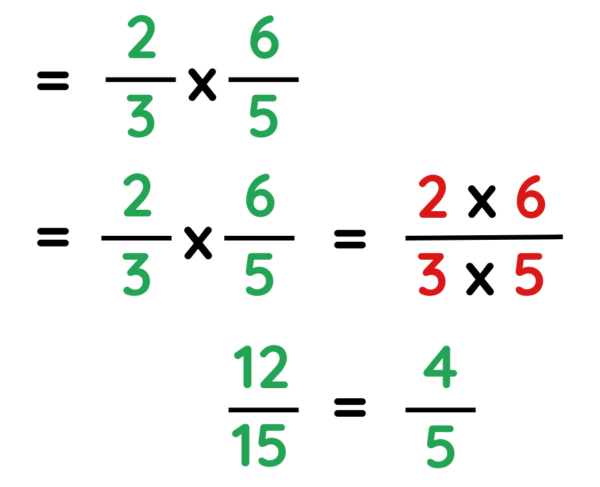
Multiplication of Fractions
1. Basic Rule- For a problem, such as:$$\frac{a}{b} \times \frac{c}{d}$$
- Numerator of the product = $a \times c$
- Denominator of the product = $b \times d$
1
Multiply the numerators: $a \times c$.
2
Multiply the denominators: $b \times d$.
3
Simplify the resulting fraction by dividing numerator and denominator by their greatest common divisor (GCD).
Need help with Fractions?
Our tutors explain it step by step, matched to your exam board.
Book a Consultation →Division of Fractions
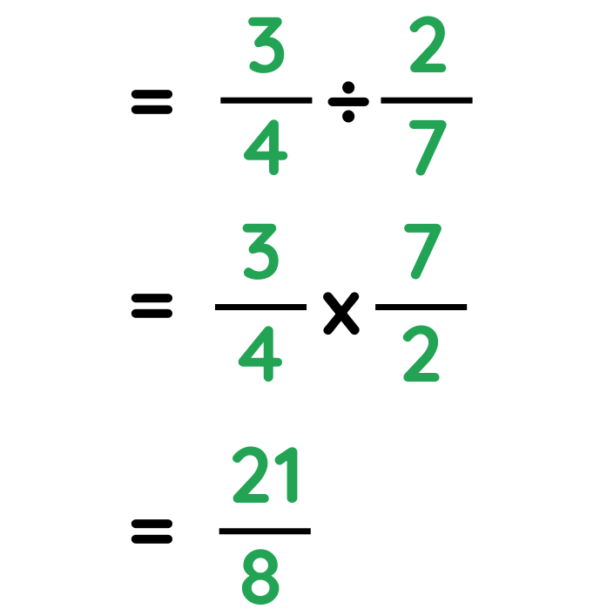
1. Basic Rule- For a problem, such as:$$\frac{a}{b} \div \frac{c}{d}$$
- Numerator of the product = $a \times d$
- Denominator of the product = $b \times c$
1
Write the problem:
$$\frac{a}{b} \div \frac{c}{d}$$
2
Reciprocal, Change to:
$$\frac{a}{b} \times \frac{d}{c}$$
3
Multiply numerators and denominators. Simplify the result by dividing numerator and denominator by their greatest common divisor (GCD).
Solved Examples
Solved Example
Convert $\frac{3}{4} + \frac{7}{2}$ into a single fraction.
SOLUTION
1
Make the bottom numbers the same:
$$\frac{3}{4} + \frac{7 \times 2}{2 \times 2} \longrightarrow \frac{3}{4} + \frac{14}{4}$$
2
Add the top numbers:
$$\frac{3 + 14}{4} = \frac{17}{4}$$
3
Convert back to a Mixed Fraction:
$$4\frac{1}{4}$$
Final Answer: $4\frac{1}{4}$
Solved Example
Convert $\frac{9}{4} – \frac{5}{2}$ as a fraction.
SOLUTION
1
Make the bottom numbers the same:
$$\frac{9}{4} – \frac{5 \times 2}{2 \times 2} \longrightarrow \frac{9}{4} – \frac{10}{4}$$
2
Subtract the top numbers:
$$\frac{9 – 10}{4} = -\frac{1}{4}$$
Final Answer: $-\frac{1}{4}$
Solved Example
Convert $\frac{8}{3} \times \frac{6}{5}$ as a fraction.
SOLUTION
1
Multiply top numbers together:
$$8 \times 6 = 48$$
2
Multiply bottom numbers together:
$$3 \times 5 = 15$$
3
Simplify the result:
$$\frac{48}{15} \longrightarrow \frac{16}{5}$$
Final Answer: $\frac{16}{5}$
Solved Example
Convert $\frac{3}{4} \div \frac{7}{2}$ as a fraction.
SOLUTION
1
Keep the first fraction same, change the divide sign to a multiplication sign, and reciprocate the second fraction:
$$\frac{3}{4} \times \frac{2}{7}$$
2
Multiply bottom and top numbers together:
$$\frac{3 \times 2}{4 \times 7} = \frac{6}{28}$$
Simplify the result:
$$\frac{6}{28} = \frac{3}{14}$$
Final Answer: $\frac{3}{14}$
Solved Example
Emma baked $\frac{2}{3}$ of a tray of cookies in the morning and $\frac{1}{4}$ of a tray in the afternoon. How much of a full tray did she bake in total?
SOLUTION
1
Write down the given information:
- In Morning, Emma baked: $\frac{2}{3}$
- At afternoon, fraction of tray gets completed: $\frac{1}{4}$
2
Simplify to make a common denominator. We know that:
$$\frac{2}{3} + \frac{1}{4} \longrightarrow \frac{8}{12} + \frac{3}{12}$$
3
Calculate the final result by applying favorable operations. The total amount of baking that has been completed:
$$\frac{8 + 3}{12} = \frac{11}{12}$$
Final Answer: $\frac{11}{12}$ of a tray
Solved Example
A ribbon is $2\frac{3}{4}$ meter long. You need pieces of length $\frac{1}{6}$ meter. How many full pieces can you cut?
SOLUTION
1
Write down the given information:
- Length of ribbon: $2\frac{3}{4} = \frac{11}{4}$ meter
- Pieces of length: $\frac{1}{6}$ meter
2
Divide total length by piece length. We know that:
$$\frac{11}{4} \div \frac{1}{6}$$
3
Calculate the final result by applying favorable operations:
$$\frac{11}{4} \times \frac{6}{1} = \frac{66}{4} = 16\frac{1}{2}$$
Final Answer: $16$ full pieces
Ready to test your knowledge?
You've reviewed the notes. Now try exam-style questions on Fractions.
Start Practice Questions →