How to Use SOHCAHTOA โ GCSE Maths
SOHCAHTOA is used in GCSE Maths to solve problems involving right-angled triangles. It involves three basic trigonometric ratios: Sine, Cosine, and Tangent.
What is SOHCAHTOA?
- The term “SOHCAHTOA” is an simple way to help remember the three main trigonometric ratios: Sine, Cosine and Tangent.

What are SOHCAHTOA Rules?
SOHCAHTOA helps you remember the relationship between angles and sides in a right-angled triangle. It stands for:
- SOH:
Sine = Opposite side รท Hypotenuse

CAH:
Cosine = Adjacent side รท Hypotenuse

TOA:
Tangent = Opposite side รท Adjacent side

โจ Tips to Rememberโจ
A clearly labeled diagram of a triangle can help you better understand these relationships.
The side opposite the angle is called the opposite.

The side touching the angle is called the adjacent.

The largest side, opposite the right angle, is called the hypotenuse.

Does SOHCAHTOA Only Work for Right Triangles?
Yes, SOHCAHTOA only works with right angle triangle.

For other triangles, we use the Law of Sine and Cosine to find missing sides and angles.

If you want to learn more about the law of sine and cosine please click on this link: Law of sine and cosine.
How to Use SOHCAHTOA โ To Find an Unknown Side of a Right Triangle
Using SOHCAHTOA involves these 3 simple steps:
Step #1: Label the Sides Clearly
- Identify the triangleโs opposite, adjacent, and hypotenuse sides based on your reference angle.
- Once the sides are labeled, you will have two sides identifiedโone is given, and the other needs to be found.

Step #2: Use the Correct Trigonometric Ratio
- Based on the given side and the side you need to find, use the correct trigonometric ratio. For example,
- Use Sine Theta (SOH) if you are dealing with opposite and hypotenuse.

- Use Cosine Theta (CAH) if you are dealing with adjacent and hypotenuse.

- Use Tangent Theta (TOA) if you are dealing with opposite and adjacent sides.

Step #3: Solve the Example Briefly
- Use the selected trigonometric formula, substitute the known values, and solve for the missing side with a quick calculation. Here’s a clear example:
- If you know the opposite side and need the hypotenuse, use the Sine formula

Solved Example
Problem: A right-angled triangle has a hypotenuse of 10 cm and an angle of 30ยฐ. Find the length of the opposite side.

Solution:ย
Step #1: Identify the given values:
- Hypotenuse = 10 cm
- Angle = 30ยฐ
Step #2: Choose the correct trigonometric ratio:
Since we are dealing with the opposite side and the hypotenuse, we use Sine Theta.
Step #3: Set up the equation:

Step #4: Rearrange the equation to solve for the opposite side:

Step #5: Substitute the value of sinโก(30ยฐ) = 0.5:

Step #6: Calculate the final answer:

Thus, the length of the opposite side is 5 cm
Final Answer: 5 cm
How to Find a Missing Angle of a Right Triangle
To find a missing angle in a right-angled triangle using SOHCAHTOA, follow these 3 steps:
Step #1: Identify the Given Sides
- Determine which two sides are providedโopposite, adjacent, or hypotenuse.
- Label the given sides clearly.

Step #2: Use the Correct Trigonometric Ratio
- Use Sine Theta (SOH) if you are dealing with opposite and hypotenuse.

- Use Cosine Theta (CAH) if you are dealing with adjacent and hypotenuse.

- Use Tangent Theta (TOA) if you are dealing with opposite and adjacent sides.

Step #3: Solve for the Angle
- Use the inverse trigonometric function (sinโปยน, cosโปยน, or tanโปยน) on your calculator to find the angle.

If you want to learn more, click this link: Casio Calculator 991ex
- Rearrange the equation if necessary.
- Calculate to determine the missing angle.
Solved Example
Problem: A right-angled triangle has an opposite side of 4 cm and a hypotenuse of 8 cm. Find the missing angle.

Solution:ย
Step #1: Identify the given values:
- Opposite = 4 cm
- Hypotenuse = 8 cm
Step #2: Choose the correct trigonometric ratio:
Since we have the opposite side and the hypotenuse, we use Sine Theta.
Step #3: Set up the equation:

Step #4: Simplify the fraction:

Step #5: Use the inverse sine function to find the angle:

Step #6: Calculate the final answer:

Thus, the missing angle is 30ยฐ.
Final Answer: 30ยฐ
Three Additional Solved Examples
Solved Example 1
Problem: A right-angled triangle has an angle of 35ยฐ and a hypotenuse of 15 cm. Find the length of the opposite side.

Solution:ย
Step #1: Identify the given values:
- Hypotenuse = 15 cm
- Angle = 35ยฐ
Step #2: Choose the correct trigonometric ratio:
Since we are dealing with the opposite side and the hypotenuse, we use Sine Theta.
Step #3: Set up the equation:

Step #4: Rearrange the equation to solve for the opposite side:

Step #5: Calculate the value:

Thus, the opposite side is 8.60 cm.
Final Answer: 8.60 cm
Solved Example 2
Problem: A right-angled triangle has an adjacent side of 5 cm and a hypotenuse of 13 cm. Find the missing angle.

Solution:ย
Step #1: Identify the given values:
- Adjacent = 5 cm
- Hypotenuse = 13 cm
Step #2: Choose the correct trigonometric ratio:
Since we have the adjacent side and the hypotenuse, we use Cosine Theta.
Step #3: Set up the equation:

Step #4: Use the inverse cosine function:

Step #5: Calculate the value:

Thus, the missing angle is 67.38ยฐ
Final Answer: 67.38ยฐ
Solved Example 3
Problem: A ladder leans against a wall, reaching a height of 15 meters. The ladder makes an angle of 65ยฐ with the ground. Find the length of the ladder.

Solution:ย
Step #1: Identify the given values:
- Opposite side (height) = 15 m
- Angle = 65ยฐ
Step #2: Choose the correct trigonometric ratio:
Since we have the opposite side and the hypotenuse, we use Sine Theta.
Step #3: Set up the equation:

Step #4: Rearrange the equation to solve for the hypotenuse:

Step #5: Calculate the value:


Thus, the ladder is 16.55 meters long
Final Answer: 16.55 m
Practice Questions and Answers on SOHCAHTOA
Question 1:
Two right-angled triangles are shown below.
AB is 10cm
BC is 3cm
Angle BCD is 65ยฐ

Calculate the size of angle ABD
ย
Question 2:
Shown below are right-angled triangles, ABD and BCD.

AB = 15cm
Angle ABD = 70ยฐ
Angle ABD : Angle DBC = 5 : 2
Work out the length of CD
ย
Question 3:
The diagram shows two right-angled triangles.

Calculate the value of x
ย
Question 4:

Work out the size of angle BAD.
Give your answer to 1 decimal place.
ย
Question 5:

Work out the value of x.
Give your answer to 1 decimal place.
ย
Question 6:ย

Work out the size of angle BCD.
Give your answer to 1 decimal place.
ย
Question 7:ย

Calculate the size of angle BAC.
ย
Question 8:

Calculate the size of angle ACB.
ย
Question 9:ย

Calculate the length AB.
ย
Question 10:ย
Triangle ABC has a right angle.
Angle BAC is 25ยฐ
AC = 12.5cm

Calculate the length of AB
Solutions
Question 1:ย
Solution:ย
Step #1: Identify the given values
AB = 10 cm (hypotenuse)
BC = 3 cm (adjacent to angle BCD)
Angle BCD = 65ยฐ
Find angle ABD
Step #2: Find BD (opposite side in triangle ABD) using tan function
tan(65ยฐ) = BD / BC
Rearranging: BD = tan(65ยฐ) ร 3
BD = 6.433 cm
Step #3: Use cosine to find angle ABD
cos(ABD) = BD / AB
cos(ABD) = 6.433 / 10
cos(ABD) = 0.6433
Step #4: Find ABD using inverse cosine
ABD = cosโปยน(0.6433)
ABD โ 49.69ยฐ
Step #5: Final Answer: Angle ABD = 49.69ยฐ
ย
Question 2:
Solution:ย
Step #1: Identify the given values
AB = 15 cm
Angle ABD = 70ยฐ
Angle ratio ABD : DBC = 5 : 2
Find CD
Step #2: Find Angle DBC
Let Angle DBC = x
Since ABD : DBC = 5 : 2, we set up:
5x + 2x = 70ยฐ
7x = 70
x = 10ยฐ
Angle DBC = 10ยฐ
Step #3: Use the sine function to find CD
sin(10ยฐ) = CD / 15
Rearranging: CD = 15 ร sin(10ยฐ)
CD โ 15 ร 0.1736
CD โ 2.73 cm
Step #4: Final Answer: CD = 2.73 cm
ย
Question 3:
Solution:ย
Step #1: Use the Pythagorean theorem if two sides are known:
xยฒ = hypotenuseยฒ – one sideยฒ
Step #2: If an angle and one side are given, use SOHCAHTOA:
sin(angle) = opposite / hypotenuse
cos(angle) = adjacent / hypotenuse
tan(angle) = opposite / adjacent
Step #3: Rearrange the equation to solve for x.
Step #4: Substitute the given values and calculate:
x = 4.66 cm
Step #5: Final Answer: Angle x = 4.66 cm
ย
Question 4:
Solution:ย
Step #1: Use the correct trigonometric function based on the given sides:
sin(angle) = opposite / hypotenuse
cos(angle) = adjacent / hypotenuse
tan(angle) = opposite / adjacent
Step #2: Rearrange to solve for the angle:
angle = sinโปยน(opposite / hypotenuse)
angle = cosโปยน(adjacent / hypotenuse)
angle = tanโปยน(opposite / adjacent)
Step #3: Substitute the given values and calculate:
angle BAD = 97.6ยฐ
Step #4: Final answer: Angle BAD = 97.6ยฐ
ย
Question 5:ย
Solution:ย
Step #1: Use the tangent function:
tan(angle) = opposite / adjacent
Step #2: Rearrange to solve for x:
x = adjacent ร tan(angle)
Step #3: Substitute the given values and calculate:
x = 28.4
Step #4: Final Answer: x = 28.4
ย
Question 6:ย
Solution:ย
Step #1: Use the tangent function:
tan(angle) = opposite / adjacent
Step #2: Rearrange to solve for the angle:
angle = tanโปยน(opposite / adjacent)
Step #3: Substitute the given values and calculate:
angle BCD = 41.8ยฐ
Step #4: Final Answer: angle BCD = 41.8ยฐ
ย
Question 7:ย
Solution:ย
Step #1: Use the sine function:
sin(angle) = opposite / hypotenuse
Step #2: Rearrange to solve for the angle:
angle = sinโปยน(opposite / hypotenuse)
Step #3: Substitute the given values and calculate:
angle BAC = 60.9ยฐ
Step #4: Final Answer: Angle BAC = 60.9ยฐ
ย
Question 8:ย
Solution:ย
Step #1: Use the cosine function:
cos(angle) = adjacent / hypotenuse
Step #2: Rearrange to solve for the angle:
angle = cosโปยน(adjacent / hypotenuse)
Step #3: Substitute the given values and calculate:
angle ACB = 18.2ยฐ
Step #4: Final Answer: Angle ACB = 18.2ยฐ
ย
Question 9:ย
Solution:
Step #1: Use the cosine function:
cos(angle) = adjacent / hypotenuse
Step #2: Rearrange to solve for AB:
AB = adjacent / cos(angle)
Step #3: Substitute the given values and calculate:
AB = 11.1 cm
Step #4: Final Answer: AB = 11.1 cm
ย
Question 10:ย
Solution:ย
Step #1: Identify the given values
Hypotenuse = 12.5 cm
Angle = 25ยฐ
Find AB (adjacent side).
Step #2: Choose the correct trigonometric function
- Since we have the adjacent side and hypotenuse, use cosine.
- cos(angle) = adjacent / hypotenuse
Step #3: Set up the equation
cos(25ยฐ) = AB / 12.5
Step #4: Solve for AB
AB = 12.5 ร cos(25ยฐ)
Step #5: Use a calculator
cos(25ยฐ) โ 0.9063
AB โ 12.5 ร 0.9063
AB โ 11.33 cm
Step #6: Final Answer: AB = 11.33 cm
Law of Indices Rules | GCSE Maths
Understanding Indices
Indices, also known as exponents or powers, provide a way to represent repeated multiplication in a simpler form.
For example:
Instead of writing 2 ร 2 ร 2 ร 2 ร 2, we write 2โต.
Here, 2 is the base, and 5 is the index (or exponent), meaning the base is multiplied five times.

Similarly, 5 ร 5 ร 5 can be written as 5ยณ, meaning 5 multiplied by itself three times.

To simplify mathematical expressions involving exponents, we use specific rules called the Laws of Indices.
Laws of Indices
1. Multiplication Rule
- Rule: When multiplying numbers with the same base, add the indices.

Example:
Question: Simplify: 23 ร 24
Solution:ย
- Step #1: Expand the Powers
(2 ร 2 ร 2) ร (2 ร 2 ร 2 ร 2) = 27
- Step #2: Apply the Multiplication Rule:
am ร an = am + n
23 ร 24 = 23 + 4 = 27
2. Division Rule
- Rule: When dividing numbers with the same base, subtract the indices.

Example:
Question: Simplify: 75 รท 72
Solution:ย
- Step #1: Expand the Powers
(7 ร 7 ร 7 ร 7 ร 7) รท (7 ร 7) = 73
- Step #2: Apply the Division Rule:
am รทย an = am –ย n
75 รท 72 = 75 – 2 = 73
3. Power of a Power Rule
- Rule: When raising a power to another power, multiply the indices.

Example:
Question: Simplify: (34)2
Solution:ย
- Step #1: Expand the Expression
(3 ร 3 ร 3 ร 3) ร (3 ร 3 ร 3 ร 3)
- Step #2: Apply the Power Rule:
(am)n = am ร n
(34)2 = 34 ร 2 = 38
4. Zero Index Rule
- Rule: Any number raised to the power of zero is always equal to 1.

Example:
- 50 = 1
5. Negative Index Rule
- Rule: A negative exponent means the reciprocal of the base with a positive exponent.

Example:
Question: Simplify: 2-3
Solution:ย
- Step #1: Apply the Negative Index Rule

2-3 = 1 / 23
- Step #2: Expand the Power:
23 = 2 ร 2 ร 2 = 8
2-3 = 1/8
6. Fractional Index Rule (GCSE Higher Maths)
- Rule: A fractional exponent represents a root.

๐ This is a GCSE Higher Maths topic. To learn more about it, click on this link: Fractional Indices
Example 1:
Question: Simplify: 16{1/2}
Solution:ย
- Step #1: Understand the Fractional Exponent Rule
16{1/2} = โ16
- Step #2: Find the Square Root
โ16 = 4
Example 2:
Question: Simplify: 27{1/3}
Solution:ย
- Step #1: Understand the Fractional Exponent Rule
27{1/3} = ยณโ27
- Step #2: Find the Square Root
ยณโ27 = 3
Solved Example
Problem: Simplify:ย

Solution:ย
Step #1: Apply the multiplication rule to the numerator:

Step #2: Apply the division rule:

Final Answer: 33
Solved Example
Problem: Simplify:ย

Solution:ย
Step #1: Group terms with the same base:

Step #2: Apply the multiplication rule to each base:

Final Answer:

Solved Example
Problem: Simplify:ย

Solution:ย
Step #1: Group terms:

Step #2: Apply multiplication and division rules:

Step #3: Convert 42 into base 2:

Final Answer:

Practice Questions and Answers on Law of Indices
Question 1:
(a) Simplify xโธ ร xยณ
(b) Simplify (5y)ยณ
(c) Simplify wโท รท wโด
ย
Question 2:
(a) Simplify aโน ร aโด
(b) Simplify (4bยฒc)ยณ
(c) Simplify dโน รท dโด
ย
Question 3:
(a) Simplify 2mยฒ ร 5nโถ
(b) Simplify 15pยณ รท 3pโด
ย
Question 4:
(a) Simplify (tยณ)โด
(b) Simplify 12mยฒnโถ รท 3mnโด
ย
Question 5:
(a) Given yยฒ ร yแต = yโท,find the value of a.
(b) Given (yโด)แต = yยนยฒ, find the value of b.
ย
Question 6:ย
(a) Given xโถ รท xแต = xโธ, find the value of a.
(b) Simplify (2mยฒ)โด.
ย
Question 7:ย
(a) Write (3โด ร 3โต) รท 3ยฒ as a power of 3.
(b) Write down the value of 3โปยณ.
(c) Write down the value of 3โฐ.
ย
Question 8:
(a) Simplify pยณ ร pโต.
(b) Simplify (4abยฒ)ยณ.
(c) Simplify 16mโทnยณ รท 4mยณn.
ย
Question 9: Work out the value of (2ยณ ร 2) รท 2โต.
ย
Question 10:ย
(a) Simplify 9pยณ ร 2pโปยฒ.
(b) Simplify (5xยณyยฒ)ยณ.
(c) Given pยณ ร pโต = pยนยฒ ร pสธ, find the value of y.
Solutions
Question 1:ย
Solution:
(a) xยนยน
(b) 125yยณ
(c) wยณ
ย
Question 2:
Solution:
(a) aยนยณ
(b) 14
(c) dโต
ย
Question 3:
Solution:
(a) 10mยฒnโถ
(b) 5pโปยน
ย
Question 4:
Solution:
(a) tยนยฒ
(b) 15mยณnโท
ย
Question 5:ย
Solution:
(a) 5
(b) 3
ย
Question 6:ย
Solution:
(a) -2
(b) 16mโธ
ย
Question 7:ย
Solution:
(a) 3โท
(b) 1/27
(c) 1
ย
Question 8:ย
Solution:
(a) pโธ
(b) 64aยณbโถ
(c) 4mโดnยฒ
ย
Question 9:ย
Solution: 1/2
ย
Question 10:ย
Solution:
(a) 10cยฒdโด
(b) 125xโนyโถ
(c) -4
Multiplying Algebraic Fractions | GCSE Maths
Introduction to Multiplying Algebraic Fractions
- Algebraic fractions are fractions that contain algebraic expressions in the numerator, denominator, or both. Just like numerical fractions, they follow specific rules for addition, subtraction, multiplication, and division.
- Among these operations, multiplication is often the easiest because it doesnโt require finding a common denominator. However, understanding simplification is crucial to solving problems efficiently.
What Skills Do You Need to Learn Before Multiplying Algebraic Fractions?
Before multiplying algebraic fractions, you should be familiar with the following key algebraic skills:
- Factorisation โ This helps simplify algebraic fractions before multiplication. For example, the quadratic expression:

can be factorised as:

Factorisation allows us to cancel common terms easily when multiplying fractions.ย Learn Factorisation
- Basic Algebraic Manipulation โ Expanding brackets, simplifying terms, and rearranging equations are fundamental. For instance:

Understanding these operations helps when working with algebraic expressions in fractions.ย Learn Basic Algebraic Manipulation
- Understanding Algebraic Fractions โ Knowing how to simplify algebraic fractions before performing operations is essential. For example:

can be rewritten as:

Simplifying before multiplying makes calculations much easier. Learn Algebraic Fractions
If you’re unsure about any of these topics, click the links to review them before moving forward!
Steps for Multiplying Algebraic Fractions
- Multiplying algebraic fractions follows the same principles as multiplying numerical fractions. However, since algebraic expressions are involved, simplifying before multiplying is crucial.
Steps to Multiply Algebraic Fractions
1. Factorise the numerators and denominators (if possible) โ This helps identify common terms that can be cancelled.

2. Cancel out any common factors โ If a term appears in both the numerator and denominator, it can be removed.

3. Multiply the remaining numerators together and multiply the remaining denominators together.

4. Simplify the final expression if necessary.

Key Rule to Remember:

- Just like with numerical fractions, you multiply across the numerators and denominators after simplification.
Before moving ahead, make sure youโre confident in simplifying algebraic fractions. If you need a quick revision, check out our Simplifying Algebraic Fractions Guide.
Examples of Multiplying Algebraic Fractions
- Now that we understand the steps, letโs go through some examples to see how to apply them in practice.
Solved Example: Basic Multiplication
Problem:

Solution:ย
Step #1: Identify Common Factors:
The variable x appears in both the numerator and denominator.
Step #2: Cancel Common Factors:

Now, multiply across:

Step #3: Simplify the fraction:

Final Answer: 5/6
Solved Example: Multiplication with Factorisation
Problem:ย

Solution:ย
Step #1: Factorise Where Possible:
The numerator x2 โ 1 is a difference of squares:

Rewrite the fractions:

Step #2: Cancel Common Factors:
- x + 4 cancels out.
- x โ 1 cancels out.
Step #2: Multiply the Remaining Terms:

Final Answer: x + 1
Solved Example: Multiplying More Complex Expressions
Problem:ย

Solution:ย
Step #1: Factorise Where Possible:
The numerator x2 โ 9 is a difference of squares:

The denominator x2 โ 4 is also a difference of squares:

Rewriting the expression:

Step #2: Cancel Common Factors:
- x – 3 cancels out.
- x + 2 cancels out.
Step #2: Multiply the Remaining Terms:

Final Answer: x + 3 / x – 2
If you’re struggling with factorisation, check out our Factorisation Guide to master this skill before moving ahead.
Common Mistakes & How to Avoid Them
When multiplying algebraic fractions, students often make errors that lead to incorrect answers. Below are the most common mistakes and how to avoid them.
Mistake 1: Directly Multiplying Without Factorising (Biggest Mistake!)
Problem:ย

Incorrect Approach:
Some students multiply directly without factorising, like this:

Expanding incorrectly:

This makes the expression unnecessarily complicated and difficult to simplify later. This is the biggest mistake students make!:
Correct Approach:
Factorise first:
- x2 โ 9 is a difference of squares:

- x2 โ 4 is also a difference of squares:

Now, rewrite the expression:

Now, cancel the common factors:
- x โ 3 cancels out.
- x + 2 cancels out.

Final Answer: x + 3 / x – 2
๐ก Tip: Never multiply directly! Always factorise first to simplify your work.
Mistake 2: Not Cancelling Common Factors Properly
Problem:

Incorrect Approach:
Some students multiply first:

Then cancel after multiplying, which creates extra steps.
Correct Approach:
Cancel common terms before multiplying:

Now, multiply:

Final Answer: x + 2 / x – 2
๐ก Tip: Cancel terms before multiplying to simplify your work.
Mistake 3: Incorrect Multiplication of Numerators and Denominators
Problem:

Incorrect Approach:
Some students incorrectly add denominators instead of multiplying:

This is wrong because denominators should be multiplied, not added.
Correct Approach:
Multiply properly:

Final Answer:ย

๐ก Tip: Always multiply numerators together and denominators together. Never add denominators!
Final Tip: Always Check Your Final Answer
Before finalizing your answer, always check:
- Did you factorise everything possible?
- Did you cancel correctly?
- Is your final answer in its simplest form?
Need extra practice? Check out our Multiplying Algebraic Fractions Worksheet for more questions!
Practice Questions and Answers on Multiplying Algebraic Fractions
- Now that you’ve learned how to multiply algebraic fractions, it’s time to test your understanding! Try solving these GCSE-style questions, making sure to factorise and simplify where possible.
Question 1: Multiply and simplify:
(3x / 5) ร (10 / 6x)
Question 2: Multiply and simplify:
(xยฒ – 16) / (x + 4) ร (x + 4) / (x – 4)
Question 3: Multiply and simplify:
(xยฒ + 7x + 12) / (x + 3) ร (x + 2) / (x + 4)
Question 4:Multiply and simplify:
(xยฒ – 9) / (xยฒ – 1) ร (x + 1) / (x – 3)
Question 5: Multiply and simplify:
(xยฒ + 5x + 6) / (xยฒ – 4) ร (x – 2) / (x + 3)
Question 6: Multiply and simplify:
(xยฒ – 4x + 4) / (xยฒ – 5x + 6) ร (x – 3) / (x – 2)
Question 7: Multiply and simplify:
(2xยฒ – 18) / (xยฒ – 9) ร (x + 3) / (x – 3)
Question 8: Multiply and simplify:
(xยณ – 8) / (xยฒ – 4x + 4) ร (x – 2) / (x + 2)
Question 9: Multiply and simplify:
(xยฒ – 7x + 10) / (xยฒ – x – 20) ร (x + 4) / (x – 2)
Question 10: Multiply and simplify:
(xยณ – xยฒ – x + 1) / (xยฒ – 1) ร (x – 1) / (x + 1)
Want to Check Your Answers?
Download the Multiplying Algebraic Fractions Worksheet with Solutions to see step-by-step explanations for each question.
Need to revise? Check out our Full Guide on Algebraic Fractions before attempting these questions!
Solutions
Question 1:ย
Solution:
Step 1: Identify Common Factors
- 10 and 5 share a common factor of 5.
- 6x and 3x share a common factor of 3x.
Step 2: Cancel Common Factors
(3x / 5) ร (10 / 6x)
= ( 3x / 3x ) ร ( 10 / 5 )
= (1 / 1) ร (2 / 2)
Step 3: Multiply Remaining Terms
(1 ร 2) / (1 ร 2) = 2 / 2 = 1
Final Answer: 1
ย
Question 2:
Solution:
Step 1: Factorise the Numerator
xยฒ – 16 = (x – 4)(x + 4)
Rewrite the expression:
((x – 4)(x + 4)) / (x + 4) ร (x + 4) / (x – 4)
Step 2: Cancel Common Factors
- x + 4 cancels out.
- x – 4 cancels out.
Final Answer: 1
ย
Question 3:
Solution:
Step 1: Factorise the Numerator
xยฒ + 7x + 12 = (x + 3)(x + 4)
Rewrite the expression:
((x + 3)(x + 4)) / (x + 3) ร (x + 2) / (x + 4)
Step 2: Cancel Common Factors
- x + 3 cancels out.
- x + 4 cancels out.
Final Answer: x + 2
ย
Question 4:
Solution:
Step 1: Factorise
xยฒ – 9 = (x – 3)(x + 3)
xยฒ – 1 = (x – 1)(x + 1)
Rewrite the expression:
((x – 3)(x + 3)) / ((x – 1)(x + 1)) ร (x + 1) / (x – 3)
Step 2: Cancel Common Factors
- x – 3 cancels out.
- x + 1 cancels out.
Final Answer: (x + 3) / (x – 1)
ย
Question 5:ย
Solution:
Step 1: Factorise
xยฒ + 5x + 6 = (x + 3)(x + 2)
xยฒ – 4 = (x – 2)(x + 2)
Rewrite the expression:
((x + 3)(x + 2)) / ((x – 2)(x + 2)) ร (x – 2) / (x + 3)
Step 2: Cancel Common Factors
- x + 3 cancels out.
- x – 2 cancels out.
- x + 2 cancels out.
Final Answer: 1
ย
Question 6:ย
Solution:
Step 1: Factorise
xยฒ – 4x + 4 = (x – 2)(x – 2)
xยฒ – 5x + 6 = (x – 3)(x – 2)
Rewrite the expression:
((x – 2)(x – 2)) / ((x – 3)(x – 2)) ร (x – 3) / (x – 2)
Step 2: Cancel Common Factors
- x – 2 cancels out (twice).
- x – 3 cancels out.
Final Answer: 1
ย
Question 7:ย
Solution:
Step 1: Factor out the common factors
2xยฒ – 18 = 2(xยฒ – 9) = 2(x – 3)(x + 3)
xยฒ – 9 = (x – 3)(x + 3)
Rewrite the expression:
(2(x – 3)(x + 3)) / ((x – 3)(x + 3)) ร (x + 3) / (x – 3)
Step 2: Cancel Common Factors
- x – 3 cancels out.
- x + 3 cancels out.
Final Answer: 2
ย
Question 8:ย
Solution:
Step 1: Factorise
xยณ – 8 = (x – 2)(xยฒ + 2x + 4)
xยฒ – 4x + 4 = (x – 2)(x – 2)
Rewrite the expression:
((x – 2)(xยฒ + 2x + 4)) / ((x – 2)(x – 2)) ร (x – 2) / (x + 2)
Step 2: Cancel Common Factors
- x – 2 cancels out (twice).
Final Answer: (xยฒ + 2x + 4) / (x + 2)
ย
Question 9:ย
Solution:
Step 1: Factorise
xยฒ – 7x + 10 = (x – 5)(x – 2)
xยฒ – x – 20 = (x – 5)(x + 4)
Rewrite the expression:
((x – 5)(x – 2)) / ((x – 5)(x + 4)) ร (x + 4) / (x – 2)
Step 2: Cancel Common Factors
- x – 5 cancels out.
- x – 2 cancels out.
- x + 4 cancels out.
Final Answer: 1
ย
Question 10:ย
Solution:
Step 1: Factorise
xยฒ – 1 = (x – 1)(x + 1)
Rewrite the expression:
(xยณ – xยฒ – x + 1) / ((x – 1)(x + 1)) ร (x – 1) / (x + 1)
Step 2: Cancel Common Factors
- x – 1 cancels out.
- x + 1 cancels out.
Final Answer: xยฒ – x + 1
Algebraic Fractions | GCSE Maths
Introduction to Algebraic Fractions
What Are Algebraic Fractions?
- An algebraic fraction is a fraction where the numerator, denominator, or both contain algebraic expressions (letters and numbers). For example:

- These work similarly to numerical fractions but follow algebraic rules when simplifying, adding, subtracting, multiplying, or dividing.
How Are Algebraic Fractions Different from Numerical Fractions?

What Skills Do You Need to Learn Algebraic Fractions?
- Before working with algebraic fractions, you should be comfortable with the following topics:
1. Simplifying numerical fractions โ Understanding how to reduce fractions by cancelling common factors.

2. Adding and subtracting fractions โ Knowing how to find the lowest common denominator (LCD).

3. Factorisation โ Being able to factorise expressions x2 – 4 into (x – 2).

4. Basic algebraic manipulation โ Expanding brackets, simplifying expressions, and rearranging equations.

If youโre not confident with any of these, click the links below to review them before continuing:
- Simplifying Fractions
- Adding and Subtracting Fractions
- Factorisation
- Basic Algebraic Manipulation
Simplifying Algebraic Fractions
- Simplifying algebraic fractions means reducing them to their simplest form by cancelling out common factors in the numerator and denominator, just like with numerical fractions.
Steps to Simplify Algebraic Fractions
1. Factorise the numerator and denominator โ If possible, rewrite them as products of factors.

2. Cancel out common factors โ Any factor that appears in both the numerator and denominator can be cancelled.

3. Write the simplified fraction โ Once all common factors are removed, write the remaining expression.

Solved Example: Simplifying a Basic Algebraic Fraction
Problem: Simplify:ย

Solution:ย
Step #1: Factorise the numerator:

So, the fraction becomes:

Step #2: Cancel out common factors:
- The (x + 3) cancels out, leaving:
x – 3
Final Answer: x – 3
Solved Example: Simplifying a More Complex Algebraic Fraction
Problem: Simplify:ย

Solution:ย
Step #1: Factorise the numerator and denominator:
Factorising the numerator:

Factorising the denominator:

Now, the fraction becomes:

Step #2: Cancel out common factors:
- The (x + 2) cancels out, leaving:

Final Answer: x + 3/ x
Adding and Subtracting Algebraic Fractions
- When adding or subtracting algebraic fractions, the process is similar to numerical fractionsโyou need a common denominator before combining the fractions.
Steps to Add or Subtract Algebraic Fractions
1. Find the Lowest Common Denominator (LCD) โ Identify the smallest common multiple of the denominators.

2. Adjust the numerators โ Rewrite each fraction so they have the same denominator.

3. Add or subtract the numerators โ Keep the denominator the same and simplify the numerator if possible.

4. Simplify the fraction โ Factorise if needed and cancel common factors.

Solved Example: Adding Algebraic Fractions with the Same Denominator
Problem: Simplify:ย

Solution:ย
Since the denominator is already the same (5), simply add the numerators:

Final Answer: x
Solved Example: Adding Algebraic Fractions with Different Denominators
Problem: Simplify:ย

Solution:ย
Step #1: Find the Lowest Common Denominator (LCD):
- The denominators are x and x + 2, so the LCD is x(x + 2).
Step #2: Adjust the numerators:
- Multiply each fraction so they both have the LCD:

Expanding the numerators:

Step #3: Add the numerators:


Final Answer: 5x + 4 / x(x + 2)
Solved Example: Subtracting Algebraic Fractions
Problem: Simplify:ย

Solution:ย
- To find the lowest common denominator (LCD), we first check if the denominators can be factorised. Here, x2 + x can be rewritten as x(x + 1).
- Rewriting the fractions:

Step #1: Find the Lowest Common Denominator (LCD):
- The denominators are x + 1 and x (x + 1). Since x (x + 1) already includes x + 1, the LCD is x (x + 1).
- Now, adjust the first fraction to have this denominator by multiplying the numerator and denominator by x:

This simplifies to:

Step #2: Subtract the numerators:
- Since the denominators are now the same, we subtract the numerators:

Final Answer: x2 – 2 / x(x + 1)
Multiplying and Dividing Algebraic Fractions
- Multiplying and dividing algebraic fractions is more straightforward than addition and subtraction because you donโt need a common denominator. However, you should always factorise first and cancel common factors to simplify the expressions.
Multiplying Algebraic Fractions
To multiply algebraic fractions, follow these steps:
1. Factorise the numerators and denominators (if possible).

2. Cancel out any common factors in the numerator and denominator.

3. Multiply the numerators together and the denominators together.

4. Simplify the final expression if needed.

Solved Example: Multiplying Simple Algebraic Fractions
Problem: Simplify:ย

Solution:ย
Step #1: Cancel common factors:
The x in the numerator and denominator cancels out:

Step #2: Multiply the remaining terms:

Step #3: Simplify the fraction:

Final Answer: 5/6
Solved Example: Multiplying More Complex Algebraic Fractions
Problem: Simplify:ย

Solution:ย
Step #1: Factorise the numerators and denominators:

Step #2: Cancel out common factors:
Cancel x + 3 and x โ 2 from both fractions:

Final Answer: x + 2
If you’d like to explore Multiplying Algebraic Fractions in more depth, check out our detailed guide here:
Multiplying Algebraic Fractions – Full Explanation & Examples
Dividing Algebraic Fractions
To divide algebraic fractions, follow these steps:
1. Flip the second fraction (reciprocal) โ Change division into multiplication.
For example:

Simply swap the numerator and denominator of the second fraction, then proceed as a multiplication problem.
2. Factorise the numerators and denominators if possible.

3. Cancel out common factors in the numerator and denominator.

4. Multiply the remaining terms and simplify.

Solved Example: Dividing Algebraic Fractions
Problem: Simplify:ย

Solution:ย
Step #1: Flip the second fraction and change to multiplication:

Step #2: Factorise the numerator and denominator:
Since x2 โ 9 is a difference of squares:

Step #3: Cancel out common factors:
The x + 3 cancels out:

Step #4: Multiply the remaining terms:

Final Answer: (x – 3)(x + 2) / x + 4
Solving Equations Involving Algebraic Fractions
- Equations with algebraic fractions often require removing the fractions before solving for the variable. The key is to find the Lowest Common Denominator (LCD) and use it to eliminate fractions.
Steps to Solve Equations with Algebraic Fractions
- Find the Lowest Common Denominator (LCD) โ Identify the smallest multiple of all denominators.
- Multiply the entire equation by the LCD โ This eliminates fractions.
- Solve the resulting equation โ Expand, simplify, and solve for the variable.
- Check for restrictions โ Ensure the final answer does not make any denominator zero (as division by zero is undefined).
Solved Example: Solving a Simple Algebraic Fraction Equation
Problem: Solve for x:ย

Solution:ย
Step #1: Find the Lowest Common Denominator (LCD):
The denominators are 3 and 5, so the LCD is 15
Step #2: Multiply the entire equation by 15:

Step #3: Simplify:

Step #4: Solve for x:

Final Answer: x = 6/5
Solved Example: Solving an Equation with Multiple Algebraic Fractions
Problem: Solve for x:ย

Solution:ย
Step #1: Find the Lowest Common Denominator (LCD):
The denominators are 4 and 3, so the LCD is 12
Step #2: Multiply the entire equation by 12:

Step #3: Simplify:

Step #4: Expand and Solve:

Final Answer: x = 3
Solved Example: Solving an Equation with a Variable in the Denominator
Problem: Solve for x:ย

Solution:ย
Step #1: Isolate the fraction:
Subtract 3 from both sides:

Step #2: Multiply by x to remove the fraction:

Step #3: Solve for x:

Final Answer: x = 1
How to Solve Equations with Algebraic Fractions โ GCSE Higher Maths
- In order to solve equations with algebraic fractions, the key is to find the Lowest Common Denominator (LCD) to eliminate fractions.
Steps to Solve Equations with Algebraic Fractions
- Find the Lowest Common Denominator (LCD) โ Identify the smallest multiple of all denominators.
- Multiply the entire equation by the LCD โ This removes fractions from the equation.
- Solve the resulting equation โ Expand, simplify, and solve for the variable.
Edexcel GCSE Maths โ November 2022 Paper 1 โ Algebraic Fractions Question
Problem: Solve:ย

Give your answer in the form a ยฑ bโ2 , where a and b are fractions.
Solution:ย
Step #1: Find the Lowest Common Denominator (LCD):
The denominators are x and x + 1, so the LCD is:

Multiply each fraction to express them with the LCD:

Now, simplify the numerators:


Step #2: Multiply Both Sides by the Denominator:
The denominators are x and x + 1, so the LCD is:
1 = 4x(x + 1)
Expand the right-hand side:
1 = 4x2 + 4x
Rearrange to form a quadratic equation:
4x2 + 4x – 1 = 0
Step #3: Solve the Quadratic Equation Using the Quadratic Formula:
4x2 + 4x – 1 = 0
Using the quadratic formula:

where:
- a = 4,
- b = 4,
- c = -1
First, calculate the discriminant:
bยฒ – 4ac = (4)ยฒ – 4(4)(-1)
= 16 + 16 = 32
Since 32 = 16 ร 2, we can simplify:
โ32 = 4โ2
Now, substitute into the quadratic formula:

Step #4: Express in the Required Form:
Simplify the fraction:


Final Answer: x = – 1/2 ยฑ (โ2 / 2)
This matches the required form a ยฑ bโ2, where:
- a = -1/2
- b = 1/2
Conclusion
- Algebraic fractions are an essential part of GCSE Higher Maths, appearing in various topics like simplifying expressions, solving equations, and performing operations such as addition, subtraction, multiplication, and division.
- Mastering these skills will not only help in exams but also build a strong foundation for advanced algebra.
- To strengthen your understanding, practice with the resources below:
Simplifying Algebraic Fractions Worksheet
Algebraic Fractions GCSE Questions
If youโd like to explore Multiplying Algebraic Fractions in more depth, check out our detailed guide here:
Practice Questions and Answers on Algebraic Fractions
Question 1: Simplify:
(xยฒ – 4) / (x + 2)
Question 2: Simplify:
(xยฒ + 6x + 9) / (xยฒ + 3x)
Question 3: Simplify:
(xยฒ – x – 6) / (xยฒ – 4x + 4)
Question 4: Simplify:
(xยฒ – 9) / (xยฒ – 6x + 9)
Question 5: Simplify:
(xยณ – x) / (xยฒ – x)
Question 6: Simplify:
(2xยฒ + 4x) / (xยฒ + 2x + 1)
Question 7: Simplify:
(xยฒ – 5x + 6) / (xยฒ – 2x – 3)
Question 8: Simplify:
(xยณ – 8) / (xยฒ – 4x + 4)
Question 9: Simplify:
(xยฒ – 7x + 10) / (xยฒ – x – 20)
Question 10: Simplify:
(xยณ – x + 1) / (xยฒ – 1)
Solutions
Question 1:ย
Solution:
Factorise the numerator:
xยฒ – 4 = (x – 2)(x + 2)
Cancel the common factor (x + 2):
(x – 2)(x + 2) / (x + 2) = x – 2
Final Answer: x – 2
ย
Question 2:
Solution:
Factorise the numerator and denominator:
xยฒ + 6x + 9 = (x + 3)(x + 3)
xยฒ + 3x = x(x + 3)
Cancel the common factor (x + 3):
(x + 3)(x + 3) / (x(x + 3)) = (x + 3) / x
Final Answer: (x + 3) / x
ย
Question 3:
Solution:
Factorise both numerator and denominator:
xยฒ – x – 6 = (x – 3)(x + 2)
xยฒ – 4x + 4 = (x – 2)(x – 2)
No common factors cancel.
Final Answer: (x – 3)(x + 2) / (x – 2)(x – 2)
ย
Question 4:
Solution:
Factorise numerator and denominator:
xยฒ – 9 = (x – 3)(x + 3)
xยฒ – 6x + 9 = (x – 3)(x – 3)
Cancel x – 3:
(x – 3)(x + 3) / (x – 3)(x – 3) =
(x + 3) / (x – 3)
Final Answer: (x + 3) / (x – 3)
ย
Question 5:ย
Solution:
Factorise:
x(xยฒ – 1) / x(x – 1)
Factorise xยฒ – 1:
x(x – 1)(x + 1) / x(x – 1)
Cancel x – 1:
(x + 1)
Final Answer: x + 1
ย
Question 6:ย
Solution:
Factorise the numerator and denominator:
2xยฒ + 4x = 2x(x + 2)
xยฒ + 2x + 1 = (x + 1)(x + 1)
No common factors cancel.
Final Answer: (2x(x + 2)) / ((x + 1)(x + 1))
ย
Question 7:ย
Solution:
Factorise:
(x – 2)(x – 3) / (x – 3)(x + 1)
Cancel x – 3:
(x – 2) / (x + 1)
Final Answer: (x – 2) / (x + 1)
ย
Question 8:ย
Solution:
Factorise numerator and denominator:
(x – 2)(xยฒ + 2x + 4) / (x – 2)(x – 2)
Cancel x – 2:
(xยฒ + 2x + 4) / (x – 2)
Final Answer: (xยฒ + 2x + 4) / (x – 2)
ย
Question 9:ย
Solution:
Factorise the numerator and denominator:
xยฒ – 7x + 10 = (x – 5)(x – 2)
xยฒ – x – 20 = (x – 5)(x + 4)
Cancel x – 5:
(x – 5)(x – 2) / (x – 5)(x + 4) = (x – 2) / (x + 4)
Final Answer: (x – 2) / (x + 4)
ย
Question 10:ย
Solution:
Factorise the denominator:
xยฒ – 1 = (x – 1)(x + 1)
No common factors cancel.
Final Answer: (xยณ – x + 1) / ((x – 1)(x + 1))
Table of Content
- Introduction to Algebraic Fractions
- Simplifying Algebraic Fractions
- Adding and Subtracting Algebraic Fractions
- Multiplying and Dividing Algebraic Fractions
- Dividing Algebraic Fractions
- Solving Equations Involving Algebraic Fractions
- How to Solve Equations with Algebraic Fractions โ GCSE Higher Maths
- Conclusion
Fractional Indices | GCSE Maths
In this lesson, we will discuss what Fractional Indices are, how they are simplified, and the logic behind negative fractional indices. We will also walk through step-by-step examples to help you understand the concepts and solve some GCSE Past Paper Questions
What Are Indices?
Indices (also known as exponents) allow us to write repeated multiplication in a simpler way. For example:
- x2 meansย “x multiplied by itself” , orย “x times x”.
- x3 meansย “x multiplied by itself three times” , or x times x times x.
- In general, “xn means you multiply x by itself n times”.

ย
This idea is fundamental to working with more advanced topics like fractional indices.
What Are Fractional Indices?
Fractional indices are Exponents written as fractions, for example,
xm/n
They combine the ideas of Powers and Roots into a single operation:
ย

ย
This means you take the n-th root of x first, then raise the result to the power of m.
ย
Which is the same as raising the n-th root of x to the power m
ย
- Numerator (m): Indicates the power (How many times x is multiplied by itself).
- Denominator (n): Indicates the root (Which root to take of x).

ย
Some examples of fractional exponents that are widely used are given below:

Steps for Simplifying Fractional Indices
Step #1: Identify the Fractional Exponent
- If you see xm/n, recognize that:
- m is the power.
- n is the root (i.e., the n-th root).
Step #2: Rewrite in Root Form
Convert

into

Step #3: Find the n-th Root
- If the number is a perfect power, you might see the root immediately (e.g., โ27 = 3).
- If you’re not sure, use prime factorization.
Step #4: Apply the Power
- After finding the n-th root, raise it to the power m.
Step #5: Combine and Simplify
- Simplify any remaining exponents or multiply out any obvious powers.
Solved Example 1
Problem: Simplify:

Solution:ย
Step #1: Identify the Exponent
2/3 means power = 2 and root = 3
Step #2: Rewrite as a Root First

Step #3: Find the Cube Root 2161/3
- Prime-factorize 216:

216 = 23 ร 33
so,

Step #4: Apply the Power m = 2
(6)2 = 36
Step #5: Final Answer
2162/3 = 36
Using these clear stepsโand prime factorization when you’re unsure about the rootโmakes fractional indices much easier to handle.
In the previous example, 216 was a perfect cubeโmaking it straightforward to take the cube root.
However, not all numbers factor into perfect powers so neatly.
Let’s look at another example with 250, which will result in a simplified radical rather than a whole number.
Solved Example 2
Problem: Simplify:

Solution:ย
Step #1: Identify the Exponent
2/3 means power = 2 and root = 3
Step #2: Rewrite in Root Form

Step #3: Prime-Factorize 250

250 = 2 ร 125 = 2 ร 53
so,

Step #4: Apply the Power m = 2

Step #5: Final Answer
(250)2/3 = 25 โ4
If you prefer a decimal approximation, then โ4 โ 1.5874
so,
25 ร 1.5874 โ 39.685
Video Tutorial on Fractional Indices
- Watch this Video Tutorial as we explain step by step to Find Fractional Indices.
Practice Questions and Answers on Fractional Indices
Question 1: Simplify: 1252/3
Question 2:ย Simplify: 643/2
Question 3: Simplify: 5002/3
Question 4:Simplify: 324/5
Question 5: Simplify: 813/4
Question 6: Simplify: 7292/3
Question 7: Simplify: 1283/7
Question 8: Simplify: 10002/3
Question 9: Simplify: 165/4
Question 10: Simplify: 2434/5
Solutions
Question 1:ย
Solution:
Step #1: Identify the Exponent
- The exponent 2/3 means the power is 2 and the root is 3.
Step #2: Rewrite in Root Form
- 1252/3 = (1251/3)2
Step #3: Prime-Factorize 125
- 125 = 5ยณ
- โ125 is 5.
Step #4:ย Apply the Power (2)
- 5ยฒ = 25
Step #5:ย Final Result
1252/3 = 25
ย
Question 2:
Solution:
Step #1: Identify the Exponent
- The exponent 3/2 means the power is 3 and the root is 2.
Step #2: Rewrite in Root Form
- 643/2 = (641/2)3
Step #3: Prime-Factorize 64
- โ64 is 8.
Step #4:ย Apply the Power (3)
- 8ยณ = 512
Step #5:ย Final Result
643/2 = 512
ย
Question 3:
Solution:
Step #1: Identify the Exponent
- The exponent 2/3 means the power is 2 and the root is 3.
Step #2: Rewrite in Root Form
- 5002/3 = (5001/3)2
Step #3: Prime-Factorize 500
- 500 = 2 ร 5ยณ
- โ500 is 5 ร โ2.
Step #4:ย Apply the Power (2)
- (5 ร โ2)ยฒ = 25 ร โ4
Step #5:ย Final Result
5002/3ย = 25 ร โ4
ย
Question 4:
Solution:
Step #1: Identify the Exponent
- The exponent 4/5 means the power is 4 and the root is 5.
Step #2: Rewrite in Root Form
- 324/5 = (321/5)4
Step #3: Fifth Root of 32
- Fifth root of 32 is 2.
Step #4:ย Apply the Power (4)
- 2โด = 16
Step #5:ย Final Result
324/5 = 16
ย
Question 5:ย
Solution:
Step #1: Identify the Exponent
- The exponent 3/4 means the power is 3 and the root is 4.
Step #2: Rewrite in Root Form
- 813/4 = (811/4)3
Step #3: Fourth Root of 81
- Fourth root of 81 is 3.
Step #4:ย Apply the Power (3)
- 3ยณ = 27
Step #5:ย Final Result
813/4 = 27
ย
Question 6:ย
Solution:
Step #1: Identify the Exponent
- The exponent 2/3 means the power is 2 and the root is 3.
Step #2: Rewrite in Root Form
- 7292/3 = (7291/3)2
Step #3: โ729
- โ729 is 9
Step #4:ย Apply the Power (2)
- 9ยฒ = 81
Step #5:ย Final Result
7292/3 = 81
ย
Question 7:ย
Solution:
Step #1: Identify the Exponent
- The exponent 3/7 means the power is 3 and the root is 7.
Step #2: Rewrite in Root Form
- 1283/7 = (1281/7)3
Step #3: Seventh Root of 128
- Seventh root of 128 is 2.
Step #4:ย Apply the Power (3)
- 2ยณ = 8
Step #5:ย Final Result
1283/7 = 8
ย
Question 8:ย
Solution:
Step #1: Identify the Exponent
- The exponent 2/3 means the power is 2 and the root is 3.
Step #2: Rewrite in Root Form
- 10002/3 = (10001/3)2
Step #3: Cube Root of 1000
- Cube root of 1000 is 10.
Step #4:ย Apply the Power (2)
- 10ยฒ = 100
Step #5:ย Final Result
10002/3 = 100
ย
Question 9:ย
Solution:
Step #1: Identify the Exponent
- The exponent 5/4 means the power is 5 and the root is 4.
Step #2: Rewrite in Root Form
- 165/4 = (161/4)5
Step #3: Fourth Root of 16
- Fourth root of 16 is 2.
Step #4:ย Apply the Power (5)
- 2โต = 32
Step #5:ย Final Result
165/4 = 32
ย
Question 10:ย
Solution:
Step #1: Identify the Exponent
- The exponent 4/5 means the power is 4 and the root is 5.
Step #2: Rewrite in Root Form
- 2434/5 = (2431/5)4
Step #3: F Fifth Root of 243
- Fifth root of 243 is 3.
Step #4:ย Apply the Power (4)
- 3โด = 81
Step #5:ย Final Result
2434/5 ย = 81
Enlargement Using a Negative Scale Factor | GCSE Maths
Video Tutorial on Enlargement Using a Negative Scale Factor
Watch this Video Tutorial as we explain step by stepย to Find Enlargement Using a Negative Scale Factor
What is Enlargement?
- Enlargement is when we change the size of a shape while keeping its proportions intact.
- You can think of it like zooming in or out on your smartphoneโthe shape gets bigger or smaller,

but the overall shape stays the same without getting stretched or squished.
- If the scale factor is greater than 1, the shape gets larger (magnified).
For example, letโs say you have a right triangle with a base of 3 cm and a height of 4 cm. If the scale factor is 2, all dimensions are doubled.

The new triangle will have a base of 6 cm and a height of 8 cm.
- If the scale factor is between 0 and 1, the shape gets smaller.
For example, take the same right triangle with a base of 3 cm and a height of 4 cm. If the scale factor is 1/2, all dimensions are halved.

The new triangle will have a base of 1.5 cm and a height of 2 cm.
Centre of Enlargement
- The centre of enlargement is the point about which all the transformations of the shape takes place. This point is generally given in the question.
- It is a fixed point from which all measurements are taken and scaled.
- This point plays a crucial role in determining how the shape is transformed.

In this image, the shape has been enlarged with a centre of enlargement (shown as O) at the origin.
What Are Negative Scale Factors?
Negative scale factor produces an image on the opposite side of the centre of enlargement and it is also flips the shape upside down.
- The shape moves to the opposite side of the centre of enlargement.

- Itโs flipped, like a mirror image.

- The size changes based on the scale factorโs absolute value (ignoring the negative sign in front of it).

Steps to Find Enlargement Using a Negative Scale Factor (Integer Scale Factor)
ย
ย
Solved Example 1
Question: For the figure given below, find the enlargement of the object with a scale factor of -2 about the centre of enlargement at the origin.

Solution:ย
Step 1: Mark the centre of enlargement:
- The centre of enlargement is the point about which all the transformations of the shape takes place. This point is generally given in the question. In our example, we are given the origin as the centre of enlargement.

Step 2: Take a ruler and measure the distance from the centre of enlargement to one vertex of the shape.
- Choose any one vertex of your shape, and measure the distance between this vertex and the origin. Letโs use a point A.
- Suppose the distance OA comes out to be 5 cm.

Step 3: Multiply by the scale factor:
- For now, ignore the minus sign.
- Multiply 5 cm by 2
5 ร 2 = 10 cm
Step 4: Extend the line:
- Extend the line OA by 10 cm TO THE OTHER SIDE ย of the origin and mark the point Aโฒ there.

Step 5: Repeat for all remaining vertices:
- Do the same for the other corners of your shape and find OBโฒ, OCโฒ, and ODโฒ.

Step 6: Join the dots:
- Connect Aโฒ, Bโฒ, Cโฒ, and Dโฒ. Youโve got an enlarged, flipped version of your shape.

Steps to Find Enlargement Using a Negative Scale Factor (Fractional Scale Factor)
ย
ย
Solved Example 2
Question: For the figure given below, find the enlargement of the object with a scale factor of -1/3 about the centre of enlargement at the point (1,1).

Solution:ย
Step 1: Mark the centre of enlargement:
- This time, we are given the point (1,1) as the centre of enlargement. Lets mark it C this time.

Step 2: Take a ruler and measure the distance from the centre of enlargement to one vertex of the shape.
- Choose any vertex and call it A. Measure the distance between (1,1) and A.
- Suppose it comes out to be 3 cm.

Step 3: Multiply by the scale factor:
- Again, ignoring the minus sign, multiply 3 cm by 1/3
3 ร 1/3 = 1 cm
Step 4: Extend the line:
- Extend the line CA by 1 cm TO THE OTHER SIDE of the centre (1,1), and mark the point Aโฒ there.

Step 5: Repeat for all remaining vertices:
- Do the same for the other corners of your shape and get Bโฒ, Eโฒ, and Fโฒ.

Step 6: Join the dots:
- Connect Aโฒ, Bโฒ, Eโฒ, and Fโฒ. Youโve got an enlarged, flipped version of your shape.

- Here, the steps are almost the same; the only difference is that now the lengths OAโฒ, OBโฒ, OEโฒ, and OFโฒ are smaller than the original lengths, and the flipped shape is also smaller.
What Is The Difference Between Positive And Negative Scale Factors For Enlargement?
- As seen in the example above, with negative scale factors, we extend the line to the opposite side of the centre of enlargement.
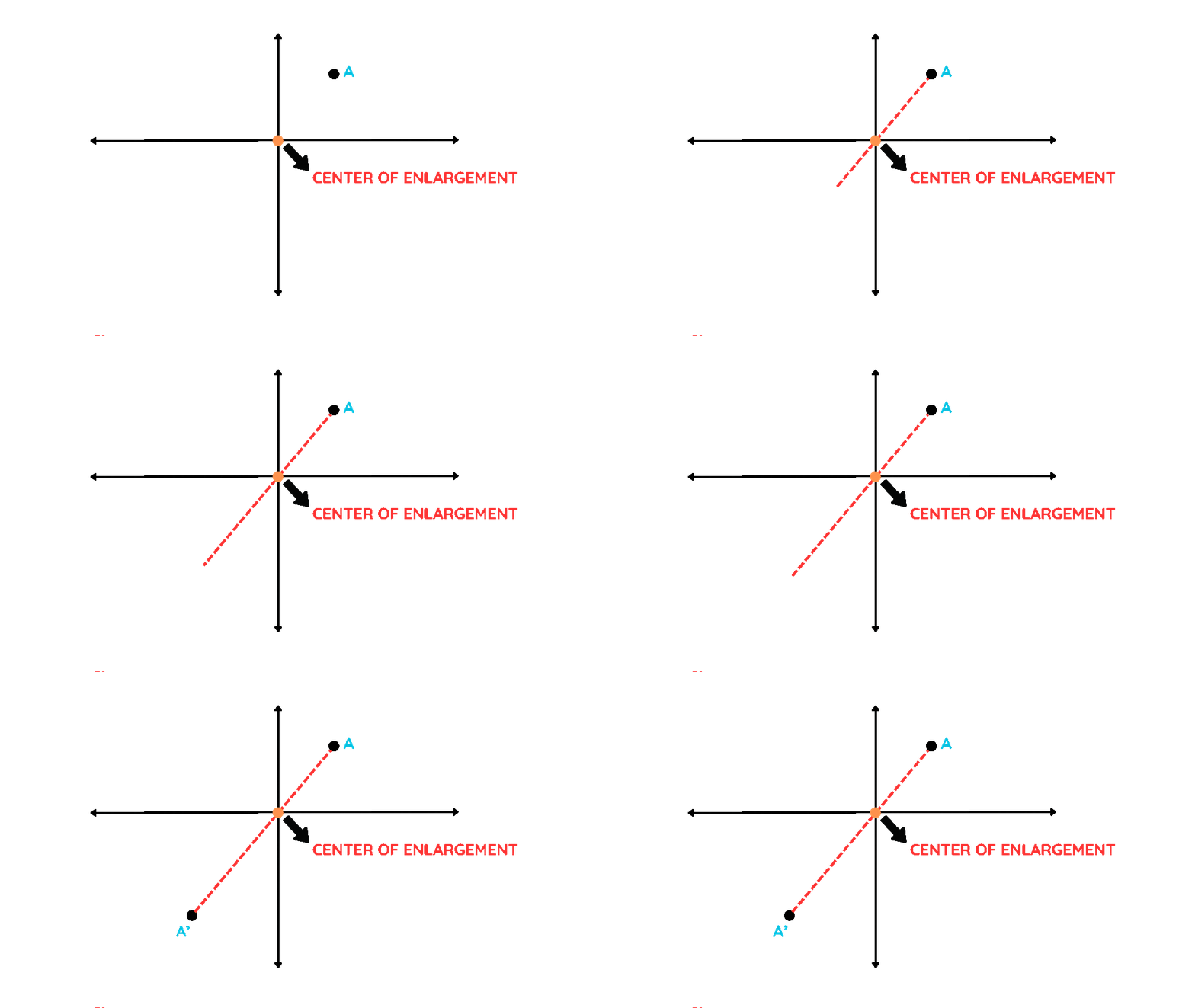
- However, with positive scale factors, the line is extended to the same side of the centre of enlargement.
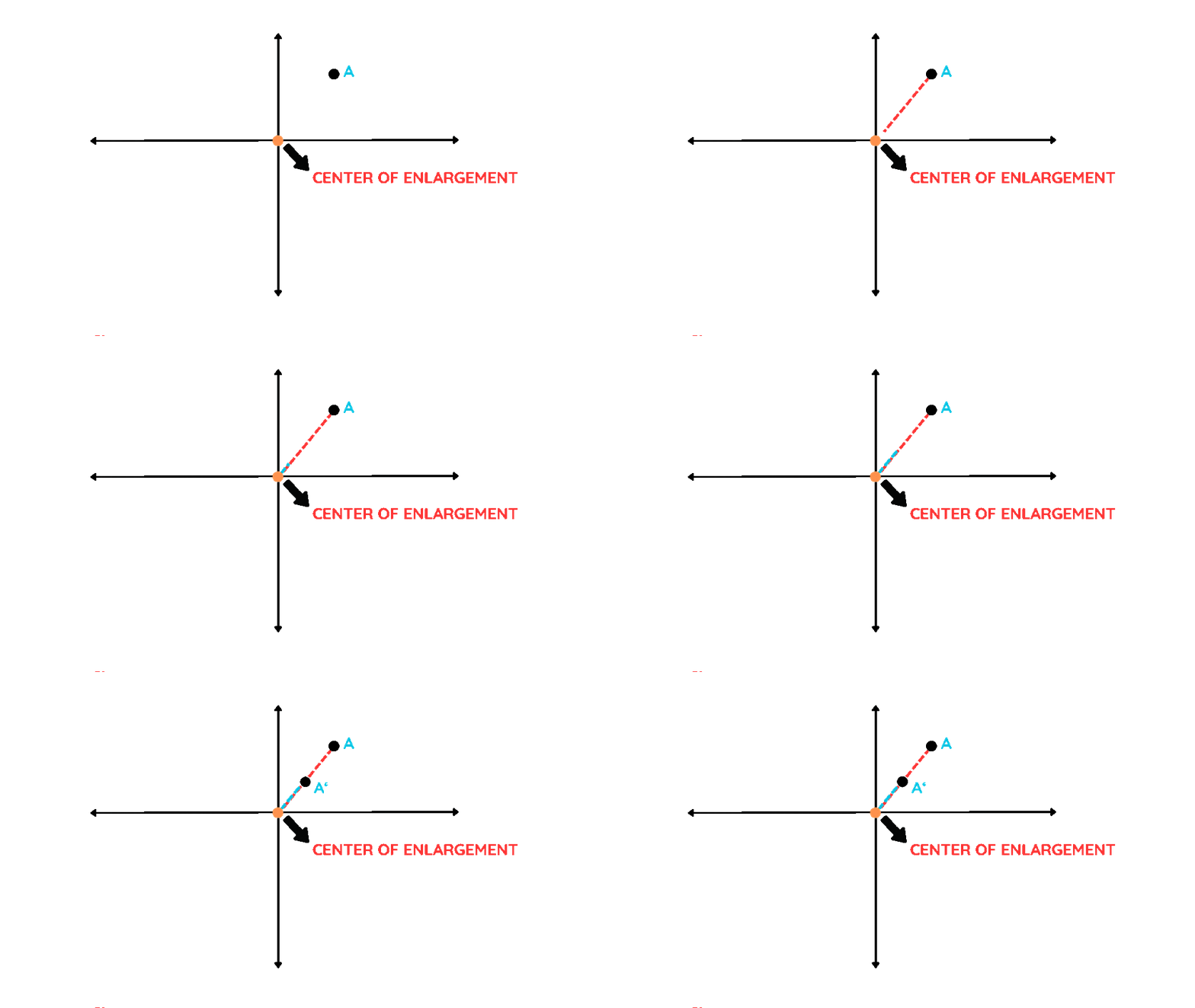
Positive Scale Factor
- The image stays on the same side of the centre of enlargement as the original shape.
- The shape is resized but keeps its original orientation (it doesnโt flip).
- Example: If the scale factor is 2, the image is twice as large as the original shape, and it remains on the same side of the centre of enlargement.

Negative Scale Factor
- The image appears on the opposite side of the centre of enlargement.
- The shape is resized and flipped upside down.
- Example: If the scale factor is -2, the image is twice as large as the original, but itโs on the opposite side and flipped.

Practice Questions and Answers on
Enlargement Using a Negative Scale Factor
Question 1: Point P(4, 6) is enlarged with a negative scale factor of -2 from the center of enlargement (0, 0). Find the coordinates of the new point.
Question 2: For the figure given below,ย Enlarge the rectangle by a scale factor of -3 with the center of enlargement at (0, 0). Determine the coordinates of the enlarged rectangle.

Question 3: The center of enlargement is (2, 2), and a square with vertices A(3, 3), B(5, 3), C(5, 5), and D(3, 5) is enlarged by a scale factor of -1. Find the coordinates of the vertices of the enlarged square.
Question 4: For the figure given below,ย Enlarge the triangle using a negative scale factor of -1.5 with the center of enlargement at (1, 1). Find the coordinates of the image.

Question 5: Point A(5, 7) is enlarged by a scale factor of -4 with the center of enlargement at (1, 2).
Question 6: A triangle has vertices X(2, 2), Y(6, 2), and Z(4, 6). It is enlarged by a scale factor of -2, with the center of enlargement at (3, 3).
Question 7: For the figure given below,ย It is enlarged by a scale factor of -1.5 from the center of enlargement (2, 2).

Question 8: A pentagon has vertices P(2, 3), Q(4, 5), R(6, 3), S(5, 1), and T(3, 1). It is enlarged by a scale factor of -0.5 with the center of enlargement at (3, 3).
Question 9: A triangle has vertices P(3, 2), Q(7, 2), and R(5, 5). It is enlarged by a negative scale factor of -2 with the center of enlargement at (4, 4). Find the coordinates of the enlarged triangle.
Question 10: For the figure given below, It is enlarged by a negative scale factor of -3 with the center of enlargement at (4, 3). Find the coordinates of the enlarged trapezium.

Solutions
Question 1:ย
Step #1: Given:
- The original point is P(4, 6).
- The center of enlargement is (0, 0).
- The scale factor is -2.
Step #2: Find the movement from the center to the point:
- From (0, 0) to (4, 6), the point moves 4 units to the right and 6 units up.
Step #3: Apply the scale factor:
- Multiply the movement by -2:
- 4 units to the right becomes 8 units to the left.
- 6 units up becomes 12 units down.
Step #4: Find the new position:
- Starting at (0, 0), move 8 units to the left and 12 units down.
- This gives the new position (-8, -12).
Step #5: Answer:
- The coordinates of the new point are (-8, -12).
ย
Question 2:
Step #1: Given:
- Original vertices: A(2, 3), B(6, 3), C(6, 7), D(2, 7).
- Center of enlargement: (0, 0).
- Scale factor: -3.
Step #2: Find the vector for each point:
- A: (2, 3).
- B: (6, 3).
- C: (6, 7).
- D: (2, 7).
Step #3: Apply the scale factor (-3):
- A: (2 ร -3, 3 ร -3) = (-6, -9).
- B: (6 ร -3, 3 ร -3) = (-18, -9).
- C: (6 ร -3, 7 ร -3) = (-18, -21).
- D: (2 ร -3, 7 ร -3) = (-6, -21).
Step #4: New coordinates:
- A'(-6, -9), B'(-18, -9), C'(-18, -21), D'(-6, -21).
ย
Question 3:
Step #1: Given:
- Original vertices: A(3, 3), B(5, 3), C(5, 5), D(3, 5).
- Center of enlargement: (2, 2).
- Scale factor: -1.
Step #2: Find the vector from the center to each vertex:
- A: (3 – 2, 3 – 2) = (1, 1).
- B: (5 – 2, 3 – 2) = (3, 1).
- C: (5 – 2, 5 – 2) = (3, 3).
- D: (3 – 2, 5 – 2) = (1, 3).
Step #3: Apply the scale factor (-1):
- A: (-1 ร 1, -1 ร 1) = (-1, -1).
- B: (-1 ร 3, -1 ร 1) = (-3, -1).
- C: (-1 ร 3, -1 ร 3) = (-3, -3).
- D: (-1 ร 1, -1 ร 3) = (-1, -3).
Step #4: Find the new coordinates:
- A'(2 + (-1), 2 + (-1)) = (1, 1).
- B'(2 + (-3), 2 + (-1)) = (-1, 1).
- C'(2 + (-3), 2 + (-3)) = (-1, -1).
- D'(2 + (-1), 2 + (-3)) = (1, -1).
Step #5: Answer:
- A'(1, 1), B'(-1, 1), C'(-1, -1), D'(1, -1).
ย
Question 4:
Step #1: Given:
- Original vertices: P(2, 4), Q(4, 6), R(6, 4).
- Center of enlargement: (1, 1).
- Scale factor: -1.5.
Step #2: Find the vector from the center to each vertex:
- P: (2 – 1, 4 – 1) = (1, 3).
- Q: (4 – 1, 6 – 1) = (3, 5).
- R: (6 – 1, 4 – 1) = (5, 3).
Step #3: Apply the scale factor (-1.5):
- P: (-1.5 ร 1, -1.5 ร 3) = (-1.5, -4.5).
- Q: (-1.5 ร 3, -1.5 ร 5) = (-4.5, -7.5).
- R: (-1.5 ร 5, -1.5 ร 3) = (-7.5, -4.5).
Step #4: Find the new coordinates:
- P'(1 + (-1.5), 1 + (-4.5)) = (-0.5, -3.5).
- Q'(1 + (-4.5), 1 + (-7.5)) = (-3.5, -6.5).
- R'(1 + (-7.5), 1 + (-4.5)) = (-6.5, -3.5).
Step #5: Answer:
- P'(-0.5, -3.5), Q'(-3.5, -6.5), R'(-6.5, -3.5).
ย
Question 5:ย
Step #1: Given:
- Original point: A(5, 7).
- Center of enlargement: (1, 2).
- Scale factor: -4.
Step #2: Find the movement from the center to the point:
- From (1, 2) to (5, 7):
- Move 4 units right (5 – 1 = 4).
- Move 5 units up (7 – 2 = 5).
Step #3: Apply the scale factor:
- Multiply each movement by -4:
- Right becomes left: 4 ร -4 = -16.
- Up becomes down: 5 ร -4 = -20.
Step #4: Find the new position:
- From (1, 2), move -16 units left and -20 units down:
- New position: (-15, -18).
Step #5: Answer:
- The coordinates of the new point are (-15, -18).
ย
Question 6:ย
Step #1: Given:
- Original vertices: X(2, 2), Y(6, 2), Z(4, 6).
- Center of enlargement: (3, 3).
- Scale factor: -2.
Step #2: Find the movement for each vertex:
- For X(2, 2):
- Move 1 left and 1 down (from (3, 3)).
- For Y(6, 2):
- Move 3 right and 1 down (from (3, 3)).
- For Z(4, 6):
- Move 1 right and 3 up (from (3, 3)).
Step #3: Apply the scale factor (-2):
- For X:
- Left becomes right: 1 ร -2 = 2.
- Down becomes up: 1 ร -2 = 2.
- For Y:
- Right becomes left: 3 ร -2 = -6.
- Down becomes up: 1 ร -2 = 2.
- For Z:
- Right becomes left: 1 ร -2 = -2.
- Up becomes down: 3 ร -2 = -6.
Step #4: Find the new coordinates:
- X’: (3 + 2, 3 + 2) = (5, 5).
- Y’: (3 – 6, 3 + 2) = (-3, 5).
- Z’: (3 – 2, 3 – 6) = (1, -3).
Step #5: Answer:
- The coordinates of the enlarged triangle are X'(5, 5), Y'(-3, 5), Z'(1, -3).
ย
Question 7:ย
Step #1: Given:
- Original vertices: A(1, 1), B(5, 1), C(5, 4), D(1, 4).
- Center of enlargement: (2, 2).
- Scale factor: -1.5.
Step #2: Find the movement for each vertex:
- For A(1, 1): Move 1 left and 1 down (from (2, 2)).
- For B(5, 1): Move 3 right and 1 down (from (2, 2)).
- For C(5, 4): Move 3 right and 2 up (from (2, 2)).
- For D(1, 4): Move 1 left and 2 up (from (2, 2)).
Step #3: Apply the scale factor (-1.5):
- For A:
- Multiply -1.5 by each movement:
- Left becomes right: 1 ร -1.5 = 1.5 right.
- Down becomes up: 1 ร -1.5 = 1.5 up.
- For B:
- Right becomes left: 3 ร -1.5 = -4.5 left.
- Down becomes up: 1 ร -1.5 = 1.5 up.
- For C:
- Right becomes left: 3 ร -1.5 = -4.5 left.
- Up becomes down: 2 ร -1.5 = -3 down.
- For D:
- Left becomes right: 1 ร -1.5 = 1.5 right.
- Up becomes down: 2 ร -1.5 = -3 down.
Step #4: Find the new coordinates:
- A’: (2 + 1.5, 2 + 1.5) = (3.5, 3.5).
- B’: (2 – 4.5, 2 + 1.5) = (-2.5, 3.5).
- C’: (2 – 4.5, 2 – 3) = (-2.5, -1).
- D’: (2 + 1.5, 2 – 3) = (3.5, -1).
Step #5: Answer:
- The coordinates of the enlarged rectangle are A'(3.5, 3.5), B'(-2.5, 3.5), C'(-2.5, -1), D'(3.5, -1).
ย
Question 8:ย
Step #1: Given:
- Original vertices: P(2, 3), Q(4, 5), R(6, 3), S(5, 1), T(3, 1).
- Center of enlargement: (3, 3).
- Scale factor: -0.5.
Step #2: Find the movement for each vertex:
- For P(2, 3): Move 1 left and 0 up (from (3, 3)).
- For Q(4, 5): Move 1 right and 2 up (from (3, 3)).
- For R(6, 3): Move 3 right and 0 up (from (3, 3)).
- For S(5, 1): Move 2 right and 2 down (from (3, 3)).
- For T(3, 1): Move 0 right and 2 down (from (3, 3)).
Step #3: Apply the scale factor (-0.5):
- For P:
- Left becomes right: 1 ร -0.5 = 0.5 right.
- No vertical movement: 0 ร -0.5 = 0.
- For Q:
- Right becomes left: 1 ร -0.5 = -0.5 left.
- Up becomes down: 2 ร -0.5 = -1.
- For R:
- Right becomes left: 3 ร -0.5 = -1.5 left.
- No vertical movement: 0 ร -0.5 = 0.
- For S:
- Right becomes left: 2 ร -0.5 = -1 left.
- Down becomes up: 2 ร -0.5 = 1 up.
- For T:
- No horizontal movement: 0 ร -0.5 = 0.
- Down becomes up: 2 ร -0.5 = 1 up.
Step #4: Find the new coordinates:
- P’: (3 + 0.5, 3 + 0) = (3.5, 3).
- Q’: (3 – 0.5, 3 – 1) = (2.5, 2).
- R’: (3 – 1.5, 3 + 0) = (1.5, 3).
- S’: (3 – 1, 3 + 1) = (2, 4).
- T’: (3 + 0, 3 + 1) = (3, 4).
Step #5: Answer:
- The coordinates of the enlarged pentagon are P'(3.5, 3), Q'(2.5, 2), R'(1.5, 3), S'(2, 4), T'(3, 4).
ย
Question 9:ย
Step #1: Given:
- Original vertices: P(3, 2), Q(7, 2), R(5, 5).
- Center of enlargement: (4, 4).
- Scale factor: -2.
Step #2: Find the movement for each vertex from the center:
- For P(3, 2):
- Move 1 unit left and 2 units down from (4, 4)
- For Q(7, 2):
- Move 3 units right and 2 units down from (4, 4).
- For R(5, 5):
- Move 1 unit right and 1 unit up from (4, 4).
Step #3: Apply the scale factor (-2):
- For P:
- Left becomes right: 1 ร -2 = 2 units right.
- Down becomes up: 2 ร -2 = 4 units up.
- For Q:
- Right becomes left: 3 ร -2 = 6 units left.
- Down becomes up: 2 ร -2 = 4 units up.
- For R:
- Right becomes left: 1 ร -2 = 2 units left.
- Up becomes down: 1 ร -2 = 2 units down.
ย
Step #4: Find the new coordinates:
- For P: Start at (4, 4), move 2 units right and 4 units up:
New position: (6, 8). - For Q: Start at (4, 4), move 6 units left and 4 units up:
New position: (-2, 8). - For R: Start at (4, 4), move 2 units left and 2 units down:
New position: (2, 2)
Step #5: Answer:
- The coordinates of the enlarged triangle are P'(6, 8), Q'(-2, 8), R'(2, 2).
ย
Question 10:ย
Step #1: Given:
- Original vertices: A(2, 4), B(6, 4), C(5, 1), D(3, 1).
- Center of enlargement: (4, 3).
- Scale factor: -3.
Step #2: Find the movement for each vertex from the center:
- For A(2, 4):
- Move 2 units left and 1 unit up from (4, 3).
- For B(6, 4):
- Move 2 units right and 1 unit up from (4, 3).
- For C(5, 1):
- Move 1 unit right and 2 units down from (4, 3).
- For D(3, 1):
- Move 1 unit left and 2 units down from (4, 3).
Step #3: Apply the scale factor (-3):
- For A:
- Left becomes right: 2 ร -3 = 6 units right.
- Up becomes down: 1 ร -3 = 3 units down.
- For B:
- Right becomes left: 2 ร -3 = 6 units left.
- Up becomes down: 1 ร -3 = 3 units down.
- For C:
- Right becomes left: 1 ร -3 = 3 units left.
- Down becomes up: 2 ร -3 = 6 units up.
- For D:
- Left becomes right: 1 ร -3 = 3 units right.
- Down becomes up: 2 ร -3 = 6 units up.
Step #4: Find the new coordinates:
- For A: Start at (4, 3), move 6 units right and 3 units down:
New position: (10, 0). - For B: Start at (4, 3), move 6 units left and 3 units down:
New position: (-2, 0). - For C: Start at (4, 3), move 3 units left and 6 units up:
New position: (1, 9). - For D: Start at (4, 3), move 3 units right and 6 units up:
New position: (7, 9).
Step # 5: Answer:
- The coordinates of the enlarged trapezium are A'(10, 0), B'(-2, 0), C'(1, 9), and D'(7, 9).
Table of Content
- What is Enlargement?
- Centre of Enlargement
- What Are Negative Scale Factors?
- Steps to Find Enlargement Using a Negative Scale Factor (Integer Scale Factor)
- Steps to Find Enlargement Using a Negative Scale Factor (Fractional Scale Factor)
- What Is The Difference Between Positive And Negative Scale Factors For Enlargement?
ย
Expanding Surds Using Double Bracket Multiplication
Expanding Surds Double Bracket
In this article, we will explore:
- How to expand surds using double bracket multiplication
- Importance of this skill for rationalizing surds and solving problems with rationalized denominators
- Why mastering this topic is crucial for surd-related exam questions
They are very important in practicing questions for Algebra as well.
Here is one more link to practice a few extra questions: Maths Genie Surds Simplified Questions
What Are Surds?
- A surd is an irrational root of a rational number that cannot be simplified to remove the radical (square root) symbol.
- Surds are exact values and are left in root form because their decimal expansions are non-repeating and non-terminating.
Examples of Surds:
โ3
โ12
โ50
These cannot be simplified to whole numbers or fractions, so they remain under the square root symbol.
Expanding Surds with Single Bracket Multiplication
Let’s begin with a simple example involving a single term outside a bracket.
Example:
Simplify: โ3 ร (3 + 2โ3)
Step 1: Multiply โ3 by each term inside the bracket individually.
- First term: โ3 multiplied by 3 equals 3โ3
- Second term: โ3 multiplied by 2โ3
- Multiply the coefficients: 1 ร 2 equals 2
- Multiply the surds: โ3 ร โ3 equals 3 (since โa ร โa equals a)
- So, โ3 ร 2โ3 equals 2 ร 3 which is 6
Step 2: Combine the results.
- The expression becomes: 3โ3 + 6
Expanding Surds Using Double Bracket Multiplication
Now, let’s explore double brackets, where we multiply two binomials involving surds.
Example:
Simplify: (โ5 + 3) ร (2โ5 + 2)
We will use the FOIL method, which stands for First, Outside, Inside, Last.
Step 1: Multiply the First terms.
- โ5 multiplied by 2โ5
- Coefficients: 1 ร 2 equals 2
- Surds: โ5 ร โ5 equals 5
- Result: 2 ร 5 equals 10
Step 2: Multiply the Outside terms.
- โ5 multiplied by 2 equals 2โ5
Step 3: Multiply the Inside terms.
- 3 multiplied by 2โ5 equals 6โ5
Step 4: Multiply the Last terms.
- 3 multiplied by 2 equals 6
Step 5: Combine like terms.
- Add the surd terms: 2โ5 + 6โ5 equals 8โ5
- Add the constants: 10 + 6 equals 16
Final Answer: 16 + 8โ5
ย
ย
Solved Example
Question: Simplify: (2โ20 + โ8) ร (3โ5 โ 4โ2)
Solution:ย
Step 1: First, simplify the surds in the expression.
Simplify โ20:
- 20 equals 4 times 5
- โ20 equals โ(4 ร 5) equals 2โ5
Simplify โ8:
- 8 equals 4 times 2
- โ8 equals โ(4 ร 2) equals 2โ2
Now, the expression becomes:
(2 ร 2โ5 + 2โ2) ร (3โ5 โ 4โ2)
Simplify coefficients:
2 ร 2โ5 = 4โ5
So, the expression simplifies to:
(4โ5 + 2โ2) ร (3โ5 โ 4โ2)
Now, apply the FOIL method.
Step 2: Multiply the First terms
4โ5 multiplied by 3โ5
- Coefficients: 4 ร 3 = 12
- Surds: โ5 ร โ5 = 5
- Result: 12 ร 5 = 60
Step 3: Multiply the Outside terms
4โ5 multiplied by (โ4โ2)
- Coefficients: 4 ร (โ4) = โ16
- Surds: โ5 ร โ2 = โ10
- Result: โ16โ10
Step 4: Multiply the Inside terms.
2โ2 multiplied by 3โ5
- Coefficients: 2 ร 3 = 6
- Surds: โ2 ร โ5 = โ10
- Result: 6โ10
Step 5: Multiply the Last terms.
2โ2 multiplied by (โ4โ2)
- Coefficients: 2 ร (โ4) = โ8
- Surds: โ2 ร โ2 = 2
- Result: โ8 ร 2 = โ16
Step 6: Combine like terms.
Combine the constants: 60 and (โ16)
- 60 โ 16 = 44
Combine the surd terms: (โ16โ10) and 6โ10
- (โ16 + 6)โ10 = โ10โ10
Final Answer: 44 โ 10โ10
Squaring a Binomial Involving Surds
ย
ย
Solved Example
Question: Simplify: (โ7 โ 6)ยฒ
Solution:
This is equivalent to (โ7 โ 6) ร (โ7 โ 6)
Apply the FOIL method.
Step 1: Multiply the First terms.
- โ7 multiplied by โ7 = 7
Step 2: Multiply the Outside terms.
- โ7 multiplied by (โ6) = โ6โ7
Step 3: Multiply the Inside terms.
- (โ6) multiplied by โ7 = โ6โ7
Step 4: Multiply the Last terms.
- (โ6) multiplied by (โ6) = 36
Step 5: Combine like terms.
- Add the constants: 7 + 36 = 43
- ,Final Answer: 43 โ 12โ7
Conclusion
Conclusion Expanding surds using double bracket multiplication is a vital skill for rationalizing denominators and solving complex surd problems.
By mastering this technique, you’ll be well-prepared to tackle exam questions involving surds. Remember to:
โข Simplify surds when possible.
โข Apply the FOIL method systematically.
โข Combine like terms carefully.
Practice Questions and Answers on Surds Expanding Double Brackets
Question 1: Simplify: (โ2 + 5) ร (โ2 + 3)
Question 2: Simplify: (3โ3 โ 2) ร (โ3 + 4)
Question 3: Simplify: (2 + โ5)ยฒ
Question 4: Simplify: (โ6 โ 4)(โ6 + 4)
Question 5: Simplify: (5 + 2โ3)(5 โ 2โ3)
Question 6: Simplify: (โ7 + โ2)(โ7 โ โ2)
Question 7: Simplify: (3โ2 + 4)(3โ2 โ 4)
Question 8: Simplify: (โ3 + โ5)ยฒ
Question 9: Simplify: (2โ5 + 3โ2)(2โ5 โ 3โ2)
Question 10: Simplify: (โ2 + โ3)ยฒ
Solutions
Question 1: Simplify: (โ2 + 5) ร (โ2 + 3)
Answer:
Step 1: Multiply the First terms.
โ2 ร โ2 = 2
Step 2: Multiply the Outside terms.
โ2 ร 3 = 3โ2
Step 3: Multiply the Inside terms.
5 ร โ2 = 5โ2
Step 4: Multiply the Last terms.
5 ร 3 = 15
Step 5: Combine like terms.
- Combine the surd terms:
3โ2 + 5โ2 = 8โ2
- Add the constants:
2 + 15 = 17
Final Answer: 17 + 8โ2
ย
Question 2: Simplify: (3โ3 โ 2) ร (โ3 + 4)
Answer:
Step 1: Multiply the First terms.
3โ3 ร โ3 = 9
Step 2: Multiply the Outside terms.
3โ3 ร 4 = 12โ3
Step 3: Multiply the Inside terms.
(โ2) ร โ3 = โ2โ3
Step 4: Multiply the Last terms.
(โ2) ร 4 = โ8
Step 5: Combine like terms.
- Combine the surd terms:
12โ3 โ 2โ3 = 10โ3
- Combine the constants:
9 โ 8 = 1
Final Answer: 1 + 10โ3
ย
Question 3: Simplify: (2 + โ5)ยฒ
Answer:
This is equivalent to (2 + โ5) ร (2 + โ5)
Step 1: Multiply the First terms.
2 ร 2 = 4
Step 2: Multiply the Outside terms.
2 ร โ5 = 2โ5
Step 3: Multiply the Inside terms.
โ5 ร 2 = 2โ5
Step 4: Multiply the Last terms.
โ5 ร โ5 = 5
Step 5: Combine like terms.
- Combine the surd terms:
2โ5 + 2โ5 = 4โ5
- Add the constants:
4 + 5 = 9
Final Answer: 9 + 4โ5
ย
Question 4: Simplify: (โ6 โ 4)(โ6 + 4)
Answer:
- Notice that this is in the form of (a โ b)(a + b) = aยฒ โ bยฒ
Step 1: Calculate aยฒ
(โ6)ยฒ = 6
Step 2: Calculate bยฒ
4ยฒ = 16
Step 3: Subtract bยฒ from aยฒ
6 โ 16 = โ10
Final Answer: โ10
ย
Question 5: Simplify: (5 + 2โ3)(5 โ 2โ3)
Answer:
Using (a + b)(a โ b) = aยฒ โ bยฒ
Step 1: Calculate aยฒ
5ยฒ = 25
Step 2: Calculate bยฒ
- (2โ3)ยฒ equals 4 ร 3 which is 12
Step 3: Subtract bยฒ from aยฒ
25 โ 12 = 13
Final Answer: 13
ย
Question 6: Simplify: (โ7 + โ2)(โ7 โ โ2)
Answer:
Using (a + b)(a โ b) = aยฒ โ bยฒ
Step 1: Calculate aยฒ
(โ7)ยฒ = 7
Step 2: Calculate bยฒ
(โ2)ยฒ = 2
Step 3: Subtract bยฒ from aยฒ
7 โ 2 = 5
Final Answer: 5
ย
Question 7: Simplify: (3โ2 + 4)(3โ2 โ 4)
Answer:
Using (a + b)(a โ b) = aยฒ โ bยฒ
Step 1: Calculate aยฒ
- (3โ2)ยฒ equals 9 ร 2 which is 18
Step 2: Calculate bยฒ
4ยฒ = 16
Step 3: Subtract bยฒ from aยฒ
18 โ 16 = 2
Final Answer: 2
ย
Question 8: Simplify: (โ3 + โ5)ยฒ
Answer:
Equivalent to (โ3 + โ5) ร (โ3 + โ5)
Step 1: Multiply the First terms.
โ3 ร โ3 = 3
Step 2: Multiply the Outside terms.
โ3 ร โ5 = โ15
Step 3: Multiply the Inside terms.
โ5 ร โ3 = โ15
Step 4: Multiply the Last terms.
โ5 ร โ5 = 5
Step 5: Combine like terms.
- Combine the surd terms:
โ15 + โ15 = 2โ15
- Add the constants:
3 + 5 = 8
Final Answer: 8 + 2โ15
ย
Question 9: Simplify: (2โ5 + 3โ2)(2โ5 โ 3โ2)
Answer:
Using (a + b)(a โ b) = aยฒ โ bยฒ
Step 1: Calculate aยฒ
- (2โ5)ยฒ equals 4 ร 5 which is 20
Step 2: Calculate bยฒ
- (3โ2)ยฒ equals 9 ร 2 which is 18
Step 3: Subtract bยฒ from aยฒ
20 โ 18 = 2
Final Answer: 2
ย
Question 10: Simplify: (โ2 + โ3)ยฒ
Answer:
Equivalent to (โ2 + โ3) ร (โ2 + โ3)
Step 1: Multiply the First terms.
โ2 ร โ2 = 2
Step 2: Multiply the Outside terms.
โ2 ร โ3 = โ6
Step 3: Multiply the Inside terms.
โ3 ร โ2 = โ6
Step 4: Multiply the Last terms.
โ3 ร โ3 = 3
Step 5: Combine like terms.
- Combine the surd terms:
โ6 + โ6 = 2โ6
- Add the constants:
2 + 3 = 5
Final Answer: 5 + 2โ6
Surds: Adding and Subtracting โ A Comprehensive Guide
Surds: Adding and Subtracting
In this article, we will explore
- How to add and subtract surds
- A fundamental concept in mathematics that often appears in exams.
- Understanding surds and their manipulation is essential for solving various algebraic problems.
- We will delve into the rules governing the addition and subtraction of surds, simplify complex surds, tackle hard questions, and provide practice questions with answers to enhance your understanding.
They are very important in practicing questions for Algebra as well.
Here is one more link to practice a few extra questions: Maths Genie Surds Questions
What Are Surds?
- A surd is an irrational root of a rational number that cannot be simplified to remove the radical (square+ root) symbol.
- Surds are exact values and are left in root form because their decimal expansions are non-repeating and non-terminating.
Examples of Surds:
โ3
โ12
โ50
These cannot be simplified to whole numbers or fractions, so they remain under the square root symbol.
Non-examples:
- โ25 = 5 (since 5 squared equals 25)
- โ36 = 6 (since 6 squared equals 36)
These are not surds because they simplify to rational numbers.
Adding and Subtracting Surds
The Basic Rule
- Surds can only be added or subtracted if they have the same irrational component (the same number under the square root sign).
- For example, you can add 2โ7 + 4โ7 because both surds contain โ7
Why Can’t Different Surds Be Added Directly?
- Surds with different radicands (numbers under the square root) represent different irrational numbers. Since irrational numbers cannot be precisely calculated or compared without approximation, adding or subtracting surds with different radicands is not straightforward and generally cannot be simplified further.
Adding Surds
Rule: To add surds, they must have the same radicand. You add the coefficients (numbers in front of the surds) and keep the common surd.
Example 1
Add: 2โ7 + 4โ7
Solution:
- Both surds have โ7
- Add the coefficients: 2 + 4 = 6
- Keep the common surd: 6โ7
ย
Example 2
Add: 5โ3 + 3โ3
Solution:
- Both surds have โ3
- Add the coefficients: 5 + 3 = 8
- Result: 8โ3
Subtracting Surds
Rule: To subtract surds, they must have the same radicand. Subtract the coefficients and keep the common surd.
Example 1
Subtract: 5โ6 – 2โ6
Solution:
- Both surds have โ6
- Subtract the coefficients: 5 – 2 = 3
- Result: 3โ6
ย
Example 2
Subtract: 6โ5 – โ5
Solution:
- Remember that โ5 has an implicit coefficient of 1.
- Subtract the coefficients: 6 – 1 = 5
- Result: 5โ5
Simplifying Surds Before Adding or Subtracting
- Sometimes, surds need to be simplified before they can be added or subtracted. Simplifying surds involves expressing the surd in its simplest form by extracting square factors.
Steps to Simplify Surds
Step 1: Factorize the number inside the surd into its prime factors.
Step 2: Identify and extract square factors (pairs of identical factors).
Step 3: Simplify the surd by bringing out the square factors.
ย
ย
Solved Example 1
Question: Simplify: 5โ50 – 6โ2
Solution:ย
Step 1: Simplify โ50
Prime factorization of 50:
50 = 2 ร 5 ร 5
โ50 = โ(2 ร 5 ร 5)
Step 2:ย Extract square factors
- The pair of 5s can be taken out of the square root as a single 5.
- So, โ50 = 5โ2
Step 3: Substitute back into the expression
5โ50 = 5 ร 5โ2 = 25โ2
Step 4: Subtract 6โ2
- Both surds now have โ2
- Subtract the coefficients: 25 – 6 = 19
- Result: 19โ2
ย
ย
Solved Example 2
Question: Simplify: โ20 + โ45 – โ12
Solution:ย
Step 1: Simplify each surd
Simplify โ20
- Factorize: 20 = 2 ร 2 ร 5
- Extract the pair of 2s:
- โ20 = 2โ5
Simplify โ45
- Factorize: 45 = 3 ร 3 ร 5
- Extract the pair of 3s:
- โ45 = 3โ5
Simplifyย โ12
- Factorize: 12 = 2 ร 2 ร 3
- Extract the pair of 2s:
- โ12 = 2โ3
Step 2: Combine like terms
- Add 2โ5 + 3โ5 = 5โ5
- The term 2โ3 remains separate.
Final Answer: 5โ5 – 2โ3
ย
ย
Solved Example 3
Question: Simplify: โ27 + โ45 – โ12
Solution:ย
Step 1: Simplify each surd
Simplify โ27
- Factorize: 27 = 3 ร 3 ร 3
- Extract the pair of 3s:
- โ27 = 3โ3
Simplify โ45
- Factorize: 45 = 3 ร 3 ร 5
- Extract the pair of 3s:
- โ45 = 3โ5
Simplifyย โ12
- Factorize: 12 = 2 ร 2 ร 3
- Extract the pair of 2s:
- โ12 = 2โ3
Step 2: Combine like terms:
- Add 3โ3 – 2โ3 = 1โ3
- The term 3โ5 remains separate.
Final Answer: โ27 + โ45 – โ12 = 1โ3 + 3โ5
ย
ย
Solved Example 4
Question: Simplify: 4โ50 – 6โ2
Solution:ย
Step 1: Simplify โ50
- Prime factorization of 50:
50 = 2 ร 5 ร 5
โ50 = โ(2 ร 5 ร 5)
Step 2:ย Calculate:
4โ50 = 4 ร 5โ2 = 20โ2
- Subtract
6โ2: 20โ2 – 6โ2 = 14โ2
Answer: 14โ2
ย
ย
Solved Example 5
Question: Simplify: โ75 – โ27
Solution:ย
Step 1: Simplify each surd
Simplify โ75
- Factorize: 75 = 25 ร 3
- Extract the square root of 25:
- โ75 = 5โ3
Simplify โ27
- Factorize: 27 = 3 ร 3 ร 3
- Extract the pair of 3s:
- โ27 = 3โ3
Step 2: Subtract:
5โ3 – 3โ3 = 2โ3
Answer: 2โ3
ย
ย
Solved Example 6
Question: Simplify: โ18 + โ32 – โ8
Solution:ย
Step 1: Simplify each surd
Simplify โ18
- Factorize: 18 = 9 ร 2
- Extract the square root of 9:
- โ18 = 3โ2
Simplify โ32
- Factorize: 32 = 16 ร 2
- Extract the square root of 16:
- โ32 = 4โ2
Simplify โ8
- Factorize: 8 = 4 ร 2
- Extract the square root of 4:
- โ8 = 2โ2
Step 2:Combine terms:
- Add 3โ2 + 4โ2 = 7โ2
- Subtract 2โ2:
7โ2 – 2โ2 = 5โ2
Answer: 5โ2
ย
ย
Solved Example 7
Question: Simplify: โ18 + โ32 – โ8
Solution:ย
Step 1: Simplify each surd
Simplify โ18
- Factorize: 18 = 9 ร 2
- Extract the square root of 9:
- โ18 = 3โ2
Simplify โ32
- Factorize: 32 = 16 ร 2
- Extract the square root of 16:
- โ32 = 4โ2
Simplify โ8
- Factorize: 8 = 4 ร 2
- Extract the square root of 4:
- โ8 = 2โ2
Step 2:Combine terms:
- Add 3โ2 + 4โ2 = 7โ2
- Subtract 2โ2:
7โ2 – 2โ2 = 5โ2
Answer: 5โ2
Multiply Surds
Understanding how to multiply surds is essential as it often comes up in simplifying expressions.
Rule for Multiplying Surds
โa ร โb = โ(a ร b)
Example: Multiply: โ5 ร โ20
Solution:
- Multiply under the radical:
โ(5 ร 20) = โ100
- Simplify:
โ100 = 10
Answer: 10
Dividing Surds
Dividing surds follows a similar principle.
Rule for Dividing Surds
- โa รท โb = โ(a รท b), provided b is not zero.
Example Divide: โ48 รท โ3
Solution:
- Divide under the radical:
โ(48 รท 3) = โ16
- Simplify:
โ16 = 4
Answer: 4
Conclusion
Understanding how to add and subtract surds is crucial for solving various mathematical problems, especially those encountered in exams. Remember:
- Only like surds (surds with the same radicand) can be added or subtracted directly.
- Simplify surds whenever possible to identify like terms.
- When multiplying or dividing surds, use the rules for operations under radicals.
By practicing these concepts and working through various problems, you will enhance your mathematical skills and be better prepared for exam questions on surds.
Practice Questions and Answers on Surds: Adding and Subtracting
Question 1: Simplify: 3โ18 + 2โ8
Question 2: Simplify: โ75 – โ27
Question 3: Simplify: 2โ20 + 3โ45
Question 4: Simplify: 5โ12 – 3โ27
Question 5: Simplify: โ98 + โ18
Question 6: Simplify: 4โ32 – 2โ8
Question 7: Simplify: โ200 – 5โ8
Question 8: Simplify: 6โ125 + 4โ80
Question 9: Simplify: 7โ12 – 2โ27
Question 10: Simplify: โ8 + โ18 + โ32
Solutions
Question 1: Simplify: 3โ18 + 2โ8
Solution:
Step 1: Simplify Each Surd
โ18 = 3โ2
- Multiply: 3โ18 = 3 ร 3โ2 = 9โ2
โ8 = 2โ2
- Multiply: 2โ8 = 2 ร 2โ2 = 4โ2
Step 2: Add
9โ2 + 4โ2 = 13โ2
Answer: 13โ2
ย
Question 2: Simplify โ75 – โ27
Solution:
Step 1: Simplify Each Surd
โ75 = 5โ3
โ27 = 3โ3
Step 2: Subtract
5โ3 – 3โ3 = 2โ3
Answer: 2โ3
ย
Question 3: Simplify 2โ20 + 3โ45
Solution:
Step 1: Simplify Each Surd
โ20 = 2โ5
- Multiply: 2โ20 = 2 ร 2โ5 = 4โ5
โ45 = 3โ5
- Multiply: 3โ45 = 3 ร 3โ5 = 9โ5
Step 2: Add
4โ5 + 9โ5 = 13โ5
Answer: 13โ5
ย
Question 4: Simplify 5โ12 – 3โ27
Solution:
Step 1: Simplify Each Surd
โ12 = 2โ3
- Multiply: 5โ12 = 5 ร 2โ3 = 10โ3
โ27 = 3โ3
- Multiply: 3โ27 = 3 ร 3โ3 = 9โ3
Step 2: Subtract
10โ3 – 9โ3 = 1โ3
Answer: 1โ3
ย
Question 5: Simplify โ98 + โ18
Solution:
Step 1: Simplify Each Surd
- โ98 = 7โ2 (since 98 = 49 ร 2)
- โ18 = 3โ2
Step 2: Add
7โ2 + 3โ2 = 10โ2
Answer: 10โ2
ย
Question 6: Simplify 4โ32 – 2โ8
Solution:
Step 1: Simplify Each Surd
โ32 = 4โ2
- Multiply: 4โ32 = 4 ร 4โ2 = 16โ2
โ8 = 2โ2
- Multiply: 2โ8 = 2 ร 2โ2 = 4โ2
Step 2: Subtract
16โ2 – 4โ2 = 12โ2
Answer: 12โ2
ย
Question 7: Simplify โ200 – 5โ8
Solution:
Step 1: Simplify Each Surd
- โ200 = 10โ2 (since 200 = 100 ร 2)
โ8 = 2โ2
- Multiply: 5โ8 = 5 ร 2โ2 = 10โ2
Step 2: Subtract
10โ2 – 10โ2 = 0
Answer: 0
ย
Question 8: Simplify 6โ125 + 4โ80
Solution:
Step 1: Simplify Each Surd
โ125 = 5โ5
- Multiply: 6โ125 = 6 ร 5โ5 = 30โ5
โ80 = 4โ5
- Multiply: 4โ80 = 4 ร 4โ5 = 16โ5
Step 2: Add
30โ5 + 16โ5 = 46โ5
Answer: 46โ5
ย
Question 9: Simplify 7โ12 – 2โ27
Solution:
Step 1: Simplify Each Surd
โ12 = 2โ3
- Multiply: 7โ12 = 7 ร 2โ3 = 14โ3
โ27 = 3โ3
- Multiply: 2โ27 = 2 ร 3โ3 = 6โ3
Step 2: Subtract
14โ3 – 6โ3 = 8โ3
Answer: 8โ3
ย
Question 10: Simplify โ8 + โ18 + โ32
Solution:
Step 1: Simplify Each Surd
- โ8 = 2โ2
- โ18 = 3โ2
- โ32 = 4โ2
Step 2: Add
2โ2 + 3โ2 + 4โ2 = 9โ2
Answer: 9โ2
ย
Surds Simplified | Explained with Examples
Surds
In this article, we will explore
- What are Surds
- How to Simplified surds
We will also delve into how to multiply and divide surds, tackle some hard exam questions on surds, and provide practice questions with answers to solidify your understanding.
They are very important in practicing questions for Algebra as well.
Here is one more link to practice a few extra questions: Maths Genie Surds Simplified Questions
What Are Surds?
- A surd is an irrational root of a rational number that cannot be simplified to remove the radical (square root) symbol.
- Surds are exact values and are left in root form because their decimal expansions are non-repeating and non-terminating.
Examples of Surds:
โ3
โ12
โ50
These cannot be simplified to whole numbers or fractions, so they remain under the square root symbol.
Approximate Decimal Values:
โ3 โ 1.732
Remember, the surd (e.g., โ3) is the exact value, while the decimal is an approximation.
Simplifying Surds
- Simplifying surds involves expressing the surd in its simplest form by extracting square factors.
Steps to Simplify a Surd:
- Factorize the Number Inside the Surd into its prime factors.
- Identify Pairs of Factors: For every pair of identical factors, one factor can be taken out of the square root.
- Simplify the Expression: Multiply the factors outside the radical and leave the remaining factors inside.
ย
ย
Solved Example 1
Question: Simplify โ50
Solution:ย
Step 1: Prime Factorization
50 = 2 ร 5 ร 5
Step 2: Identify Pairs
- Pair of 5s.
Step 3: Simplify
โ50 = โ(2 ร 5 ร 5)
- Take one 5 out:
5โ2
Simplified Surd: 5โ2
Multiplying Surds
Multiply surds by multiplying the numbers inside the radicals.
Rule:
โa ร โb = โ(a ร b)
Example:
โ5 ร โ3 = โ(5 ร 3) = โ15
Note: You cannot multiply a surd by a regular integer under the radical.
2 ร โ5 โ โ(2 ร 5)
- It remains as 2โ5
Dividing Surds
Divide surds by dividing the numbers inside the radicals.
Rule:ย
โa รท โb = โ(a รท b)
Example:
โ20 รท โ2 = โ(20 รท 2) = โ10
Note: You cannot divide a surd by a regular integer under the radical.
โ14 รท 2 remains as (โ14) / 2
ย
ย
Solved Example 2
Question: Simplify โ72
Solution:ย
Step 1: Prime Factorization
72 = 2 ร 2 ร 2 ร 3 ร 3
Step 2: Identify Pairs
- Pair of 2s
- Pair of 3s
Step 3: Simplify
โ72 = โ(2 ร 2 ร 2 ร 3 ร 3)
- Take out one 2 and one 3:
2 ร 3 = 6
- Remaining inside the radical: 2
Simplified Surd: 6โ2
ย
ย
Solved Example 3
Question: Simplify -5โ60
Solution:ย
Step 1: Prime Factorization
60 = 2 ร 2 ร 3 ร 5
Step 2: Identify Pairs
- Pair of 2s
Step 3: Simplify
-5โ60 = -5โ(2 ร 2 ร 3 ร 5)
- Take out one 2:
-5 ร 2 = -10
- Remaining inside the radical: 3 ร 5 = 15
Simplified Surd: -10โ15
ย
ย
Solved Example 4
Question: Simplify -4โ200
Solution:ย
Step 1: Prime Factorization
200 = 2 ร 2 ร 2 ร 5 ร 5
Step 2: Identify Pairs
- Pair of 2s
- Pair of 5s
Step 3: Simplify
-4โ200 = -4โ(2 ร 2 ร 2 ร 5 ร 5)
- Take out one 2 and one 5:
-4 ร 2 ร 5 = -40
- Remaining inside the radical: 2
Simplified Surd: -40โ2
Exam Questions on Surds
ย
ย
Solved Example 5
Question: Simplify โ98
Solution:ย
Step 1: Prime Factorization
98 = 2 ร 7 ร 7
Step 2: Identify Pairs
- Pair of 7s
Step 3: Simplify
โ98 = โ(7 ร 7 ร 2)
- Take out one 7:
7โ2
Simplified Surd: 7โ2
ย
ย
Solved Example 6
Question: Simplify 3โ45
Solution:ย
Step 1: Prime Factorization
45 = 3 ร 3 ร 5
Step 2: Identify Pairs
- Pair of 3s
Step 3: Simplify
3โ45 = 3โ(3 ร 3 ร 5)
- Take out one 3:
3 ร 3 = 9
- Remaining inside the radical: 5
Simplified Surd: 9โ5
Simplifying Surds Questions
ย
ย
Solved Example 7
Question: Simplify โ18 + โ8
Solution:ย
Step 1: Simplify โ18
18 = 2 ร 3 ร 3
โ18 = 3โ2
Step 2: Simplify โ8
8 = 2 ร 2 ร 2
โ8 = 2โ2
Step 3: Add the Simplified Terms
3โ2 + 2โ2 = 5โ2
Simplified Surd: 5โ2
ย
ย
Solved Example 8
Question: Simplify (โ3)ยฒ
Solution:
Step 1: Write the Expression as a Product
(โ3)ยฒ = โ3 ร โ3
Step 2: Use the Property of Square Roots
โ3 ร โ3 = 3
Simplified Surd: 3
Multiply Surds Questions
ย
ย
Solved Example 9
Question: Simplify โ6 ร โ14
Solution:
Step 1: Use the Product Property of Square Roots
- Combine the square roots:
โ6 ร โ14 = โ(6 ร 14)
Step 2: Multiply Inside the Square Root
6 ร 14 = 84
- so we have:
โ6 ร โ14 = โ84
Step 3: Prime Factorization
84 = 2 ร 2 ร 3 ร 7
Step 4: Identify Pairs
- Pair of 2s
Step 5: Simplify
โ84 = โ(2 ร 2 ร 3 ร 7)
- Take out one 2:
2โ21
Simplified Surd: 2โ21
ย
ย
Solved Example 10
Question: Simplify (2โ5)(3โ10)
Solution:
Step 1: Multiply the Coefficients
- Multiply the numbers outside the square roots:
2 ร 3 = 6
- This gives us:
(2โ5)(3โ10) = 6โ(5 ร 10)
Step 2: Multiply Inside the Square Root
- Multiply the numbers inside the square root:
5 ร 10 = 50
So we have:
6โ50
Step 3: Simplify โ50 Using Prime Factorization
50 = 2 ร 5 ร 5
Step 4: Identify Pairs
- Pair of 5s
Step 5: Simplify
โ50 = โ(2 ร 5 ร 5)
- Take out one 5:
6 ร 5โ2 = 30โ2
Simplified Surd: 30โ2
Dividing Surds
ย
ย
Solved Example 11
Question: Simplify โ80 รท โ5
Solution:
Step 1: Use the Product Property of Square Roots
- Combine the square roots:
โ80 รท โ5 = โ(80 รท 5)
Step 2: Divide Inside the Square Root
- Calculate 80 รท 5:
80 รท 5 = 16
- Now we have:
โ80 รท โ5 = โ16
Step 3: Simplify โ16
- Since 16 is a perfect square:
โ16 = 4
Simplified Surd: 4
ย
ย
Solved Example 12
Question: Simplify (6โ18) รท (3โ2)
Solution:
Step 1: Divide the Coefficients
- Divide the numbers outside the square roots:
6 รท 3 = 2
- This gives us:
(6โ18) รท (3โ2) = 2(โ18 รท โ2)
Step 2: Use the Quotient Property of Square Roots
- Rewrite โ18 รท โ2 as a single square root:
โ18 รท โ2 = โ(18 รท 2)
Step 3: Divide Inside the Square Root
- Calculate
18 รท 2 = 9
- So we have:
โ(18 รท 2) = โ9
Step 4: Simplify โ9
- Since 9 is a perfect square:
โ9 = 3
Step 5: Multiply the Result Now substitute back:
2 ร 3 = 6
Simplified Surd: 6
Conclusion
- Understanding how to simplify surds, multiply surds, and divide surds is essential for solving various mathematical problems, especially those that appear in exams. By mastering these concepts and practicing with hard questions, you can enhance your mathematical skills and confidence.
Practice Questions and Answers on Surds
Question 1: Simplify โ75
Question 2: Simplify 2โ27 + 3โ12
Question 3: Simplify (โ8) ร (โ2)
Question 4: Simplify โ125 รท โ5
Question 5: Simplify 4โ45 โ 2โ20
Question 6: Simplify (โ3)ยณ
Question 7: Simplify โ32
Question 8: Simplify (5โ2)(2โ8)
Question 9: Simplify โ18 รท โ2
Question 10: Simplify 3โ50 + 2โ8
Solutions
Question 1: Simplify โ75
Step 1: Prime Factorize 75
75 = 25 ร 3 = 5 ร 5 ร 3
Step 2: Identify Pairs
- We have a pair of 5’s.
Step 3: Simplify
- Take one 5 out of the square root:
โ75 = 5โ3
Answer: 5โ3
ย
Question 2: Simplify 2โ27 + 3โ12
Step 1: Simplify Each Square Root
- For โ27: 27 = 9 ร 3, so โ27 = โ(9 ร 3) = 3โ3
- For โ12: 12 = 4 ร 3, so โ12 = โ(4 ร 3) = 2โ3
Step 2: Multiply by the Coefficients
- 2โ27 = 2 ร 3โ3 = 6โ3.
- 3โ12 = 3 ร 2โ3 = 6โ3.
Step 3: Combine Like Terms
6โ3 + 6โ3 = 12โ3
Answer: 12โ3
ย
Question 3: Simplify (โ8) ร (โ2)
Step 1: Use the Product Property of Square Roots
โ8 ร โ2 = โ(8 ร 2) = โ16
Step 2: Simplify the Square Root
โ16 = 4
Answer: 4
ย
Question 4: Simplify โ125 รท โ5
Step 1: Use the Quotient Property of Square Roots
โ125 รท โ5 = โ(125 รท 5) = โ25
Step 2: Simplify the Square Root
โ25 = 5
Answer: 5
ย
Question 5: Simplify 4โ45 โ 2โ20
Step 1: Simplify Each Square Root
- For โ45: 45 = 9 ร 5, so โ45 = โ(9 ร 5) = 3โ5
- For โ20: 20 = 4 ร 5, so โ20 = โ(4 ร 5) = 2โ5
Step 2: Multiply by the Coefficients
- 4โ45 = 4 ร 3โ5 = 12โ5
- 2โ20 = 2 ร 2โ5 = 4โ5
Step 3: Subtract Like Terms
12โ5 โ 4โ5 = 8โ5
Answer: 8โ5
ย
Question 6: Simplify (โ3)ยณ
Step 1: Rewrite as a Product of Square Roots
(โ3)ยณ = โ3 ร โ3 ร โ3
Step 2: Simplify Pairs of Square Roots
- Combine two of the โ3 terms:
โ3 ร โ3 = 3
- Now we have 3 ร โ3
Step 3: Multiply
3 ร โ3 = 3โ3
Answer: 3โ3
ย
Question 7: Simplify โ32
Step 1: Prime Factorize 32
32 = 2 ร 2 ร 2 ร 2 ร 2
Step 2: Identify Pairs
- We have two pairs of 2’s.
Step 3: Simplify
Take out two 2’s from the square root:
โ32 = 4โ2
Answer: 4โ2
ย
Question 8: Simplify (5โ2)(2โ8)
Step 1: Multiply the Coefficients
5 ร 2 = 10
- so we have:
(5โ2)(2โ8) = 10โ(2 ร 8)
Step 2: Multiply Inside the Square Root
2 ร 8 = 16
- so we have:
10โ16
Step 3: Simplify โ16
- Since โ16 = 4,
- we get:
10 ร 4 = 40
Answer: 40
ย
Question 9: Simplify โ18 รท โ2
Step 1: Use the Quotient Property of Square Roots
โ18 รท โ2 = โ(18 รท 2) = โ9
Step 2: Simplify โ9
- Since โ9 = 3,
- we have:
โ18 รท โ2 = 3
Answer: 3
ย
Question 10: Simplify 3โ50 + 2โ8
Step 1: Simplify Each Square Root
- For โ50: 50 = 25 ร 2, so โ50 = 5โ2
- For โ8: 8 = 4 ร 2, so โ8 = 2โ2
Step 2: Multiply by the Coefficients
- 3โ50 = 3 ร 5โ2 = 15โ2
- 2โ8 = 2 ร 2โ2 = 4โ2
Step 3: Combine Like Terms
15โ2 + 4โ2 = 19โ2
Answer: 19โ2