Introduction
- Two or more equations are solved together at the same time.
- A solution of these equation is the value of variables which satisfy both of the equations.

Simultaneous Equations
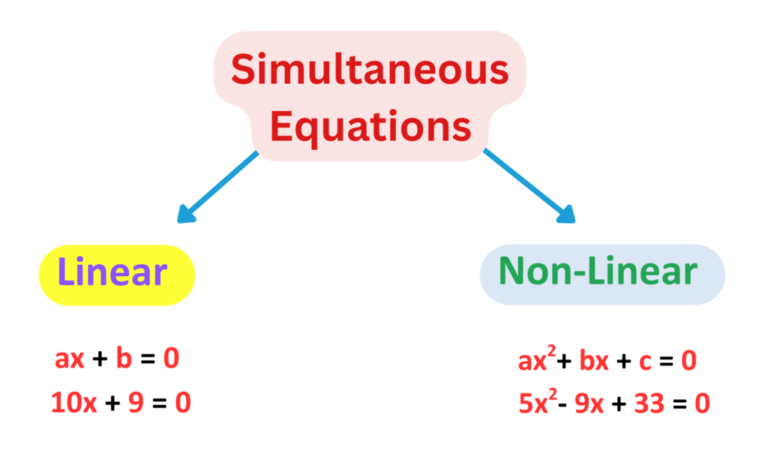
Types of Simultaneous Equations
- Simultaneous equations can be linear (where variables are raised to the power 1) or non linear (exponent more than 1)
- Solution of Simultaneous equation: values of variables that satisfy both the equations.
- Simultaneous equations are used in various fields like mathematics, physics, computer science and economics.
Methods to Solve Simultaneous Equations
There are two methods to solve Simultaneous Equations-- Elimination method: In this method, we eliminate one of the variables by adding or subtracting the equations, which results in a simpler equation with only one variable.
- Substitution method: In this method one variable is expressed in terms of the other variable and then its value is substituted in other equation, which results in a simpler equation with one variable.
Steps to Solve by Elimination Method
Let us solve the following simultaneous equations step by step using the elimination method:1
Identify the variable that can be eliminated:We can see that if we multiply the 2nd equation with 2 then the coefficient of $x$ in both the equations will become equal and then it can be eliminated by subtraction:
$$2x + 3y = 5 \dots (1)$$
$$1x – 1y = 0 \dots (2)$$
2
Add or subtract the equations to get a combined equation with only one variable:Here, one variable ($x$) will get eliminated if we subtract equation 2 from 1:
Multiply equation (2) by 2:
$$2x – 2y = 0$$
Subtract from equation (1):
$$(2x + 3y) – (2x – 2y) = 5 – 0$$
The combined equation is:
$$5y = 5 \implies y = 1$$
3
Use the known variable’s value to find the other variable’s value:Pick one of the simultaneous equations and put the value of $y$ in it –
$$1x – 1(1) = 0 \implies x = 1$$
So, the solution of these simultaneous equations is:
$x = 1$ and $y = 1$
Need help with Simultaneous Equations?
Our tutors explain it step by step, matched to your exam board.
Book Student Assessment →Steps to Solve by Substitution Method
Let us solve the pair of Simultaneous equations by using Substitution method :$$y – x = 0 \dots (1)$$
$$\frac{x}{2} + \frac{y}{3} = \frac{5}{2} \dots (2)$$
1
Find one variable’s value in the form of the other variable:From 1st Equation:
$$y = x$$
2
Put the value in the 2nd equation.
$$\frac{x}{2} + \frac{x}{3} = \frac{5}{2}$$
Taking LCM (which is 6):
$$\frac{3x + 2x}{6} = \frac{5}{2}$$
$$\frac{5x}{6} = \frac{5}{2} \implies 10x = 30 \implies x = 3$$
3
Use the known value of one variable to find the value of the other-
Pick one of the original Equations:From 1st Equation, put $x=3$,
$$y – 3 = 0 \implies y = 3$$
Thus the solution for the simultaneous equation is:
$x=3$ and $y=3$
Solved Examples
Solved Example
Solve the following pair of simultaneous equations using the Elimination method.
$$3x + 2y = 12 \dots (1)$$
$$x – 2y = 4 \dots (2)$$
SOLUTION
1
Identify the variable that can be eliminated:Notice that the $y$ terms have coefficients of $+2$ and $-2$. We can efficiently add the two equations together to eliminate the $y$ terms instantly.
2
Add the equations together:
$$(3x + 2y) + (x – 2y) = 12 + 4$$
$$4x = 16 \implies x = 4$$
3
Use the known value of one variable to find the value of the other variable:Put $x = 4$ into equation (2) –
$$(4) – 2y = 4 \implies -2y = 0 \implies y = 0$$
Final Answer: Thus the solution for the equations is $x = 4$ and $y = 0$
Solved Example
Solve the following pair of simultaneous equations using the Elimination method.
$$4x + y = 3 \dots (1)$$
$$3x – 2y = 5 \dots (2)$$
SOLUTION
1
Identify the variable that can be eliminated:Multiply equation (1) by 3 and equation (2) by 4 so the coefficients of $x$ become equal.
$$3(4x + y) = 3(3) \implies 12x + 3y = 9 \dots (3)$$
$$4(3x – 2y) = 4(5) \implies 12x – 8y = 20 \dots (4)$$
2
Subtract equation (4) from equation (3) to eliminate $x$:
$$(12x + 3y) – (12x – 8y) = 9 – 20$$
$$11y = -11 \implies y = -1$$
3
Use the known variable’s value to find the other:Put $y = -1$ into equation (1) –
$$4x + (-1) = 3 \implies 4x – 1 = 3 \implies 4x = 4 \implies x = 1$$
Final Answer: The solution for the equations is $x = 1$ and $y = -1$
Solved Example
Solve the following non-linear simultaneous equations using the Substitution method.
$$y = 8 – 3x \dots (1)$$
$$y = x^2 + 2x + 4 \dots (2)$$
SOLUTION
1
Substitute the linear equation into the quadratic equation:Equate the two expressions for $y$ to properly show the relationship:
$$8 – 3x = x^2 + 2x + 4$$
2
Rearrange to form a standard quadratic equation ($ax^2 + bx + c = 0$):
$$0 = x^2 + 2x + 3x + 4 – 8$$
$$x^2 + 5x – 4 = 0$$
3
Solve the quadratic equation for $x$:Using the quadratic formula $x = \frac{-b \pm \sqrt{b^2 – 4ac}}{2a}$:
$$x = \frac{-5 \pm \sqrt{5^2 – 4(1)(-4)}}{2(1)}$$
$$x = \frac{-5 \pm \sqrt{41}}{2}$$
4
Find the corresponding $y$ coordinates:Substitute the $x$ values back into the linear equation (1):
For $x = \frac{-5 + \sqrt{41}}{2}$: $y = 8 – 3\left(\frac{-5 + \sqrt{41}}{2}\right) = \frac{31 – 3\sqrt{41}}{2}$
For $x = \frac{-5 – \sqrt{41}}{2}$: $y = 8 – 3\left(\frac{-5 – \sqrt{41}}{2}\right) = \frac{31 + 3\sqrt{41}}{2}$
Final Answer: The coordinates of intersection are $\left(\frac{-5 + \sqrt{41}}{2}, \frac{31 – 3\sqrt{41}}{2}\right)$ and $\left(\frac{-5 – \sqrt{41}}{2}, \frac{31 + 3\sqrt{41}}{2}\right)$
Ready to test your knowledge?
You've reviewed the notes. Now try exam-style questions on Simultaneous Equations.
Start Practice Questions →