GCSE Maths

Circle Theorems

Edexcel

Introduction

  • Circle Theorems are a set of rules and properties related to angles, chords, and segments in a circle.
  • They describe relationships between different geometric elements within and around a circle.

Watch: Circle Theorems

What are Circle Theorems?

  • Circle theorems are special rules in geometry that describe relationships between angles, lines, and arcs in a circle.
  • They help us find unknown angles or lengths using properties like angles in a semicircle, angles at the centre, and cyclic quadrilaterals, without the use of a protractor.
  • This has very useful applications in engineering and design for analyzing circular patterns and structures.
  • There are seven main circle theorems.

Basic Terminology of a Circle

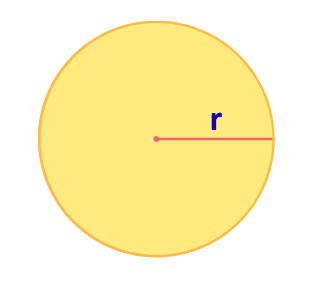
  • Radius(r): A line from the center of the circle to any point on its edge.
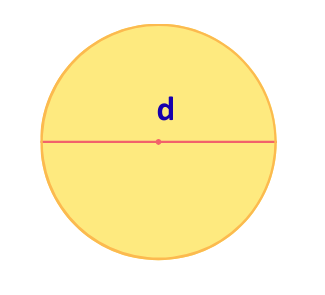
  • Diameter(d): A line passing through the center, touching two points on the circle, equal to twice the radius.
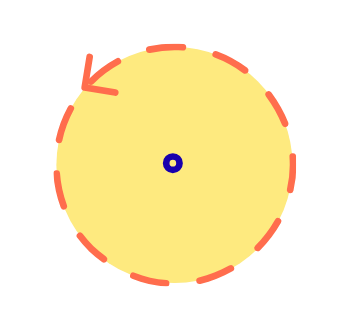
  • Circumference: The total distance around the circle.
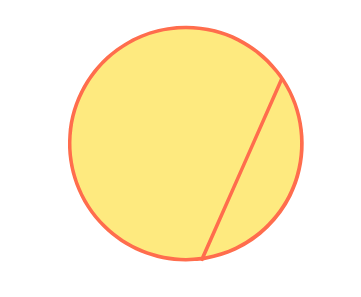
  • Chord: A line joining any two points on the circle but does not have to pass through the center.
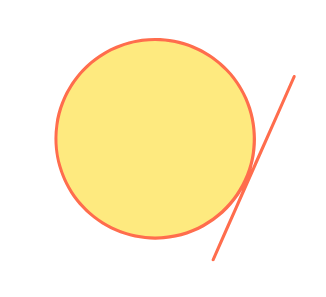
  • Tangent: A line that touches the circle at exactly one point and does not cross it.
  • Arc: A part of the circumference between two points.
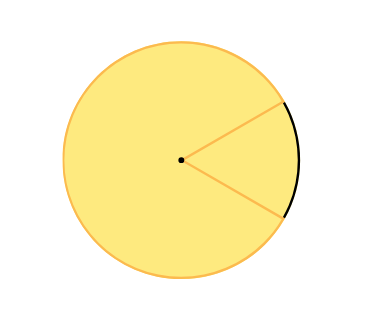
  • Sector: A part of a circle between two radii and the arc.

  • Segment: The area between a chord and the arc above it.

Circle Theorem 1: The Alternate Segment

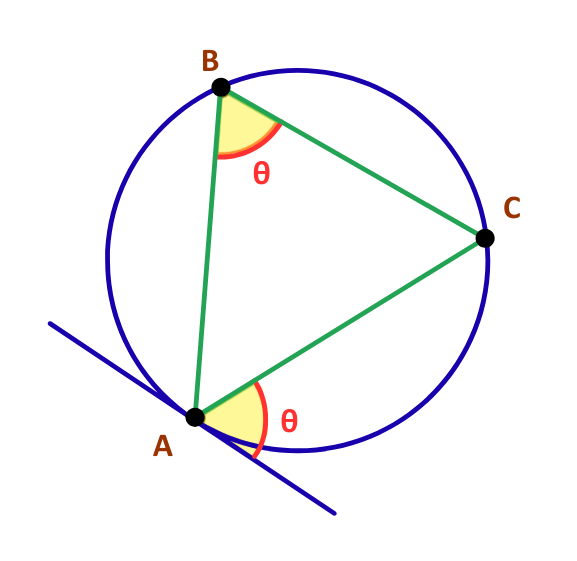
  • The angle that lies between a tangent and a chord is the same as the angle in the opposite part of the circle.
  • It helps to find unknown angles in circle problems easily when tangents and chords are involved in geometry questions.
Steps to use the alternate segment theorem:
1
Find and mark the important parts on the circle.
2
Use other angle rules to find one of the angles.
3
Use the alternate segment theorem to find the other missing angle easily.
Solved Example
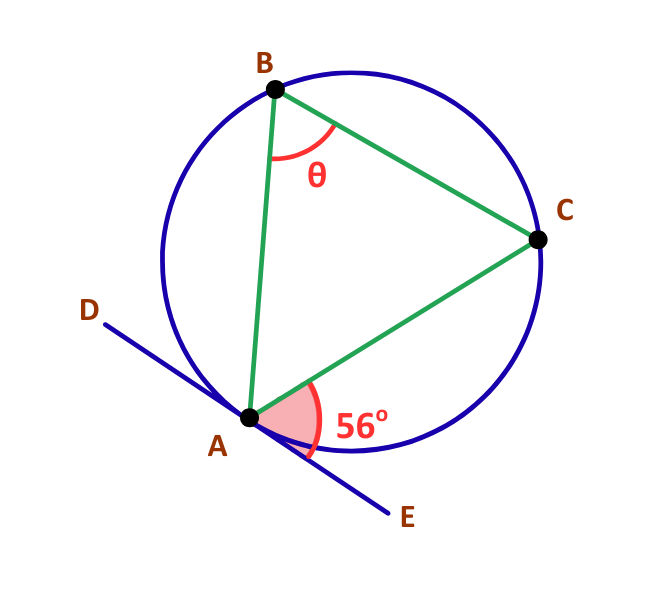
Triangle ABC is inscribed in a circle with centre O. A tangent DE touches the circle at point A. If the angle $\angle CAE = 56^\circ$, calculate the size of the angle $\angle ABC$.
SOLUTION
1
Find and mark the important parts on the circle. Given:
  • The tangent DE touching the circle at A.
  • The chord AC meeting the tangent at A.
  • The angle $\angle CAE = 56^\circ$ (angle between the tangent and chord).
2
Use other angle rules to find one of the angles. Since we already know $\angle CAE = 56^\circ$, no additional angle facts are needed for this step.
3
Use the alternate segment theorem. The Alternate Segment Theorem directly tells us that the angle between the tangent and the chord is equal to the angle in the opposite segment.

Final Answer: $\angle ABC = 56^\circ$

Circle Theorem 2: Angles at the Centre and at the Circumference

  • The angle at the centre of a circle is twice the angle at the circumference when both angles stand on the same arc.
  • It helps to find unknown angles in circle geometry problems when we know one of the two angles.
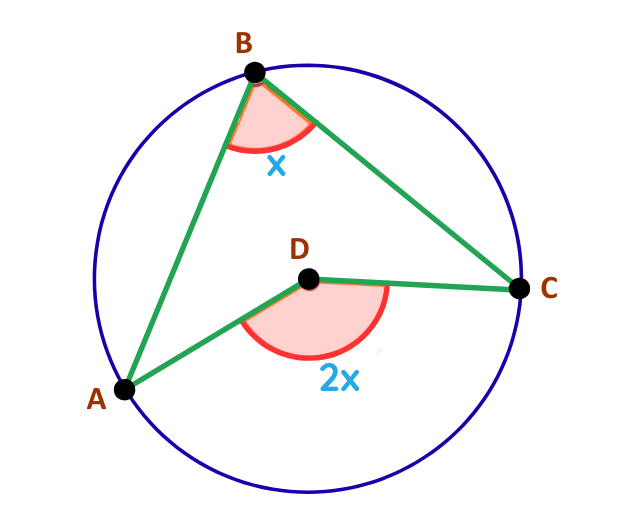
Steps to use the angle at the center theorem:

1
Find and mark the important parts on the circle.
2
Use other angle rules we know to find the angle at the centre or the angle at the edge (circumference).
3
Use the angle at the centre theorem to find the missing angle.
Solved Example
In a circle with centre C, A, B, and D lie on the circumference, and if $\angle BCD = 150^\circ$, find $\angle BAD$.
SOLUTION
1
Find and mark the important parts on the circle. Given:
  • Angle at centre $\angle BCD = 150^\circ$
  • Angle at circumference $\angle BAD = \theta$ on the same arc.
  • We have radius BC and DC.
  • AB and AD are chords.
2
Use other angle rules. Since we already know $\angle BCD = 150^\circ$, no additional angle facts are needed for this step.
3
Use the angle at the center theorem to find the missing angle. Since the angle at the center is twice the angle at the circumference, we divide the given central angle by 2 to find $\angle BAD$.
$$\angle BAD = \frac{150^\circ}{2} = 75^\circ$$

Final Answer: $\angle BAD = 75^\circ$

Circle Theorem 3: Angles in the Same Segment

  • Angles in the same segment of a circle are equal.
  • If we draw two angles on the circumference standing on the same chord, they will be equal, no matter where they are on that arc.
  • It helps us to find unknown angles in circle geometry problems when angles stand on the same chord.
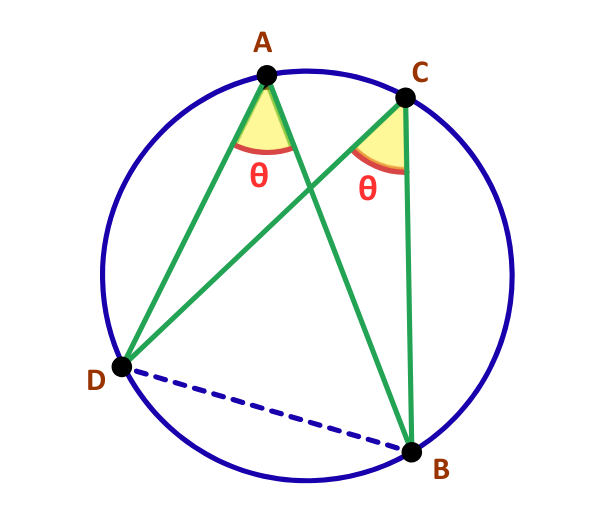
Steps to use the angles in the same segment theorem:
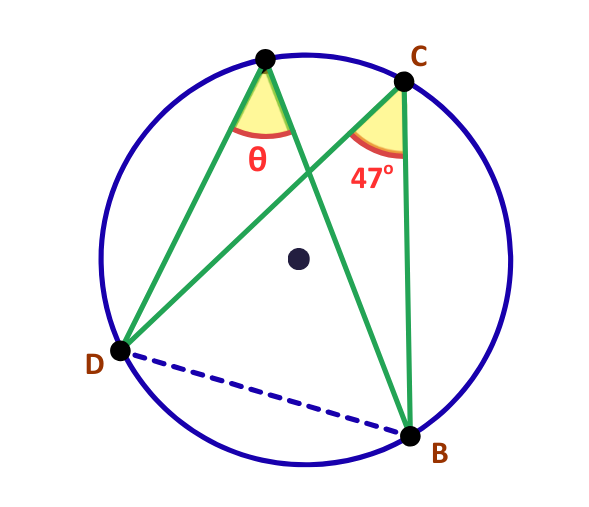
1
Find and mark the important parts on the circle.
2
Use any known angle rules to find one of the angles on the circumference in that segment.
3
Use the angles in the same segment theorem to find the other angle (it will be equal).
Solved Example
In the circle below with centre O, if $\angle DBC = 47^\circ$, calculate the size of $\angle CAD$.
SOLUTION
1
Find and mark the important parts on the circle. Given:
  • The angle $\angle CBD = 47^\circ$
  • AC and BD are chords
2
Use any known angle rules to find one of the angles on the circumference in that segment. Since we already know $\angle CBD = 47^\circ$, no additional angle facts are needed for this step.
3
Use the angles in the same segment theorem to find the other angle (it will be equal). Using the Circle Theorem (angles in the same segment are equal):
$$\angle CAD = \angle CBD$$

Final Answer: $\angle CAD = 47^\circ$

Need help with Circle Theorems?

Our tutors explain it step by step, matched to your exam board.

Book a Consultation →

Circle Theorem 4: Angles in a Semicircle

  • The angle in a semicircle is always $90^\circ$.
  • If we draw a triangle using the diameter of a circle, then the angle opposite the diameter will always be $90^\circ$ or right angle.
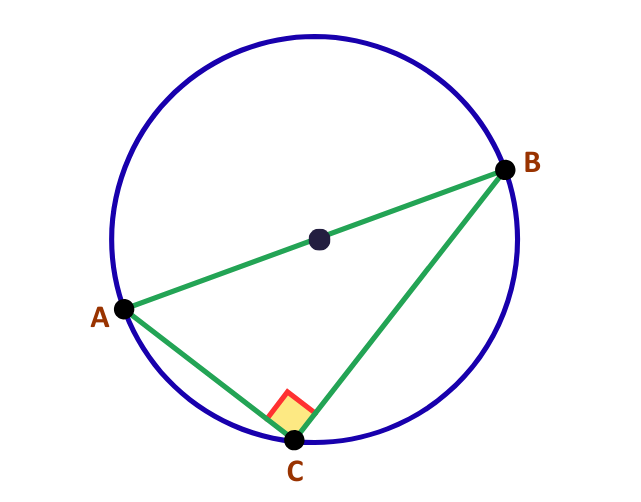
Steps to use the angles in a semicircle theorem:

1
Find and mark the diameter and the triangle on the circle.
2
Use known angle facts to find any other needed angles in the triangle if required.
3
Use the semicircle theorem to state that the angle opposite the diameter is $90^\circ$.
Solved Example
In a circle, ABC is a triangle with AB as the diameter and $\angle ABC = 58^\circ$. Find $\angle BAC$.
SOLUTION
1
Find and mark the diameter and the triangle on the circle. Given:
  • AB is the diameter.
  • $\triangle ABC$ lies on the circle.
2
Use known angle facts. Sum of angles in a triangle: $180^\circ = \angle ABC + \angle BAC + \angle ACB$
3
Use the semicircle theorem. As the angle in a semicircle is equal to $90^\circ$, so $\angle ACB = 90^\circ$. Then, sum of angles:
$$180^\circ = 58^\circ + \angle BAC + 90^\circ$$
$$\angle BAC = 180^\circ – 148^\circ = 32^\circ$$

Final Answer: $\angle BAC = 32^\circ$

Circle Theorem 5: Chord of a Circle

  • When we draw a perpendicular line from the center of a circle to any chord, it neatly splits that chord into two equal parts.
  • It helps us to find unknown lengths in geometry problems and proves equal parts on either side of the chord.
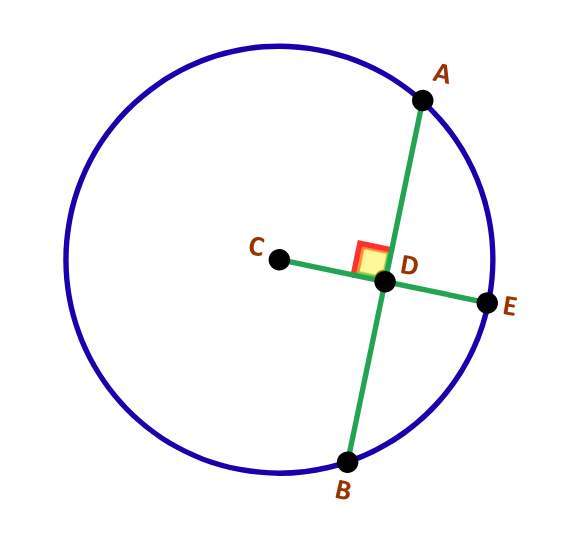
Steps to find missing lengths using chords:

1
Mark the important parts (centre, chord, and the perpendicular from the centre to the chord).
2
Use any known angle rules if we need to find missing angles in the triangle formed.
3
Use Pythagoras’ theorem or trigonometry to find the missing length.
Solved Example
Calculate the length of chord BC, given that $AE = 5\text{ cm}$, $\angle ADE = 65^\circ$, and $AB \perp CD$ at E, with O as the centre of the circle.
SOLUTION
1
Find and mark the diameter and the triangle on the circle. Given:
  • O is the centre of the circle.
  • Chord BC is perpendicularly bisected by OE (since $AB \perp CD$ at E, and O is the centre).
  • $AE = 5\text{ cm}$, $\angle ADE = 65^\circ$
2
Use any known angle rules if we need to find missing angles in the triangle formed.
  • Angles: $\angle ABC = \angle ADE = 65^\circ$ (angles in the same segment are equal).
  • Lengths: Since the centre line BE is perpendicular to chord AD, it splits it evenly. So, $BE = AE = 5\text{ cm}$.
3
Find Radius OB. Using $\triangle ABE$:
$$\tan(65^\circ) = \frac{OB}{5}$$ $$OB = 5 \cdot \tan(65^\circ)$$
4
Find Chord BC. Find half-chord (BE) and double it for full chord (BC).

Final Answer: Chord length calculated using trigonometric steps above.

Circle Theorem 6: Tangent of a Circle

  • At the point where a tangent touches a circle, it forms a right angle ($90^\circ$) with the radius drawn to that point.
  • This theorem helps calculate unknown angles and verify right angles in circle geometry problems.
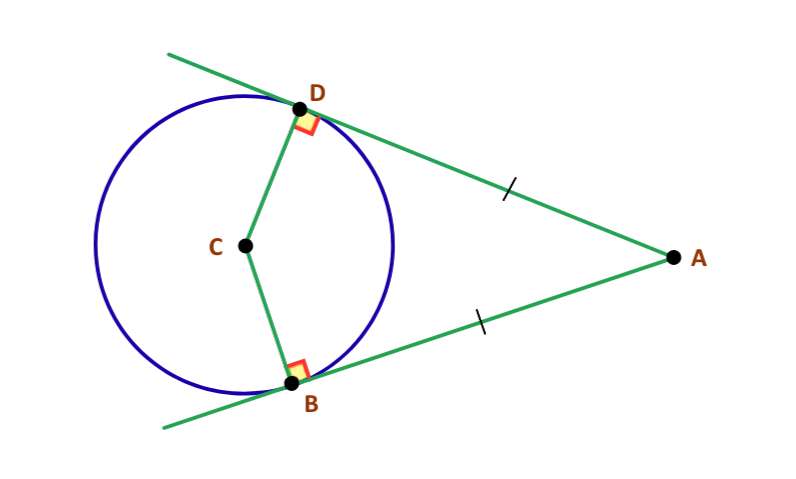
Steps to use the tangent of a circle theorems:
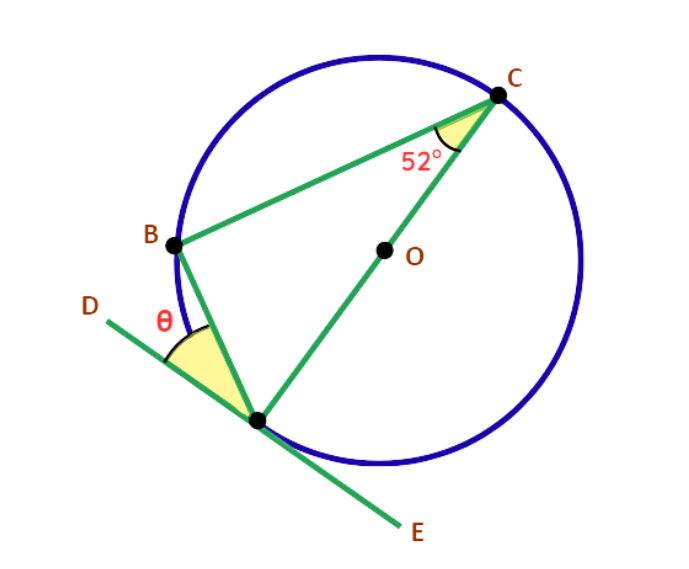
1
Mark the important parts.
2
Use any other angle facts you know to find missing angles near the tangent.
3
Use the tangent theorem to find the missing angle.
Solved Example
Points A, B, and C lie on the circumference of a circle with centre O. Line DE is a tangent at point A. If angle $\angle ACB = 63^\circ$, find angle $\angle BAD$.
SOLUTION
1
Mark the important parts. Given:
  • DE is a tangent to the circle at point A.
  • AC is a chord that meets the tangent.
  • $\angle BAD = \theta$ is the angle in the alternate segment.
  • $\angle ACB = 63^\circ$
2
Use any other angle facts you know to find missing angles near the tangent. $\angle ACB = 63^\circ$ is on the opposite side of chord AC from the tangent.
3
Use the tangent theorem. Using the Alternate Segment Theorem, the angle between the tangent and the chord equals the angle in the alternate segment.

Final Answer: $\angle BAD = 63^\circ$

Circle Theorem 7: Cyclic Quadrilateral

  • In a quadrilateral with all corners on the circle, the opposite angles add up to $180^\circ$.
  • If a 4-sided shape is inside a circle, then opposite angles sum to $180^\circ$.
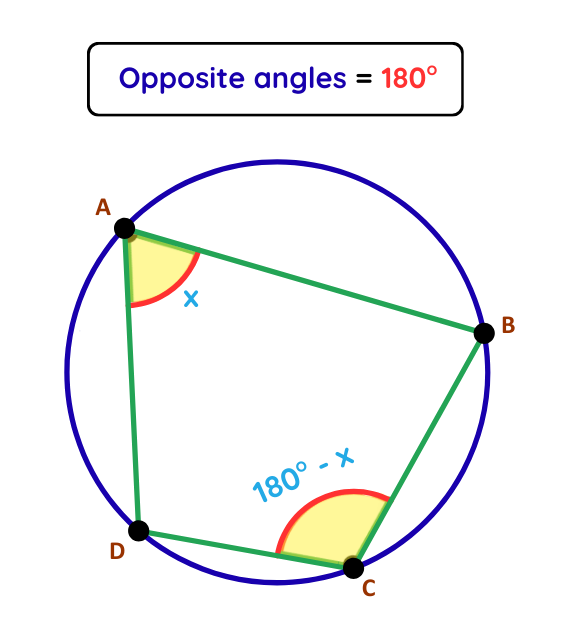
Steps to use the cyclic quadrilateral theorem:
1
Mark the key parts.
2
Use any angle rules you know to find one of the opposite angles in the quadrilateral.
3
Use the cyclic quadrilateral theorem to find the other missing angle.
Solved Example
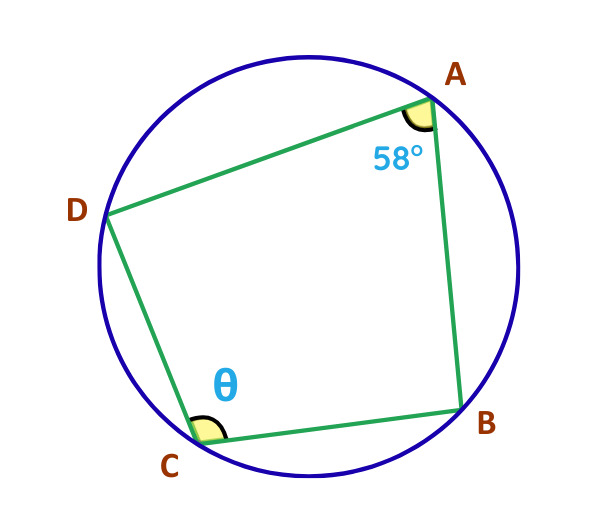
ABCD is a cyclic quadrilateral where A, B, C, and D lie on the circumference of a circle. If angle $\angle DAB = 58^\circ$, calculate the size of angle $\angle BCD$.
SOLUTION
1
Mark the key parts. Given:
  • The angle $\angle BAD = 51^\circ$ (Note: Diagram may state 58, substituting 58)
  • The angle $\angle BCD = \theta$
2
Use any angle rules you know to find one of the opposite angles in the quadrilateral. This is a cyclic quadrilateral, so opposite angles add up to $180^\circ$.
3
Use the cyclic quadrilateral theorem to find the other missing angle.
$$\angle BCD = 180^\circ – 58^\circ = 122^\circ$$

Final Answer: $\angle BCD = 122^\circ$

Additional Solved Examples
Solved Example
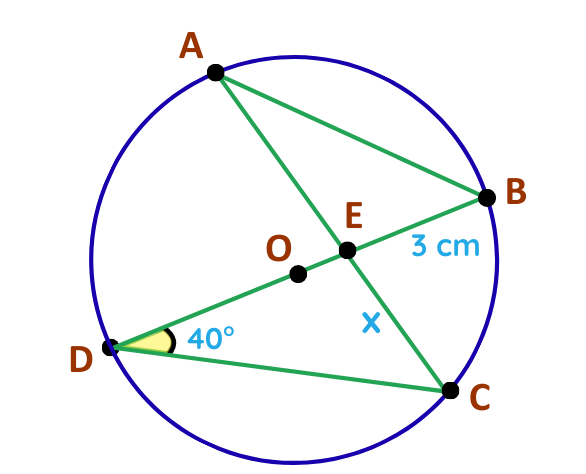
Points A, B, C, and D lie on a circle with centre O. BD is the diameter, and AC is a chord perpendicular to the diameter at point E. If $BE = 3\text{ cm}$ and $\angle CDE = 40^\circ$, calculate the distance $x$, which is the length from C to E.
SOLUTION
1
Mark the key parts. Given:
  • CE is perpendicular to BD (right angle at E)
  • Triangle CDE is right-angled at E
  • $BE = 3\text{ cm}$, $\angle CDE = 40^\circ$
2
Use angle facts. In triangle CDE:
  • $\angle CED = 90^\circ$ (since $CE \perp BD$)
  • $\angle CDE = 40^\circ$ (given)
3
Use tan to find $x$.
$$\tan(40^\circ) = \frac{x}{ED}$$

Final Answer: Calculated length $x$ using trigonometric functions.
Solved Example
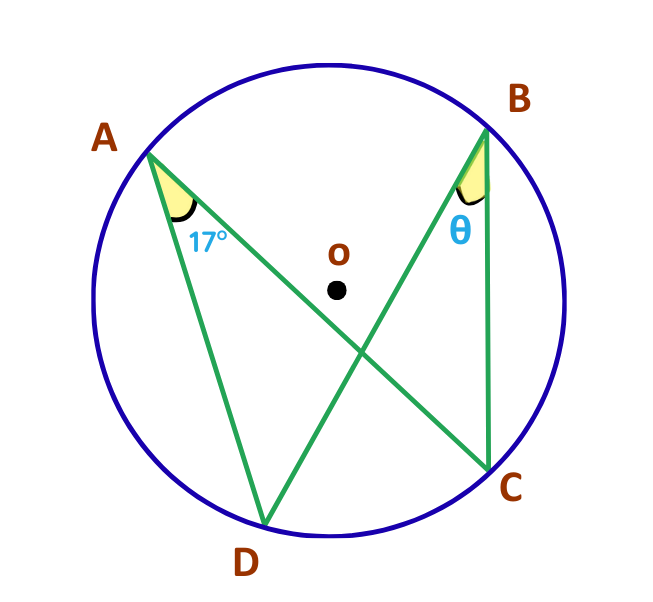
A circle with centre O has four points on the circumference: A, B, C, and D. Angle $\angle CAD = 17^\circ$. Find the size of angle $\angle CBD$.
SOLUTION
1
Understand the Figure. $\angle CAD$ and $\angle CBD$ are angles subtended by the same chord CD on opposite sides of the circle.
2
Apply the Circle Theorem. Angles in the same segment are equal. That means: $\angle CAD = \angle CBD$
3
Conclude the answer. Since $\angle CAD = 17^\circ$, then $\angle CBD = 17^\circ$.

Final Answer: $\angle CBD = 17^\circ$

Ready to test your knowledge?

You've reviewed the notes. Now try exam-style questions on Circle Theorems.

Start Practice Questions →

Want a Tutor for This Topic?

Sehaj
Sehaj Lead Maths Tutor Personalised lessons matched to your exam board.
Book a Consultation →

Ready to Get Started?

Book a consultation and let's build a plan for your child. £3.99 refundable deposit, deducted from your first lesson.

Book Your Consultation →