Chemical energy is a form of _____ energy?

If you are looking for a one work answer:

“Chemical Energy is a form of Potential Energy”

Chemical Energy, when you hear this word for the first time, what is the thing that comes to your mind? Normally many people associate chemicals with only something like acids or bases.

But that is not true.

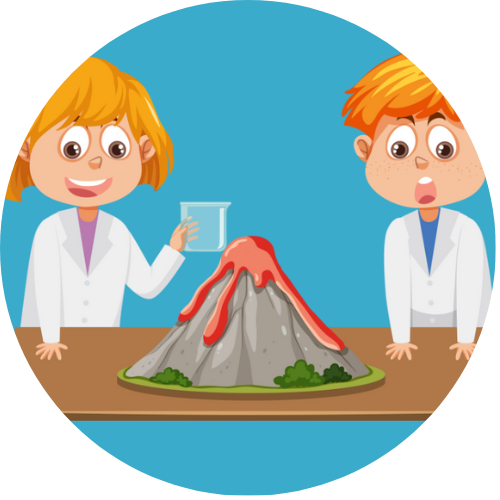
Two children wearing safety goggles and lab coats conducting a chemical experiment with beakers and test tubes.

Everything around us is made of chemicals. It is the food you eat, a wooden table or even your very own body, everything is made of chemicals and everything has chemical energy inside it.

Bowl of salad highlighting food as a source of stored nutrients

In this particular article, we will discuss the following things:

1) What is Actually Chemical Energy?

2) How is Chemical Energy a form of Potential Energy?

3)Some common applications of Chemical Energy.

So lets begin, but before that if you want to have a basic understanding of all the different stores of energy, please click on this link: Stores of Energy: Types, Transfer, and Applications

Contents

Chapter 1

What is Actually Chemical Energy?

Chapter 2

How is Chemical Energy a Form of Potential Energy?

Chapter 3

Common Applications of Chemical Energy

Chapter 4

Conclusion

Chapter 1

What is Actually Chemical Energy?

Everything around us is made of matter, which is nothing but atoms and molecules. If we go deeper into the Chemistry of this, we know that atoms react with one another during chemical reactions to form bonds which can be ionic bonds or covalent bonds.

Diagram illustrating atoms and molecules, representing chemical energy as a form of potential energy stored in chemical bonds.

So, in any type of chemical reaction, new bonds are formed and old bonds are broken. And whenever there is a bond formed or broken, there will Energy that will be released or absorbed.

This Energy that is released or absorbed during a chemical reaction is known as “Chemical Energy”

So the only thing necessary for a change in Chemical Energy is a Chemical reaction.

To understand this better, remember some basic processes like:

Photosynthesis,

Diagram showing the process of photosynthesis with sunlight, a plant, water, and roots.

Burning of glucose in your body,

Illustration of chemical energy burning glucose in the human body

The burning of fuel in your car,

Illustration of chemical energy burning fuel in a car

Rusting of iron

Rusting iron gears representing chemical energy

These all are nothing but chemical reactions, so they all are accompanied by change in Chemical Energy. In some of these, chemical energy is absorbed and in some chemical energy is released.

When you consume food, your body breaks down these chemical bonds, releasing the energy stored within, which your cells use to function.

Similarly, when fuel burns in an engine, the chemical bonds in the fuel are broken, releasing energy that moves your car.

These reactions can either release energy, which can be used to do work, or they absorb energy from the surroundings.

Chapter 2

How is Chemical Energy a Form of Potential Energy?

Chemical energy is categorized as potential energy because it is the energy stored inside the bonds of a compound, waiting to be released.

3D molecular model demonstrating chemical energy as potential energy stored in bonds

This stored energy is due to the position and arrangement of atoms within molecules, very similar to how a stretched rubber band has Elastic potential energy (link) due to its stretched state.

Person stretching a rubber band.

1. Energy Stored: Chemical bonds hold atoms together in molecules. These bonds can be thought of as tiny springs connecting the atoms. Energy will be required to break these bonds later in the future and we can think of them as energy stored.

Diagram showing energy stored in chemical bonds

2. Energy Released: When chemical bonds are broken, such as during digestion or combustion, the stored potential energy is converted into other forms of energy, like kinetic energy (movement) or thermal energy (heat). This transformation from stored energy to usable energy is a hallmark of potential energy.

Diagram showing energy released when chemical bonds are broken

In summary, we can say that chemical energy is a type of potential energy because whenever a chemical reaction takes place and results in the formation of new bonds and molecules. This energy is stored in these molecules which can later be used for different processes.

Chapter 3

Common Applications of Chemical Energy

Two scientists conducting experiments in a lab with test tubes and beakers.

1. Biological Processes:

  • Photosynthesis: Plants convert light energy into chemical energy stored in glucose through photosynthesis. In this process, new bonds are formed when glucose is formed
Photosynthesis process diagram showing plants converting light energy into chemical energy stored in glucose.
  • Respiration: When we breathe, the cells in our body convert the chemical energy in food into ATP (which is a form of energy for our body), The reaction breaks down the bonds of glucose present in our food.
Respiration process diagram showing cells converting chemical energy in food into ATP.

2. Combustion:

  • Fuels: Gasoline, diesel, and natural gas are rich in chemical energy. When burned in engines or power plants, the chemical bonds in these fuels break, releasing energy that is converted into mechanical work or electricity.
Illustration of a car with exhaust, representing the chemical energy in fuels like gasoline and diesel.

3. Batteries:

  • Electrochemical Cells: Batteries store chemical energy and convert it into electrical energy to power various devices, from smartphones to electric vehicles.
Illustration of a battery representing the storage of chemical energy and its conversion to electrical energy.

Chapter 4

Conclusion

Chemical energy is a form of potential energy. Understanding how chemical energy is stored, released, and utilized helps us in the basic steps behind many natural and man-made processes.

Checklist representing the conclusion of a blog with key points summarized.

Whether in the bonds of the food we eat, the fuel that drives our vehicles, or the batteries that power our gadgets, chemical energy is all around us, silently enabling the many activities.

For a deeper understanding of different energy stores, their types, transfers, and applications, explore our comprehensive guide: Stores of Energy: Types, Transfer, and Applications.

Elastic Potential Energy Examples: Understanding Key Concepts and Uses

What if I told you that there is a magic trick? And if you learn this magic trick, you can become a world-champion archer. With this trick, you can learn exactly how much to draw your bow to hit a target. And this trick is known as “ELASTIC POTENTIAL ENERGY”.

"Young girl drawing a bow to demonstrate elastic potential energy for hitting a target"

From the simplest children’s toys to complex industrial machinery, elastic potential energy is all around us. But what exactly is elastic potential energy, and how does it work?

In this blog post, we will explore the key concepts of elastic potential energy with very simple examples that will help us understand its everyday applications.

Contents

Chapter 1

What is Elastic Potential Energy?

Chapter 2

Everyday Examples of Elastic Potential Energy

Chapter 3

Industrial and Technological Applications

Chapter 4

Conclusion

Chapter 1

What is Elastic Potential Energy?

Whenever we stretch or compress an object from its natural length, a particular type of energy is stored in that object. This type of energy is known as elastic potential energy. And whenever you remove the force that is stretching or compressing the object, this elastic potential energy will be released, causing the object to return to its original length.

Person stretching a rubber band.

The amount of elastic potential energy stored in an object depends on two major factors:

1. The stiffness of the object

2. The amount of stretching or compression caused by the applied force

1. The Stiffness of the Object

The stiffer the object, the more force or work you will need to apply to stretch it, and therefore, more energy will be stored in the spring.

The stiffness of an object, like a spring, is given by the term “spring constant,” usually denoted by the symbol “k”.

Spring constant (k) illustration showing a coil spring.

So, the greater the value of “k,” the more Elastic Potential Energy will be stored.

2. The Amount of Stretching or Compression (Deformation)

Similarly, if you want to deform an object like a spring by a large amount, you will need to do a large amount of work. Therefore, the more you deform the object, the more elastic potential energy will be stored in that spring.

Deformation and elastic potential energy in a spring

When we combine these two factors, we get the formula for Elastic Potential Energy:

EPE = 1/2 kx2

Elastic potential energy formula EPE = 1/2 kx^2

Where:

  • EPE refers to elastic potential energy (measured in Joules).
  • k refers to the spring constant (measured in Newtons per meter, N/m).
  • x refers to the deformation from the natural length (measured in meters, m).

Chapter 2

Everyday Examples of Elastic Potential Energy

To better understand elastic potential energy, let’s look at some very simple real-life examples:

Illustration of a boy pulling back a slingshot to demonstrate elastic potential energy.

1. Springs

A spring is a twisted piece of metal or other material that you can stretch or compress, but then it will bounce right back to its original shape.

Elastic potential energy in a spring being stretched

So, whether itโ€™s in your carโ€™s suspension, inside your mattress, or in a ballpoint pen, the spring is like a tiny superhero that can stretch and compress, always ready to snap back and keep things in balance. Whenever we compress a spring, we need to apply a force that does work and stores energy in that material. This stored energy is then released when the spring returns to its natural shape, allowing it to perform work.

Illustration of energy storage and release in compressed springs

Letโ€™s take an example of a car’s suspension system: Youโ€™re driving along, enjoying a peaceful drive, when suddenlyโ€”BAM!โ€”your car hits a pothole. At that time, the spring in your car’s suspension system absorbs the shock from the bump, temporarily storing the energy.

When compressed, springs store energy as elastic potential energy. Once this bump is over, they will release this energy, pushing the car back to its normal position.

Car suspension system showing a tire and spring absorbing shock

2. Rubber Bands and Slingshots

Rubber bands and slingshots are two classic examples of elastic potential energy in action.

Whenever we stretch a rubber band or the elastic component of a slingshot, we store energy in that material. Upon release, this stored energy is converted into kinetic energy, propelling the object forward.

This principle is utilized in many toys and simple devices, which show the transformation of stored elastic potential energy into motion.

Elastic potential energy examples with rubber bands and slingshots

3. Trampolines

Trampolines are another fun and engaging way to experience elastic potential energy. The trampoline consists of a mat and springs that work together to store energy when you jump on it.

As you land on it and the mat stretches downward, elastic potential energy is stored in both the mat and the springs. This energy is then released, propelling you back into the air, converting the Elastic Potential Energy into Kinetic Energy.

Now it goes on in a loop. You land on a trampoline, and your kinetic energy gets converted into Elastic Potential Energy. This energy is then released, pushing you back into the air and converting into kinetic energy. This loop keeps on going.

Trampoline elastic potential energy illustrated with children jumping

4. Bow and Arrow

At the beginning of the blog, we discussed the Bow and Arrow. The bow and arrow is a classic example of elastic potential energy.

When you draw a bow, you apply force to stretch the bowstring and bend the bow limbs. This deformation stores elastic potential energy in the bow.

Bow and arrow illustrating elastic potential energy

Upon releasing the string, the stored energy is transferred to the arrow, propelling it forward with great speed.

Boy demonstrating elastic potential energy with a bow and arrow.

In short, you do the work to bend the bow limbs, which gets converted into elastic potential energy. Finally, upon release, this elastic potential energy gets converted into the kinetic energy of the arrow. If you can effectively master these forms of energy, your arrow can reach any target.

5. Diving Boards

Diving boards at swimming pools are another perfect example that uses elastic potential energy to provide the necessary bounce for divers.

When a diver jumps onto the end of the board, it bends under the weight, storing elastic potential energy. When the board rebounds, this stored energy is released, propelling the diver into the air.

Diving board demonstrating elastic potential energy with a boy about to dive.

The elasticity of the diving board determines how much energy can be stored and later released, deciding the height and distance the diver can reach.

Chapter 3

Industrial and Technological Applications

Beyond everyday examples, elastic potential energy is also critical in various industrial and technological applications.

Illustration of airbags deploying in a car during a collision.

1. Shock Absorbers in Vehicles

We have already discussed shock absorbers in vehicles. Shock absorbers in vehicles use springs and dampers to manage energy from impacts and vibrations.

When a vehicle encounters a bump, the shock absorber’s spring compresses, storing elastic potential energy. This energy is then gradually released, ensuring the car returns to its normal position.

Without this energy-absorbing capability, vehicles would experience much harsher rides and less control over rough terrain.

Illustration of shock absorbers in vehicles.

2. Seismic Dampers in Buildings

In earthquake-prone areas, buildings are often equipped with seismic dampers designed to absorb and dissipate energy from ground movements. These dampers use the principles of elastic potential energy to reduce the impact of seismic waves.

Modern building equipped with seismic dampers to reduce earthquake impact.

When the ground shakes, the dampers deform, storing elastic potential energy. This energy is then released in a controlled manner, reducing the overall movement of the building and helping to prevent structural damage.

Chapter 4

Conclusion

To sum it up, elastic potential energy is a versatile and essential concept in both everyday life and advanced technological applications. By understanding how elastic potential energy works through its various examples, we can gain a deeper appreciation for the concept of materials.

Checklist representing the conclusion of a blog with key points summarized.

So, whether itโ€™s the bounce of a trampoline or the use of seismic dampers, elastic potential energy enables countless processes and innovations that shape our daily experiences and improve our quality of life.

You too can understand this concept and design a new, innovative way in which elastic potential energy can be used to improve the quality of life.

Stores of Energy: Types, Transfer, and Applications

Energy, what is the first thing that comes to your mind when you think about this word? Is it a fire burning, or an electric shock, or Goku in Dragon Ball Z throwing an energy blast.

Now what if I tell you, that although you may think that all these are different things but they are actually the exact same thing. It is just like you wearing different clothes on different days.

Goku from Dragon Ball Z throwing an energy blast illustrating stores of energy.

Energy is one of the most fundamental concepts in physics, and it is very crucial for us to understand this concept if we want to understand how the world operates.

From the heat of the sun to the electricity powering our homes, energy exists in various forms and can be stored in different ways.

But no matter what happens: “We can never create or destroy Energy, we can only convert it from one form to another” Even Goku needed to eat a lot of food to produce his energy blasts.

Goku from Dragon Ball Z eating food to store energy

Also remember, the unit of measurement for all types of energy is joules (J).

In this article, we will explore the 8 main stores of energy, their unique characteristics, and practical examples of how they are converted from one form to another.

Understanding the 8 Stores of Energy

Energy can be stored in many ways, each crucial for different processes and applications. The main stores of energy are:

Chapter 1

Kinetic Energy

Chapter 2

Thermal Energy (Heat)

Chapter 3

Chemical Energy

Chapter 4

Gravitational Potential Energy

Chapter 5

Elastic Potential Energy

Chapter 6

Electrical Energy

Chapter 7

Magnetic Potential Energy

Chapter 8

Nuclear Energy

Types of Energy Stores:

Chapter 1

Kinetic Energy

Whenever an object is moving, it has a form of energy, and the energy that an object has when it is moving is known as kinetic energy.

Boy kicking a soccer ball to illustrate kinetic energy

Kinetic energy depends on two factors:

1. The mass of the object : more the mass, more the KE

2. The velocity of the object: faster the object, more will be KE

The formula for kinetic energy is:

Formula explaining stores of energy through kinetic energy relationship.

It means the faster an object moves and the heavier it is, the more kinetic energy it will carry.

Solved Example Symbol

Solved Example : Calculate the kinetic energy of a 60 kg boy who is running at a speed of 5 m/s.

Boy running at a speed of 5 m/s to illustrate kinetic energy

Solution:ย 

Given:

  • Mass of the object, m=60kg
  • Velocity of the object, v=5m/s

Using the formula for kinetic energy

KE = 1/2 mv2

Plugging the values

KE = 1/2 x 60kg x (5m/s)2

= 750J

Therefore, the kinetic energy of the boy is 750 joules (J)

Chapter 2

Thermal Energy (Heat)

Thermal energy, or heat energy, is the internal energy in a substance due to the movement of its particles. This energy increases as the temperature of the substance increases.

Pot of boiling water to demonstrate thermal energy as a store of energy

Thermal energy depends on:

1. Mass (m)

2. Temperature (T)

3. Specific Heat Capacity (C) (it is a property of a material)

The formula for calculating the change in thermal energy is:

The formula for calculating thermal energy: Q = mcฮ”T.

Examples of Thermal Energy:

  • A hot cup of coffee: When you touch a hot cup of coffee, you feel warm. This is due to the thermal energy of the liquid present inside the cup, which is transferred to your hand when you touch it.
Boy touching a hot cup of coffee, illustrating heat transfer.
  • Sunlight: The sun emits vast amounts of thermal energy, which warms the Earth and all the other planets near it.
Solar system illustration depicting the sun's emission of thermal energy vital for planetary stores of energy.

If you want to learn more about it, please click here: The Complete Guide to Thermodynamics.

Chapter 3

Chemical Energy

We have already learned that whenever a chemical reaction takes place, old bonds are broken and new bonds are formed. There will always energy released or absorbed during this process, and the this energy is known as chemical energy.

Illustration showing energy release and absorption during chemical reactions, demonstrating chemical energy

Chemical energy depends on:

1. The type of chemical bonds present

2. The amount of substance involved

Examples of Chemical Energy:

  • Batteries: They always undergo a chemical reaction which results in the release or absorption of energy
Batteries representing a store of chemical energy
  • Food: Contains chemical energy that our bodies convert into kinetic and thermal energy for movement and maintaining body temperature.
Bowl of salad highlighting food as a source of stored nutrients

To know more about chemical energy and understand it better, please click here: Chemical Energy Explained.

Chapter 4

Gravitational Potential Energy

The energy associated with an object due to its position is known as gravitational potential energy (GPE).

Apple falling from a tree representing gravitational potential energy

The value of Gravitational Potential Energy (GPE) depends on:

1. Mass (m) : more the mass, more will be GPE

2. Height (h) : higher the height, more will be GPE

The formula for gravitational potential energy is:

Gravitational potential energy formula showing GPE equals mass times gravitational acceleration times height

Therefore, the greater the mass and the height, the higher the GPE.

Solved Example Symbol

Solved Example : Calculate the gravitational potential energy of a 40 kg boy who is at a height of 20 meters above the ground.

Illustration of a 40 kg boy at a height of 20 meters.

Solution:ย 

Given:

  • Mass, m=40kg
  • Height, h=20m
  • Gravitational acceleration, g=9.81m/s2

Using the formula:

GPE = mgh

= 40 ร— 9.81 ร— 20

= 7,848J

Therefore, the gravitational potential energy of the boy is 7,848 joules (J).

Chapter 5

Elastic Potential Energy

Whenever we stretch or compress an object like a spring or rubber band, we apply some energy in doing so. This energy gets stored in that object in the form of elastic potential energy (EPE) and is released when the object returns to its original length.

Person stretching a rubber band.

The amount of elastic potential energy that can be stored in an object depends on two things:

1. Stiffness of the object: The stiffer the object, the more elastic energy it can store.

2. The amount of extension or deformation: The greater the deformation, the more elastic energy is stored.

To know more about elastic potential energy and its examples, as well as the type of energy it is, please click on this link: Elastic Potential Energy Examples.

Chapter 6

Electrical Energy

All the lights and appliances in your home are powered by a special form of energy known as electrical energy. This energy is responsible for the movement of charges inside a wire or any metal, making current flow.

Glowing table lamp emitting light.

Electrical energy depends on two things:

1. Charge flowing: The more charge that flows, the more electrical energy there is.

2. Potential difference through which the charge flows.

To know more about electrical energy and its formula, click on this link: The Complete Guide to Electrical Energy.

Chapter 7

Magnetic Potential Energy

A magnet attracting metal bars, showing magnetic potential energy

What is magnetic potential energy?

Whenever we bring an iron object near a magnet, it gets attracted to the magnet. Or whenever we bring two magnets together, they attract or repel each other. In short, this results in motion.

Magnet attracting iron nails to demonstrate magnetic potential energy.

The energy responsible for this motion is known as magnetic potential energy.

Magnetic Potential Energy is also known as “magnetization energy.”

Chapter 8

Nuclear Energy

Almost every one of us has heard or seen this equation: E = mc2. This is the famous equation given by Einstein that explains how mass gets converted into energy.

Photo of Albert Einstein illustrating nuclear energy concept.

This equation forms the basis for understanding the energy released in nuclear reactors or nuclear bombs.

Image of a nuclear bomb explosion illustrating nuclear energy.

Whenever we talk about energy released by fission or fusion of atoms, we refer to nuclear energy.

Comparison table illustrating the main stores of energy, including kinetic, thermal, chemical, gravitational potential, elastic potential, electrical, magnetic potential, and nuclear energy.

Waves: An Exploration of Types, Calculations, Speed and Differences

Introduction

  • Waves are fundamental to our understanding of Energy Transfer.
  • Waves are natureโ€™s way of moving energy without moving matter.

Real life Example:

Illustration comparing sound waves entering an ear and light waves from a red beacon

Medical ultrasound imaging system and microwave oven representing types of waves

What are Waves?

  • Waves are a means of transferring energy from one place to another without the actual transfer of matter.
  • It is a fundamental concept in physics that applies to various types of waves, such as light wave and sound wave.
  • There is a transfer of energy from a source to your senses.

Diagram showing sound waves moving from a person speaking to another personโ€™s ear

Types of Waves:

  • There are mainly two big categories of waves:

Diagram showing two main types of waves: Mechanical Waves and Electromagnetic Waves

Mechanical Waves: (Required Medium like air, water etc.)

  • Transverse Waves
  • Longitudinal Waves

Electromagnetic Waves: (Do not Required Medium)

  • Radio Waves
  • Microwaves
  • Infrared Waves
  • Ultraviolet (UV) Rays
  • X-Rays

What are the Components and Properties of Waves?

  • To understand wave better, itโ€™s essential to know their key components and properties.

Amplitude:

  • The amplitude of a wave is the maximum displacement from the equilibrium position.
  • Itโ€™s the height of a wave from its resting point.

Wave diagram labeled with peak, trough, and amplitude

Frequency:

  • Frequency is the number of complete oscillations or cycles a wave completes per unit of time, typically measured in Hertz (Hz), which represents cycles per second.
  • A higher frequency means more oscillations in a given time period.
  • The frequency of a wave can be calculated using the equation:

Frequency equals one divided by time formula

Wave Speed:

  • Wave speed is a fundamental property that indicates how fast a wave travels.
  • Itโ€™s calculated by multiplying the wavelength by the frequency:

Wave speed equals wavelength times frequency formula

Where,

    • v = It is the wave speed in meters per second (m/s).
    • ฮป = It is the wavelength in meters (m).
    • f = It is the frequency in Hertz.

Wavelength:

  • Wavelength is the distance between two successive points in a wave that are in phase, typically measured from crest to crest or trough to trough.
  • It represents the length of one complete oscillation in the wave.

Diagram of a wave labeled with wavelength, peak, and trough

Time Period:

  • The Time Period of a wave is the time it takes to complete one full oscillation or one wavelength, measured in seconds.
  • It can be Calculated as,

Equation showing time period equals one divided by frequency

Distinguishing Between Transverse and Longitudinal Waves

  • Waves are classified into two main types:

Transverse waves:

  • In Transverse wave, the oscillations occur perpendicular (at right angles) to the direction of energy transfer.
  • Picture a wave travelling horizontally from left to right.
  • The particles involved in the wave move vertically, oscillating up and down.
  • One common example of a transverse wave is a light wave.

Real life Example:

Images showing examples of waves including ripples on water, guitar strings, light waves, and vibrating rope

Longitudinal Waves:

  • Longitudinal wave have oscillations parallel to the direction of energy transfer.
  • Imagine a slinky toy being stretched and compressed horizontally.
  • As the wave moves, the coils of the slinky move back and forth in the same direction as the wave itself.
  • A classic example of a longitudinal wave is a sound wave.
  • When you hear a sound, itโ€™s the result of air particles compressing and expanding as the wave of energy passes through.

Real life Example:

Sound waves, seismic P waves, ultrasound waves, and spring vibrations representing longitudinal waves

How to Calculate Wave Speed?

  • Calculating Wave Speed is a fundamental concept in understanding how wave behave and interact with their surroundings.
  • It can be Calculated as:

Wave speed equals wavelength times frequency formula

Where,

    • Wave Speed (v) = This is what we want to find, measured in meters per second (m/s).
    • Wavelength (ฮป) = Measure the length of one complete oscillation, typically in meters (m).
    • Frequency (f) = Determine how many complete oscillations occur per second, measured in Hertz (Hz).

certified Physics and Maths tutorSolved Example

Problem: A sound wave has a frequency of 500 Hz and a wavelength of 0.68 m. Calculate its speed.

Solution:ย 

Step #1: Given:

    • Frequency (f) = 500 Hz
    • Wavelength (ฮป) = 0.68 m

Step #2: Applying the formula:

Equation showing wave speed equals wavelength times frequency with numerical example v = 500 ร— 0.68 = 340 m/s

The wave speed is 340 m/s

Final Answer: 340 m/s

certified Physics and Maths tutorSolved Example

Problem: A sound wave in water has a wavelength of 2.5 meters and travels at 1500 m/s. What is its frequency?

Solution:ย 

Step #1: Given:

    • Wave Speed (V) = 1500 m/s
    • Wavelength (ฮป) = 2.5 m

Step #2: Applying the formula:

Formula showing frequency equals wave speed divided by wavelength with an example f = 1500 รท 2.5 = 600 Hz

The Frequency is 600 Hz.

Final Answer: 600 Hz

certified Physics and Maths tutorSolved Example

Problem: A radio station transmits at 105.3 MHz. If the speed of radio waves (a type of EM wave) is 3 ร— 108โ€‰m/s3, what is the wavelength?

Solution:ย 

Step #1: Given:

    • Frequency (f) = 105.3MHz = 105.3 ร— 106Hz
    • Wave Speed (v) = 3 ร— 108โ€‰m/s3

Step #2: Applying the formula:

Equation showing how to calculate wavelength from wave speed and frequency with example ฮป = 3ร—10โธ รท 105.3ร—10โถ = 2.85 m

The wavelength is 2.85 meters.

Final Answer: 2.85 meters

Unlocking the Mysteries of Gravity, Weight, and Energy

The study of physics unravels the mysteries of the universe and provides insight into the fundamental forces governing our world. Among these forces, gravity stands out as one of the most profound. In this comprehensive guide, we will embark on a journey through the fascinating realm of gravity, explore the nuances of weight, and dive into the concept of gravitational potential energy.

Newton

Whether you’re preparing for your upcoming studies or seeking to deepen your knowledge, take the next step by clicking this link:ย  Physics Private Tutoring

Discover a deeper understanding of the topic “Exploring the Fundamentals of Energy Transfer and Work Done in Physics.” Click the link to learn more: Stores of Energy

Contents

Chapter 1

The Enigma of Gravity

Chapter 2

The Distinction Between Mass and Weight

Chapter 3

Gravitational Potential Energy

Chapter 4

Conclusion

Chapter 1

The Enigma of Gravity

At its core, gravity is the force of attraction between two objects with mass. This force is responsible for binding celestial bodies, such as planets and moons, and even plays a significant role in the trajectory of objects on Earth. However, the strength of this force is not uniform; it depends on two primary factors:

The Enigma of Gravity
1. Mass: The mass of the objects involved is a crucial determinant of gravitational force. In simple terms, the more massive an object, the stronger its gravitational pull.
2. Distance: The separation between the objects is equally vital. As objects move farther apart, the gravitational force weakens, while a decrease in distance intensifies this force. Imagine gravity as an invisible web connecting all matter in the universe. This web of gravitational forces pulls objects toward one another, creating the gravitational attraction that governs celestial motion.

Gravitational Fields and Field Strength

In the world of physics, we use the concept of gravitational fields to describe the region around an object where its gravitational influence extends. Essentially, it’s the space where an object with mass can exert its gravitational force.

The intensity of this field is quantified using gravitational field strength, represented by the symbol “g.” Gravitational field strength is measured in newtons per kilogram (N/kg) and serves as an indicator of the gravitational pull’s strength in a particular location.

Weight Gravitational Fields and Field Strength

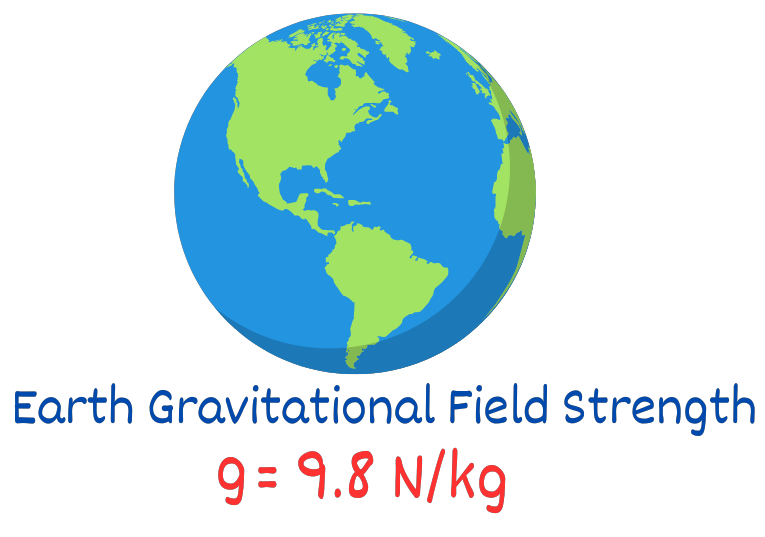
Earth's Gravitational Field Strength

On Earth, the gravitational field strength is approximately 9.8 N/kg. This means that for every kilogram of mass, there exists a gravitational force of 9.8 newtons. This relatively high gravitational field strength is responsible for the noticeable gravitational force experienced by objects near the Earth’s surface.

Earth's Gravitational Field Strength

Variation in Gravitational Field Strength

It’s important to recognize that gravitational field strength is not constant everywhere. Its value is contingent upon the mass of the celestial body generating the field. For instance, the Moon, being significantly smaller than Earth, possesses a lower gravitational field strength, approximately 1.6 N/kg. Consequently, the experience of weight differs dramatically between the Moon and Earth.
Weight Variation in Gravitational Field Strength

Having grasped the fundamentals of gravity, let’s now explore weightโ€”a concept often misconstrued in everyday language.

Chapter 2

The Distinction Between Mass and Weight

Mass is an intrinsic property of an object, representing the amount of matter it contains. Crucially, an object’s mass remains constant regardless of its location in the universe. Mass is typically measured in kilograms (kg).
The Distinction Between Mass and Weight

To illustrate, if you were to measure your mass on Earth using a scale, the result would be identical to a measurement on the Moon or in outer space. Your mass remains unaltered.

Comprehending Weight

Weight, on the other hand, refers to the force of gravity acting on an object with mass. It varies depending on the gravitational field strength of the celestial body the object is situated on.

Weight is calculated using the following formula:

Weight (W) = Mass (m) ร— Gravitational Field Strength (g)

Weight Formula

Where:

  • Weight (W) is measured in newtons (N).
  • Mass (m) is measured in kilograms (kg).
  • Gravitational Field Strength (g) is measured in newtons per kilogram (N/kg).

Consider an example: a box with a mass of 10 kilograms. When placed on Earth’s surface, where the gravitational field strength (g) is approximately 9.8 N/kg, the box’s weight (W) is calculated as follows:

W = 10 kg ร— 9.8 N/kg = 98 N

In this scenario, the box’s weight is 98 newtons.

Comprehending Weight

However, if this same box were transported to the Moon, where the gravitational field strength (g) is significantly lower (about 1.6 N/kg), its weight would be:

W = 10 kg ร— 1.6 N/kg = 16 N

On the Moon, the box’s weight is merely 16 newtons, substantially lighter than its weight on Earth.

This distinction between mass and weight can be somewhat perplexing, given that we often colloquially use the term “weight” to denote mass. Nevertheless, in the realm of physics, it is crucial to differentiate between these two properties.

Chapter 3

Gravitational Potential Energy

Now that we have a solid understanding of gravity, weight, and their distinctions, let’s delve into the concept of gravitational potential energy (GPE).

Gravitational Potential Energy

Unraveling Gravitational Potential Energy

Gravitational potential energy (often denoted as “GPE”) is a form of potential energy associated with an object’s position within a gravitational field. It represents the energy an object possesses due to its elevation above a reference point, typically the surface of a celestial body like Earth.ย 

The formula for calculating gravitational potential energy is:

GPE (EP) = Mass (m) ร— Gravitational Field Strength (g) ร— Height (h)

Gravitational Potential Energy Formula

Where:

  • GPE (EP) is measured in joules (J).
  • Mass (m) is measured in kilograms (kg).
  • Gravitational Field Strength (g) is measured in newtons per kilogram (N/kg).
  • Height (h) is measured in meters (m).

In essence, gravitational potential energy quantifies the energy an object possesses due to its position relative to a celestial body. The higher an object is above the reference point, the greater its gravitational potential energy

Calculating Gravitational Potential Energy: An Example

Solved Example Symbol

Solved Example: Suppose we have an apple with a mass of 0.1 kilograms (equivalent to 100 grams), and we lift it to a height of 3 meters above the ground.

Solution:

First, we ensure that all our units are consistent by converting the mass from grams to kilograms:

Mass (m) = 0.1 kg

Now, we calculate the gravitational potential energy using the formula:

GPE (EP) = 0.1 kg ร— 9.8 N/kg ร— 3 m = 2.94 J

Calculating Gravitational Potential Energy

The apple possesses a gravitational potential energy of 2.94 joules due to its position above the ground.

Gravitational potential energy plays a significant role in various natural phenomena. It’s the energy associated with the positioning of objects within gravitational fields and has applications in understanding the behaviour of celestial bodies, the operation of hydroelectric dams, and even the exhilarating experience of a roller coaster ride.

Chapter 4

Conclusion

In this comprehensive exploration of gravity, weight, and gravitational potential energy, we’ve journeyed through the fundamental principles that govern the behaviour of objects within gravitational fields.

Mysteries of Gravity, Weight, and Energy Conclusion

We’ve demystified gravity as a force of attraction dependent on mass and distance, clarified the distinction between mass and weight, and unravelled the concept of gravitational potential energy.

These foundational concepts are instrumental in the field of physics

Unlocking the Mysteries of Gravity, Weight, and Energy

“Dive into the captivating world of Gravity, Weight, and Gravitational Potential Energy.

Heat Transfer Unveiled A Comprehensive Guide to Thermal Energy

Welcome back to MyExamRevision! In today’s blog post, we’re diving into the fascinating world of heat transfer. When objects are heated, energy flows and is stored in their thermal energy reserves. Let’s explore the three methods through which heat can be transferred and the unique ways they impact different materials and environments.

Heat transfer methods illustrated with icons for mechanical, heating, electrical, radiation, and sound energy transfers.
Heat transfer methods showing radiation, convection, conduction, and thermal energy stores with icons.

If you’re looking for a tailored and comprehensive approach to understanding heat transfer dynamics โ€“ conduction, convection, and radiation โ€“ your search ends here. My personalized tutoring is designed to cater to your unique learning style, pace, and academic goals. Together, we’ll unravel the complexities of energy movement and excel in grasping this fundamental concept.

Whether you’re preparing for your upcoming studies or seeking to deepen your knowledge, take the next step by clicking this link:ย  Physics Private Tutoring

Unlocking the Mysteries of Gravity, Weight, and Energy delves deep into the fascinating realm of physics, offering insights into fundamental principles. Explore this captivating topic now: Unlocking the Mysteries of Gravity, Weight, and Energy

Contents

Chapter 1

Conduction: Vibrational Energy Transmission

Chapter 2

Thermal Conductivity: Efficiency of Conduction

Chapter 3

Convection: Fluid Dynamics of Heat Transfer

Chapter 4

Radiation: The Silent Traveler of Heat

Chapter 5

Conclusion: Unraveling the Tapestry of Heat Transfer

Chapter 1

Conduction: Vibrational Energy Transmission

Let’s start our exploration with conduction, a heat transfer mechanism that primarily occurs in solids. The underlying principle here revolves around the vibrating particles within a substance, which transfers energy to their neighbouring particles through these vibrations.

Conduction Vibrational Energy Transmission

Imagine heating one end of a metal rod. As the energy is supplied, it’s absorbed by the particles at that end, intensifying their kinetic energy and causing them to vibrate more vigorously. These high-energy particles then collide with adjacent particles, transmitting their energy in a chain reaction. This transfer of kinetic energy continues throughout the substance until a state of equilibrium is achieved, resulting in uniform temperature distribution.

Conduction Heat Transfer

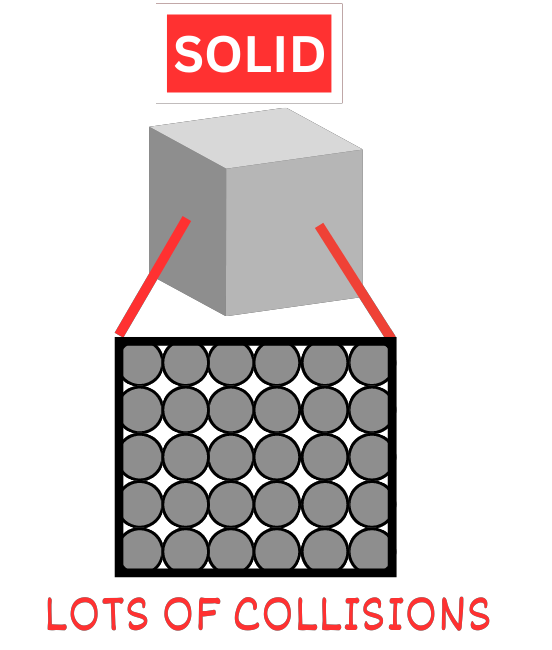
Conduction is especially effective in solids due to the close proximity of particles. The tightly packed structure allows for efficient energy transmission through frequent collisions and interactions. In contrast, liquids and gases have particles that are more spaced out, making conduction less efficient in these mediums.

SOLID Heat Transfer

Chapter 2

Thermal Conductivity: Efficiency of Conduction

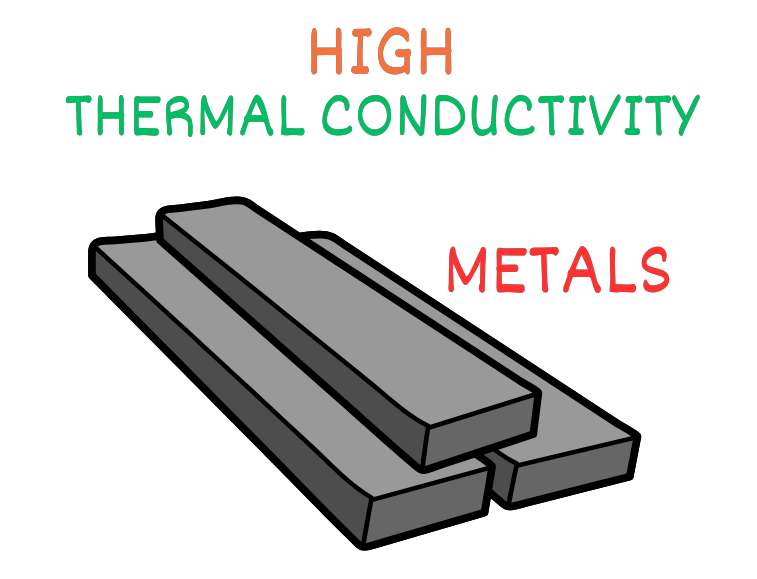
The efficiency of conduction is quantified by a property known as thermal conductivity. Metals, characterized by their closely packed atomic arrangements, exhibit high thermal conductivity.ย 

Thermal Conductivity Efficiency of Conduction

Consequently, metals can rapidly transfer heat energy over relatively large distances. This property is harnessed in various applications, from cooking utensils to heat sinks in electronics.

Heat Transfer HIGH THERMAL CONDUCTIVITY

On the other hand, substances with lower thermal conductivity, such as plastics, serve as effective insulators. This is why plastic handles on cooking utensils stay cooler even when the metal part is heated. The ability to control heat transfer by exploiting thermal conductivity variations is essential in engineering and design.

Heat Transfer LOW THERMAL CONDUCTIVITY

Chapter 3

Convection: Fluid Dynamics of Heat Transfer

Convection takes center stage when we shift our focus to fluids, encompassing both liquids and gases. Unlike solids, the particles in fluids are not fixed in place; they can move freely.

When a fluid is heated, its particles gain kinetic energy, leading to increased motion and random diffusion. This phenomenon causes the more energetic particles to move away from the heat source and towards cooler regions.

Convection Heat Transfer

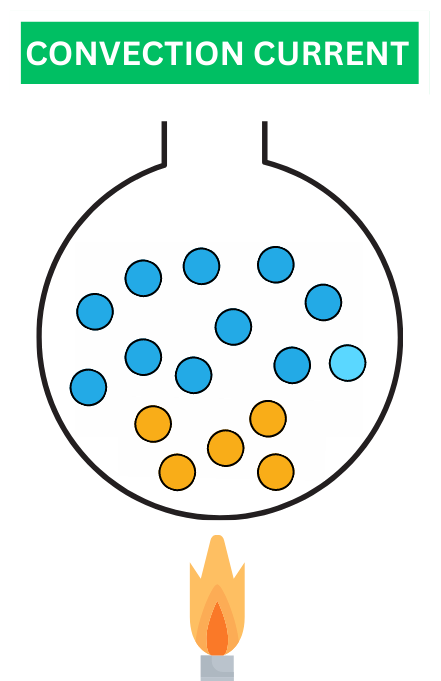
As the warmer fluid rises due to its reduced density, it creates an upward flow. Conversely, the cooler, denser fluid near the heat source descends. This circulation of fluid due to temperature differences is referred to as a convection current. You might have witnessed convection currents in action when observing a pot of water heating on a stove. The warmer water near the bottom rises, while cooler water descends to take its place. This movement contributes to the even distribution of temperature within the fluid.

CONVECTION CURRENT

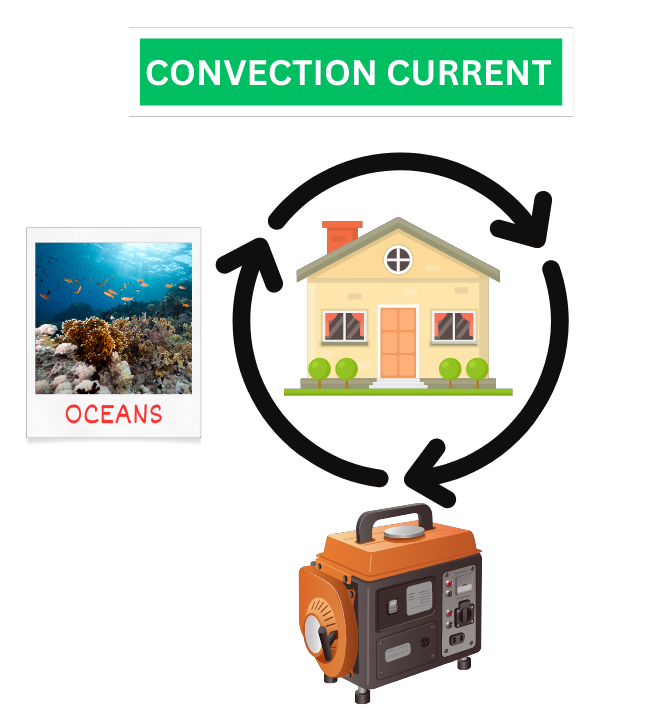
Convection currents are not limited to kitchen scenarios โ€“ they play a crucial role in various natural phenomena. For instance, ocean currents are driven by convection currents, which in turn influence climate patterns around the world.

Heat Transfer CONVECTION CURRENT

Chapter 4

Radiation: The Silent Traveler of Heat

While conduction and convection rely on particles for heat transfer, radiation offers an entirely different mechanism. In contrast to the first two methods, radiation doesn’t require a medium or particles to propagate. It can occur even in the vacuum of space. This makes radiation a vital player in the universe’s energy balance.

Radiation The Silent Journey of Energy

Radiation occurs through electromagnetic waves, specifically in the infrared region of the electromagnetic spectrum. All objects with a temperature above absolute zero emit radiation. The amount of radiation emitted by an object is directly related to its temperature โ€“ hotter objects emit more radiation.

RADIATION

You may have experienced this phenomenon firsthand when standing near a barbecue grill. Even if you’re not touching the grill, you can feel the heat radiating from it.

Radiation is an integral aspect of Earth’s energy budget. The Sun’s energy, radiated as electromagnetic waves, reaches our planet and is absorbed by the surface. The surface then re-emits this energy as lower-energy infrared radiation, contributing to Earth’s overall heat balance.

Chapter 5

Conclusion: Unraveling the Tapestry of Heat Transfer

And there you have it โ€“ a comprehensive journey through the intricate world of heat transfer. From the vibrating particles in solids to the fluid dynamics of convection and the silent journey of radiation, these mechanisms shape our understanding of energy exchange. Each method, governed by unique principles, offers insights into the behaviour of heat energy in various scenarios

Conclusion Unraveling the Tapestry of Heat Transfer

As you go about your daily life, remember that the transfer of heat energy is at the heart of countless natural processes, technological innovations, and environmental phenomena. We hope this exploration has deepened your appreciation for the multifaceted nature of heat transfer. Until our next adventure, stay curious and keep exploring the wonders of the physical world!

Gain deeper insights into the world of Heat Transfer: Conduction, Convection, and Radiation. Explore further by clicking the link: Difference between Conduction Convection and Radiation