Momentum– GCSE Physics

Introduction

  • Momentum is a measure of an object’s resistance to stopping or changing its motion.
  • It helps us to understand motion and explain collisions.

Examples:

A fast-moving soccer player and a roller coaster both demonstrate momentum in motion

A punch in boxing and a skateboard show examples of momentum in action in physics

What is Momentum?

  • Momentum is a measure of how much Motion an object has.
  • It represents the quantity of motion an object has and how difficult it is to stop or change its motion.

Key properties:

  • A heavier or faster-moving object has more Momentum.
  • Momentum depends on both the speed and the direction of motion.
  • In a closed system,
    • Total momentum before and after a collision remains constant.

Example:

If a Truck and a Car are moving at the same speed, the Truck has more momentum because it has more mass.

A truck and a car both moving at 60 km/h, demonstrating momentum in physics

A small car hitting a truck won’t move the truck much, because the truck has way more Momentum.

A visual comparison showing the scenario before and after a collision, demonstrating the concept of momentum in physics with two cars, a truck, and traffic lights

How to calculate Momentum?

  • Momentum depends on Mass and Velocity.
  • It is a Vector Quantity.
  • Mathematically,

A visual representation of the momentum equation in physics: p = mv, where p is momentum, m is mass, and v is velocity

Where,

    • p = Momentum
    • m = Mass
    • v = Velocity

SI Unit: Kilogram-meter per second (kg.m/s)

certified Physics and Maths tutorSolved Example: Momentum GCSE Questions

Problem: A car has a mass of 1000 kg and is moving at a velocity of 20 m/s in North side. What’s the Momentum of car in the direction it’s moving?

Solution: 

Step #1: Given

    • m = 1000 kg
    • v = 20 m/s

Step #2: Using the Formula:

A visual representation of the momentum equation in physics: p = mv, where p is momentum, m is mass, and v is velocity

Step #3: Putting the values:

An example of calculating momentum in physics using the equation p = mv. With mass (1000 kg) and velocity (20 m/s), the momentum is calculated as 20,000 kg·m/s.

The car’s momentum is 20,000 kg·m/s in the direction it’s moving.

Final Answer: 20,000 kg·m/s

Can Momentum be Positive or Negative?

  • Yes, Momentum can be both positive and negative, which indicates the direction of an object’s motion.

Positive Acceleration:

Directional Reference:

    • Object moves in the defined positive direction (e.g., right/east/up/north).

Meaning of Signs:

    • +p: Object moves in the positive direction.

Example:

Problem: A 10 kg soccer ball is kicked eastward at 5 m/s.

Solution: Let East = positive (+) direction.

An example showing momentum calculation in physics using the equation p = mv. With mass (10 kg) and velocity (5 m/s), the momentum is calculated as +50 kg·m/s.


Negative Acceleration:

Directional Reference:

    • Object moves in the opposite (negative) direction (e.g., left, west, down)

Meaning of Signs:

    • –p: Object moves in the negative direction.

Example:

Problem: A 10 kg soccer ball is kicked westward at 5 m/s.

Solution: Let West = negative (-) direction.

An example showing momentum calculation with a negative result using the equation p = mv. With mass (10 kg) and velocity (-5 m/s), the momentum is calculated as -50 kg·m/s.

Relationship Between Force, Momentum & Acceleration

  • Momentum and Acceleration are fundamental concepts in physics, connected through Newton’s Second Law of Motion.
  • Momentum depends on velocity, any change in velocity (i.e. acceleration) causes a change in momentum.

An image illustrating Newton's Second Law of Motion, showing the formula F = ma, where F is force, m is mass, and a is acceleration.

But Since,

An image showing the formula for acceleration in physics: a = (v - u) / t, where a is acceleration, v is final velocity, u is initial velocity, and t is time.

And Momentum is:

An image showing the momentum formula in physics: p = mv, where p is momentum, m is mass, and v is velocity.

Then change in momentum is:

An image showing the formula for change in momentum: Δp = m × Δv, where Δp is change in momentum, m is mass, and Δv is change in velocity.

Substituting this into equation 1,

An image showing the relation between force, mass, change in velocity, and change in time: F = m × Δv / Δt = Δp / Δt, where F is force, m is mass, Δv is change in velocity, Δt is change in time, and Δp is change in momentum.

It says:

  • The Force acting on an object is equal to the rate of change of its Momentum.
  • If an object’s momentum changes quickly, a large force is involved.
  • If it changes slowly, the force is smaller.
  • It can also be written as,

An image showing the formula for force in physics: F = m(v - u) / t, where F is force, m is mass, v is final velocity, u is initial velocity, and t is time.

certified Physics and Maths tutorSolved Example: Momentum GCSE Questions

Problem: A cricket ball of mass 0.2 kg is moving at a speed of 25 m/s. What is the momentum of the ball?

Solution: 

Step #1: Given

    • m = 0.2 kg
    • v = 25 m/s

Step #2: Using the Formula:

A visual representation of the momentum equation in physics: p = mv, where p is momentum, m is mass, and v is velocity

Step #3: Putting the values:

An example showing momentum calculation in physics using the equation p = mv. With mass (0.2 kg) and velocity (25 m/s), the momentum is calculated as 5 kg·m/s.

The momentum of the cricket ball is 5 kg·m/s.

Final Answer: 5 kg·m/s.

certified Physics and Maths tutorSolved Example: Momentum GCSE Questions

Problem: A car of mass 1200 kg moves backward with a velocity of 5 m/s. What is its momentum?

Solution: 

Step #1: Given

    • m = 1200 kg
    • v = 5 m/s

Step #2: Using the Formula:

A visual representation of the momentum equation in physics: p = mv, where p is momentum, m is mass, and v is velocity

Step #3: Putting the values:

An example showing momentum calculation in physics using the equation p = mv. With mass (1200 kg) and velocity (-5 m/s), the momentum is calculated as -6000 kg·m/s.

The momentum of the car is -6000 kg·m/s.

Final Answer: -6000 kg·m/s.

Frequently Asked Questions

Solution:

Momentum is a measure of the motion of an object and is the product of its mass and velocity. It is a vector quantity, meaning it has both magnitude and direction.

Solution:

The principle states that in a closed system (no external forces acting), the Total momentum before a collision is equal to the total momentum after the collision

Solution: 

Formula for Momentum:

p = m x v

Where,

  • p = Momentum
  • m = Mass
  • v = Velocity

Solution:

SI Unit for Momentum is kilogram-meter per second (kg·m/s)

Solution:

Yes, Momentum is a Vector Quantity which depends on both direction and magnitude.

Stopping Distances– GCSE Physics

Introduction

  • The Total distance a vehicle covers from the moment a driver identifies a hazard until the vehicle comes to a complete stop, is known as Stopping Distances.

This concept is important:

    • To Prevent Accidents
    • To Be a More Aware Driver
    • To Drive Safely in Different Conditions
    • Understand how long it really takes to stop

Stopping Distances Examples

What is Stopping Distances?

  • Stopping Distance is how for a car moves between the driver noticing something in front of them and the car coming to a stop.
  • It’s affected by two main features,

1. Thinking Distance:

  • The Distance the vehicle travels while the driver reacts and decides to brake.
  • It depends on reaction time (typically 0.5–2 seconds).
  • Affected by driver alertness, distractions, fatigue, and intoxication.

2. Braking distance:

  • The Distance the vehicle travels after the brakes are applied until it fully stops.
  • It depends on speed, road conditions, vehicle weight, and brake efficiency.
  • Affected by wet/icy roads, worn tires, or faulty brakes.

So,

Stopping Distances: Thinking Distance & Braking distance Examples

Factors That Affect Stopping Distance

  • Speed — Higher speeds mean longer stopping distances.

Stopping Distances Speed Example

  • Driver reaction time — Affected by tiredness, distractions, alcohol, or drugs.

Stopping Distances Example: Driver reaction time

  • Road conditions — Wet, icy, or uneven roads increase braking distance.

Stopping Distances Example: Road Conditions

  • Vehicle condition — Things like brake quality and tire grip matter too.

Stopping Distances Example: Vehicle condition

How to Calculate Stopping Distance

  • It involves two components: Thinking Distance and Braking Distance.
  • The Total Stopping Distance is the sum of these two.

Stopping Distances Formula

Where,

Thinking Distance:

  • The distance traveled while the driver reacts before applying the brakes is called the Thinking Distance.

Thiking Distance Formula

  • Speed = Vehicle speed (Typically in m/s).
  • Reaction time = Around 0.7 to 1.5 seconds, depending on the driver and conditions.

Braking Distance:

  • The distance traveled while the vehicle decelerates to a stop after the brakes are applied is called the Braking distance.

Braking Distance Formula

  • v = Speed in m/s.
  • a = Deceleration in m/s² (depends on brakes, road surface, tires, weather, etc.)

certified Physics and Maths tutorSolved Example

Problem: If a car is traveling at 72 km/h. The driver has a reaction time of 1.5 seconds, and the car decelerates at 6 m/s² when the brakes are applied. Calculate the Total Stopping Distance.

Solution: 

Step #1: Convert speed to m/s

Stopping Distances Solved Example 1 Equation Part 1

Step #2: Calculate Thinking Distance:

Stopping Distances Solved Example 1 Equation Part 2

Step #3: Calculate Braking Distance:

Stopping Distances Solved Example 1 Equation Part 3

Step #4: Calculate Total Stopping Distance:

Stopping Distances Solved Example 1 Equation Part 4

Total Stopping Distance is 63.33m.

Final Answer: 63.33m

certified Physics and Maths tutorSolved Example

Problem: A motorcycle is moving at 54 km/h. The rider’s reaction time is 1.2 seconds. The motorcycle decelerates at 7 m/s² after braking. Find the Total Stopping Distance.

Solution: 

Step #1: Convert speed to m/s

Step #2: Calculate Thinking Distance:

Step #3: Calculate Braking Distance:

Step #4: Calculate Total Stopping Distance:

Total Stopping Distance is 34.07m.

Final Answer: 34.07m

certified Physics and Maths tutorSolved Example

Problem: A truck travels at 90 km/h. The driver reacts in 2 seconds. The truck decelerates at 5 m/s². Find the total stopping distance.

Solution: 

Step #1: Convert speed to m/s

Step #2: Calculate Thinking Distance:

Step #3: Calculate Braking Distance:

Step #4: Calculate Total Stopping Distance:

Total Stopping Distance is 112.5m.

Final Answer: 112.5m

Frequently Asked Questions

Solution:

Stopping distance is the total distance a vehicle travels from the moment the driver perceives a hazard until the vehicle comes to a complete stop. It includes thinking distance (reaction time) and braking distance.

Solution:

  • Speed (most critical, braking distance ∝ speed²)
  • Road conditions (wet, icy, or dry surfaces)
  • Tire condition & brake efficiency
  • Driver reaction time (affected by fatigue, distractions, alcohol)

Solution: 

Higher speeds exponentially increase braking distance (e.g., doubling speed quadruples braking distance).

Example:

At 30 mph, stopping distance ≈ 23 meters (75 ft)

Solution:

Thinking distance = Distance covered during driver’s reaction time.

Braking distance = Distance needed to stop after brakes are applied.

Difference Between Mass and Weight – GCSE Physics

Introduction

  • To understand how things move, interact, and behave in the physical world, the concepts of Mass and Weight are studied.

Difference Between Mass and Weight Examples

What is Mass?

  • Mass is how much matter is in an object.
  • It is the property of physical objects that measures:
    • Inertia: Resistance to acceleration when a force is applied.
    • Gravitational influence: Shows the strength of attraction between two objects.

Key Points:

  • SI Unit of Mass is Kilogram (Kg).
  • It is a Scalar Quantity.
  • Mass never changes no matter where the object is—on Earth, on the Moon, or in space.
  • It measures Inertia.

Example:

A Rocket has a mass of 2,000 kg, whether it’s on Earth, the Moon, or floating in space, it’s still 2,000 kg.

Difference Between Mass and Weight Example for Students

In all Scenario the Mass of Rocket will remain same (e.g.,2,000 kg)

What is Weight?

    • Measure of the Gravitational pull of an object.
    • It depends on both the object’s Mass and the local Gravitational Acceleration.

Key Points:

  • SI Unit of Weight is Newton (N).
  • It is a Vector Quantity.
  • It changes with gravity, so weight varies depending on where the object is (Earth, Moon, or space).
  • It measures Gravitational force.

Example:

A person with a mass of 60 kg,

weight Example

Difference between Mass and Weight

Difference Between Mass and Weight Example 2

Calculating Mass and Weight

Formula for Mass:

Where,

  • W = Weight
  • g = Acceleration due to Gravity

Formula for Weight:

Where,

  • m = Mass
  • g = Acceleration due to Gravity

certified Physics and Maths tutorSolved Example

Problem: A bag of rice has a weight of 49 newtons on Earth. What is the mass of the bag?

Solution: 

Step #1: Given

    • W = 49N
    • Take gravitational acceleration,

g = 9.8 m/s2

Step #2: Using the formula:

Step #3: Putting the Values:

The mass of the bag of rice is 5 kilograms.

Final Answer: 5 kg

certified Physics and Maths tutorSolved Example

Problem: An object has a mass of 8 kilograms. What is its weight on Earth?

Solution: 

Step #1: Given

    • m = 8kg
    • Take gravitational acceleration,

g = 9.8 m/s2

Step #2: Using the formula:

Step #3: Putting the Values:

The weight of the object is 78.4 newtons.

Final Answer: 78.4 N

Frequently Asked Questions

Solution:

Mass is how much matter you have. Weight is how strongly gravity pulls on that matter.

Solution:

Gravity is different on every planet. Your mass doesn’t change, but the force (weight) does.

Example: 60 kg mass

– Earth: 60 x 10 = 600 N

– Moon: 60 x 1.6 = 96 N

Solution: 

Mass- Kilogram (kg)

Weight- Newton (N)

Solution:

Use W= m x g If you know your mass and the planet’s gravity, multiply them.

Example:

70 kg on Mars (g = 3.7)-70 x 3.7 = 259 N

Solution:

Weight is a force. Mass is how much matter you have.

Weight = gravity pulling on that matter.

Newton's Third Law – GCSE Physics

Introduction

  • Newton’s Third Law of Motion states that, for every action, there is an equal and opposite reaction.
  • It explains the fundamental interactions between objects in the universe and help us to understand how forces work in pairs.

Example: 

A visual representation of Newton's Third Law of Motion showing walking and the recoil of a gun. For every action force, there is an equal and opposite reaction.

A visual representation of Newton's Third Law of Motion, showing a rocket launching into space and a person swimming. For every action, there is an equal and opposite reaction.

What is Newton’s Third Law of Motion?

  • It states that, when two objects interact, the forces they exert on each other are Equal and Opposite.
  • Equal refers to the magnitudes of two forces whereas Opposite refers to their direction.

Real-life Examples:

Running:

  • Action: Our foot pushes backward against the ground.
  • Reaction: The ground pushes us forward with an equal force, making us move.

A visual representation of Newton's Third Law of Motion, showing runners in a sprint race and a person running hurdles. The action of running and hurdling generates an equal and opposite reaction force.

Bird Flying:

  • Action: A bird’s wings push air downward.
  • Reaction: The air pushes the bird upward, allowing flight.

A visual representation of Newton's Third Law of Motion, showing birds flying in the sky and across the water. The birds push air downwards to generate lift, while the air pushes back with an equal and opposite force.

What are the Balanced Forces and Action-Reaction Pairs?

Balanced Forces

  • These are two or more forces that act on the same object, are equal in size, and opposite in direction, so they cancel each other out.
  • No change in Motion or constant Speed (if already moving).

Examples:

Action-Reaction Pairs:

  • These are two forces that act on the different objects, are equal in size, and direction, so they do not cancel each other out.
  • Cause Motion and Accelerates.

Examples:

examples of the third law of newton

What is Collison?

  • Collison is an example of a Newtons 3rd law of Motion which states that when two objects collide, both objects exert equal and opposite forces on each other.
  • Newtons 3rd Law Applies to Collisions based on:
    • Force Pairs During Impact
    • Momentum Conservation
    • Different Effects Based on Mass

Examples:

Frequently Asked Questions

Solution:

It means that whenever one object pushes or pulls another, the second object pushes or pulls back with the same force in the opposite direction.

Solution:

No. Balanced forces act on the same object. Action reaction forces act on different objects.

Solution: 

No, because they act on different objects, they do not cancel each other.

Solution:

When you jump off a small boat, you push back on the boat and the boat moves backward.

Solution:

Yes. According to Newtons 3rd law, forces always come in pairs — Action and Reaction.

Newton's Second Law – GCSE Physics

Introduction

  • Newton’s Second Law of Motion states, Non-Zero Resultant Force acts on an object, then it will cause the object to Accelerate.
  • Where Acceleration is,

acceleration formula gcse

Example: Pushing a Shopping Cart:

  • If we push an empty shopping cart with certain force, then it Accelerates quickly.
  • If we push a loaded shopping cart with same force, then it Accelerates slowly.

A comparison of two shopping carts showing how one accelerates quickly and the other slowly, demonstrating Newton's 2nd Law of motion. The left cart is empty and accelerates quickly, while the right cart is full and accelerates slowly.

What is Newton’s 2nd Law of Motion?

  • It states that, Acceleration of an object is directly proportional to the net Force acting on it and inversely proportional to its Mass.
  • Mathematically,

Newton's Second Law equation showing the relationship between acceleration, force, and mass. The formula is displayed as a = F/m or F = ma, where 'a' is acceleration, 'F' is force, and 'm' is mass.

Where,

  • F = Net Force applied
  • m = Mass of an Object
  • a = Acceleration

certified Physics and Maths tutorSolved Example

Problem: If you push a 10 kg box with a 20 N force, what is the Acceleration of the Box?

Solution: 

Step #1: Given

    • F = 20N
    • M = 10kg

Step #2: Using the value:

Newton’s Second Law formula showing acceleration (a) equals force (F) divided by mass (m), a = F/m.

Step #3: Putting the Values:

Example of Newton’s Second Law: acceleration (a) calculated as 20 N of force divided by 10 kg mass, resulting in 2 m/s² acceleration.

Final Answer: 2 m/s2

certified Physics and Maths tutorSolved Example

Problem: A 5 kg box is pushed with a net force of 20 N. What is the acceleration of the box?

Solution: 

Step #1: Given

    • F = 20N
    • M = 5 kg

Step #2: Using the value:

Newton’s Second Law formula showing acceleration (a) equals force (F) divided by mass (m), a = F/m.

Step #3: Putting the Values:

Final Answer: 4 m/s2

certified Physics and Maths tutorSolved Example

Problem: A car with a mass of 1000 kg accelerates at 2 m/s². What is the net force acting on the car?

Solution: 

Step #1: Given

    • A = 20m/s2
    • M = 1000 kg

Step #2: Using the value:

Step #3: Putting the Values:

Final Answer: 2000 N

How Newton’s 2nd Law Works?

  • Newton’s Second Law explains how an object’s motion changes when a force is applied.

Relationship between Force, Mass and Acceleration:

  • Force is directly proportional to Acceleration when Mass is constant.

Newton’s Second Law showing force (F) is directly proportional to acceleration (a), with mass constant.

  • Force is directly proportional to Mass when Acceleration is constant.

Newton’s Second Law showing force (F) is directly proportional to mass (m), with acceleration constant.

  • Acceleration is inversely proportional to Mass when Force is constant.

Newton’s Second Law showing that acceleration (a) is inversely proportional to mass (m) when force is constant.

What is Inertial Mass?

  • Inertial mass is a measure of an object’s Resistance to Acceleration when a Force is applied.
  • If there is more Inertial Mass then, it’s harder to Accelerate.
  • If there is less Inertial Mass then, it’s easy to Accelerate.

Examples:

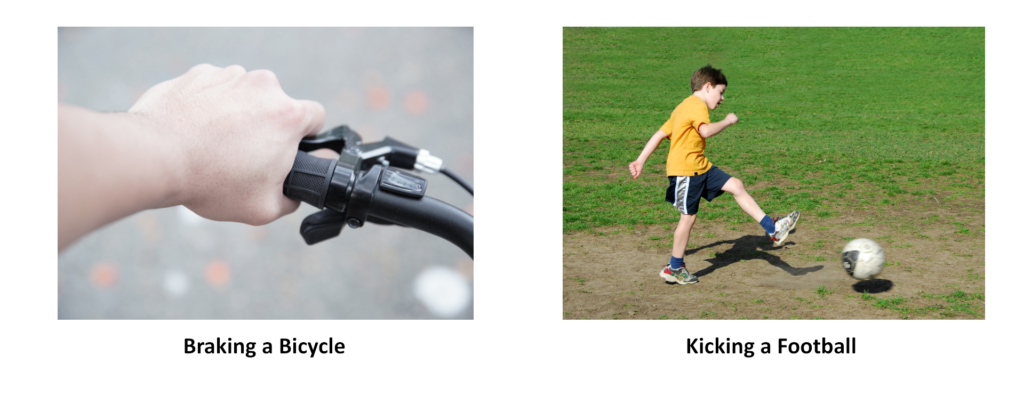
  • Bicycles are lightweight, stops quickly when brakes are applied while Trucks are Massive, takes much longer to stop even with strong brakes.

Newton’s Second Law demonstrating the relationship between acceleration and mass for two different vehicles.

  • Soccer Ball are low mass, small kick makes it fly fast (large acceleration) while Bowling Ball are high mass, Same kick barely moves it (small acceleration).

A football and a bowling ball demonstrate the effect of force on objects of different mass.

Frequently Asked Questions

Solution:

Newton 2nd Law says that the more force you apply to an object, the faster it will Accelerate. But if the object is heavier, it won’t speed up as quickly with the same force.

Solution:

Use the formula:

Force = Mass × Acceleration (F = m x a).

For example:

if a car has a mass of 1000 kg and accelerates at 2 m/s2, the force is 2000 N.

Solution: 

Mass is how much matter something has. Inertial mass tells us how much an object resists being pushed or sped up. It’s calculated by dividing force by acceleration.

Solution:

Yes. A light bicycle accelerates faster than a heavy car when the same force is applied. This is because the bike has less mass, so it speeds up more.

Solution:

A Newton Second is a unit of Impulse (force x time). It’s not directly part of Newton’s Second Law, but it comes up when studying how momentum changes over time.

Newtons First Law – GCSE Physics

Introduction

  • Motion is the change in position of an object with respect to time.
  • Newton’s First Law of Motion explains how objects behave when no external forces act on them.
  • An object in motion stays in motion with the same Speed and same Direction unless an External Force act on it.

Examples:

Two examples of Newton's First Law: a sudden brake in a car, and a ball at rest on the ground.

Two examples of Newton's First Law: riding on a swing and standing in a moving bus, illustrating motion and inertia.

What is Newtons First Law of Motion?

  • It States that a Resultant Force is required to change the Motion of an object.
  • Newtons First Law of Motion is also called Inertia because it describes the concept of Inertia which is,

The Natural tendency of an objects to Resist changes in their state of Motion.

Examples:

  • A satellite in space continues moving unless acted upon by gravity.

newton's law about gravity

  • The ketchup stays at the bottom until the force overcomes its inertia.

An elderly man applying force to a ketchup bottle, demonstrating Newton's First Law where an object at rest (the ketchup) stays at rest until acted upon by an external force.

  • A bike stays balanced while moving.

A motorcycle in motion on a curved road, demonstrating Newton's First Law where an object in motion stays in motion unless acted upon by an external force.

What are Balanced and Unbalanced Force?

Balanced Force:

  • Forces acting on an object are equal in Magnitude but opposite in Direction.
  • They cancel each other out, so the Resultant Force is Zero.

Characteristics:

    • No change in Motion.
    • Object or Body remains at rest or continues at Constant Velocity.

Examples:

Unbalanced Force:

  • Forces acting on an object are not equal in Unbalanced Force.
  • They do not cancel each other out, so the Resultant Force is non-zero.

A formula showing the situation where the resultant force (FR) is not equal to zero, indicating an unbalanced force.

Characteristics:

  • Change in Motion.
  • Object or Body accelerates (speed up, speed down or change direction).

Examples:

Real-life Examples

  • A rolling soccer ball slows down and stops because Inertia keeps it moving, but friction and air resistance act as external forces to stop it.

A soccer ball at rest on the field, illustrating Newton's First Law of Motion where an object at rest stays at rest unless acted upon by an external force.

  • When we beat a carpet, dust particles fall out because the carpet moves, but dust tends to stay at rest until gravity pulls it down.

A man swinging a stick at an object, demonstrating Newton's First Law where an object at rest stays at rest until acted upon by an external force.

  • In a collision, seatbelts prevent passengers from flying forward.

A person fastening a seatbelt in a car, demonstrating Newton's First Law where an object in motion will continue in motion unless acted upon by an external force.

Frequently Asked Questions

Solution:

It means that an object will keep doing what it’s doing – moving or staying still — unless a force changes that.

Solution:

It means that a moving object will keep going at the same speed and in the same direction unless something like friction or another force slows it down.

Solution: 

Balanced forces don’t change motion. Unbalanced forces cause an object to speed up, slow down, or change direction.

Solution:

It’s seen when a car stops suddenly, and passengers jerk forward — their bodies want to keep moving because of Inertia.

Solution:

Gravity is a force, and Newton’s First Law explains how forces like gravity can change an object’s motion. So, Gravity can act as the external force mentioned in the law.

Resultant Forces – GCSE Physics

Introduction

  • Force is a push or pull acting on a body.
  • A body needs Force to change its state of motion.
  • There are number of Forces acting on a body at a same time, so instead of analyzing multiple forces individually, we use the Resultant Force to predict Motion.
  • The Resultant Force is the single Force that replaces multiple forces acting on an object, producing the same effect.

Real-life Scenario:

Resultant Forces Example 1

Resultant Forces Example 2

What is Free Body Diagram?

  • A Free Body Diagram is a simplified visual representation of an object to visualize the forces acting on a single object (or body).
  • It helps analyze the effects of External Forces.

Examples:

Resultant Forces Free Body Diagram

Characteristics:

  • The arrow points in the direction that the force is acting.
  • The length of the arrow shows how strong the force is:

Resultant Forces Example 3

Common Forces in Free Body Diagrams:

  • Weight
  • Tension
  • Friction
  • Air Resistance/Drag

What is Resultant Force Equation?

  • Resultant Force is the Vector sum of all the individual forces acting on an object.
  • It is also called a net force which represent the combined effect of all other forces.
  • SI Unit of Force: Newton(N)

Equation 1:

  • If F1, F2, F3,….are the forces acting on a body, the Resultant Force FR is calculated using the formula with positive and negative signs used for pair of opposite forces,

Resultant Forces Equation

  • Where F1, F2, F3, . . . are the Linear Forces acting of the body.

Equation 2:

  • If F1 and F2 are the forces perpendicular to each other then their Resultant Force is,

Resultant Forces Equation 2

  • This consequence can also be calculated geometrically using other methods.

How to Calculate Resultant Force?

Method #1:

  • If force acts on a same direction, then the Resultant force is,

Resultant Forces Method 1

Method #2:

  • If force acts on a opposite direction, then the Resultant force is,

Resultant Forces Method 2

certified Physics and Maths tutorSolved Example: Method 1

Problem: If Person A pushes a car in the East direction with a Force of 200 N, and Person B also pushes the car in the same direction with a Force of 300 N, what will be the Resultant Force?

Solution: 

Step #1: Given

    • Person A applies Force F1 : 200N
    • Person B applies Force F2 : 300N

Step #2: Then the Resultant Force will be:

Final Answer: 500N

certified Physics and Maths tutorSolved Example: Method 2

Problem: If Person A pushes a box to the Left with a Force of 200 N, and Person B pushes the same box to the Right with a Force of 300 N, what is the Resultant Force on the box?

Solution: 

Step #1: Given

    • Person A applies Force F1 : 200N
    • Person B applies Force F2 : 300N

Step #2: Then the Resultant Force will be:

Final Answer: 100N

What are Balanced and Unbalanced Force?

Balanced Force:

  • Forces acting on an object are equal in Magnitude but opposite in Direction.
  • They cancel each other out, so the Resultant Force is Zero.

Characteristics:

    • No change in Motion.
    • Object or Body remains at rest or continues at Constant Velocity.

Examples:

Unbalanced Force:

  • Forces acting on an object are not equal in Unbalanced Force.
  • They do not cancel each other out, so the Resultant Force is non-zero.

Characteristics:

  • Change in Motion.
  • Object or Body accelerates (speed up, speed down or change direction).

Examples:

Frequently Asked Questions

Solution:

A Resultant Force is the overall force acting on an object after all individual Forces are combined.

Solution:

  • Add Forces in the same direction
  • Subtract it they act in opposite directions. This gives the net force.

Solution: 

  • Resultant force = Larger Force – Smaller Force (if opposite)
  • Resultant force = Sum of Forces fil same direction

Solution:

A drawing that shows the size and direction of each force using arrows.

Solution:

When the Resultant Force is not zero this causes movement or change.

Solution:

The object is Balanced. It either stays still or keeps moving at Constant Speed.

Solution:

A Rocket producing 13,000 N thrust and 5,000 N weight then,

Resultant Force is,

FR = FL (Larger Force) – FS (Smaller Force)

FR = 13,000 – 5000 = 8,000 N upwards

Acceleration – GCSE Physics

Introduction

  • Acceleration is the rate at which an object’s velocity changes over time.
  • It is a vector quantity.
  • It measures the motion of an object.

Real-life Scenario:

Acceleration GCSE Example 1

Acceleration GCSE Example 2

What is Acceleration?

  • Acceleration is the rate of change of the Velocity of an object with respect to time.

Acceleration Formula

Types of Acceleration:

  • Uniform Acceleration – Velocity changes at a constant rate .

Examples:

Acceleration GCSE Example 3

  • Non-Uniform Acceleration – Velocity changes at a varying rate.

Examples:

Acceleration GCSE Example 4

Acceleration Formula

Basic Acceleration Formula:

  • This formula defines Acceleration as the rate of change of velocity over time.

Basic Acceleration Formula

Where:

  • a = acceleration (m/s2)
  • Δv = change in velocity (v − u)
  • Δt = time taken (s)

certified Physics and Maths tutorSolved Example

Problem: A truck speeds up from 5 m/s to 25 m/s in 10 seconds. Find the acceleration.

Solution: 

Step #1: Given

    • v = 25m/s
    • u = 5m/s
    • t = 10s

Step #2: Using the formula:

Acceleration GCSE Formula

Step #3: Putting the values and solve:

Acceleration GCSE Equation 1

Acceleration is 2 m/s2

Final Answer: 2 m/s2

Acceleration Formula (Kinematic Equation)

Formula #1:

  • When Acceleration is constant, and time is not directly involved then this equation is used.
  • It helps calculate Final Velocity, Initial Velocity, Acceleration, or Displacement

Acceleration formula 1

Where:

  • v = final velocity (m/s)
  • u = initial velocity (m/s)
  • a = acceleration (m/s2)
  • s = displacement (m)

Formula #2:

  • This equation is used to calculate the Final Velocity of an object when Initial Velocity, Acceleration, and Time are known.

Acceleration GCSE Formula 2

Where:

  • v = final velocity (m/s)
  • u = initial velocity (m/s)
  • a = acceleration (m/s2)
  • t = time (s)

certified Physics and Maths tutorSolved Example: Acceleration GCSE Questions

Problem: A bike starts from rest and accelerates at 3 m/s2 over a distance of 50 meters. Find its final velocity.

Solution: 

Step #1: Given

    • u = 0 m/s
    • a = 3 m/s2
    • s = 50m

Step #2: Using the formula:

Step #3: Putting the values and solve:

Final velocity is 17.32 m/s

Final Answer: 17.32 m/s

certified Physics and Maths tutorSolved Example: Acceleration GCSE Questions

Problem: A car starts from rest and accelerates at 4 m/s2 for 5 seconds. Find the final velocity of a car.

Solution: 

Step #1: Given

    • u = 0 m/s
    • a = 4 m/s2
    • t = 5s

Step #2: Using the formula:

Step #3: Putting the values and solve:

Final Velocity is 20 m/s

Final Answer: 20 m/s

Can Acceleration be Positive or Negative?

  • Yes, acceleration can be both positive and negative, depending on an object whether it is speeding up or slowing down.

Positive Acceleration:

  • When an object’s velocity increases over time, then the acceleration is in the same direction as its velocity, and it consider as Positive Acceleration.

Examples:

    • Car speeding up
    • Launching a Rocket into a Space
    • A Plane Taking Off
    • Ball Rolling Down a Hill

Negative Acceleration:

  • When an object’s velocity decreases over time, then the acceleration is in the opposite direction to its velocity, and it consider as Negative Acceleration.

Examples:

    • Car Braking to Stop
    • Bicycle Stopping After Pedaling
    • Throwing a Ball Upwards
    • Parachute Opening During a Skydive

Learn More About Click this Link: Acceleration GCSE Physics

What is Acceleration due to Gravity?

  • Without any forces acting on an object, when it falls freely under the influence of Earth’s Gravity then the Acceleration is said as Acceleration due to Gravity.

Value of g on Earth:

Frequently Asked Questions

Solution:

A negative acceleration is called deceleration. It means the object is slowing down.

Solution:

Acceleration is measured in metres per second squared (m/s2).

Solution: 

Acceleration is a vector — it has both size and direction.

Solution:

It is 9.8 m/s2, often rounded to 10 m/s2 in GCSE calculations.

Solution:

Use this when you know Initial Velocity, Final Velocity, and Time.

Vectors and Scalars – GCSE Physics

Introduction

  • Motion is defined as the change in the position of an object with respect to time.
  • Scalar and Vector Quantities are used to describe the motion of an object.
  • Scalars are quantities defined by magnitude alone, such as Speed or Temperature, while Vectors are characterized by both Magnitude and Direction, like Velocity and Force.

Scalar Quantities in Real Life:

  • Speed in Transportation
  • Temperature in Weather Forecasting
  • Energy Consumption

Vector Quantities in Real Life:

  • Force in Engineering
  • Navigation and Aviation
  • Sports and Physics

What are Scalar Quantities

  • A scalar quantity is a physical measurement that has only Magnitude (size or amount) and no Direction.
  • They can be described completely by a single number with a unit.

Examples:

  • Mass: It is Scalar Quantity that measure the amount of matter in an object

Vectors and Scalars Example 1

  • Distance: The total length of the path traveled by an object, regardless of its direction.

Vectors and Scalars Example 2

  • Speed: How fast an object moves.

Vectors and Scalars Example 3

  • Temperature: Measures the average kinetic energy of particles in a substance.

Vectors and Scalars Example 4

What are Vector Quantities

  • A vector quantity is a physical measurement that has both Magnitude and Direction.
  • They can be described by a single number with a unit and Direction.

Examples:

  • Force: It is a Vector Quantity that describes a push or pull acting on an object

Vectors Example 1

  • Weight: It is the force exerted on an object due to gravity.

Vectors and Scalars Example 5

  • Velocity: It is the rate of change of an object’s displacement

Vectors and Scalars Example 6

  • Momentum: It is a vector quantity that describes the quantity of motion of an object.

Vectors and Scalars Example 7

Scalars vs Vectors: What’s the Difference

Real-World Examples

Weather:

  • Scalar: Temperature (“It’s 39°C outside”) – only Magnitude
  • Vector: Wind (“20 km/h from the Northwest”) – needs both Speed and Direction

Shopping:

  • Scalar: Grocery bill (“£45.60”) – just an amount
  • Vector: Walking in a store (“Move 10 meters to aisle 3, then turn right”) – requires Direction

Construction:

  • Scalar: Amount of concrete (“50 cubic meters”) – quantity alone
  • Vector: Crane operation (“Lift 200 kg upward while moving east at 1 m/s”) – Direction essential

Common Misunderstandings

Speed ≠ Velocity:

  • Speed is scalar (e.g. 20 m/s)
  • Velocity is vector (e.g. 20 m/s North).

Distance ≠ Displacement:

  • Distance = Total journey
  • Displacement = Straight-line from start to finish.

Frequently Asked Questions

Solution:

Mass is a scalar quantity. It tells us how much matter is in an object, but it does not have a direction.

Solution:

Energy is a scalar. Like mass, it only has Magnitude and no Direction.

Solution:

Power is a scalar quantity. It measures how quickly energy is transferred or used, without any direction.

Solution:

Time is a scalar. It moves forward, but in physics, we measure it without direction.

Solution:

Speed is a scalar. It shows how fast something is moving. If you include direction, it becomes velocity, which is a vector.

Energy Transferred Equation : Physics Overview

In this blog, we will discuss the most important energy transferred equation,

  • E = Pt

We will also explore other energy transfer equations:

    • E=QV
    • E=IVt
Illustration of energy transferred from various sources such as solar panels, wind turbines, and electric vehicles.

By the end of this blog, you will understand which equation to use in different conditions, learn about common mistakes to avoid in your exams, and explore real-life applications that will enhance your understanding for future studies.

Contents

Chapter 1

What is Energy Transfer?

Chapter 2

E = Pt (Energy = Power x time)

Chapter 3

E = QV (Energy = Charge x Potential Difference)

Chapter 4

E = IVt (Energy = Current x Potential Difference x time)

Chapter 5

How to Choose the Right Energy Transferred Equation and Some Common Mistakes to Avoid

Chapter 1

What is Energy Transfer?

Energy transfer refers to the movement of energy from one place or form to another.

In physics, energy exists in various forms — such as kinetic, potential, thermal, electrical, chemical, and nuclear—and can be transferred between objects or converted from one form to another within a system.

People surrounding a globe with solar panels and wind turbines, demonstrating energy transfer

For a detailed explanation of energy transfer and its significance in physics, please refer to our previous blog post: Stores of Energy

Work Done and Energy Transferred Equation​

In physics,

  • Work done refers to the energy transferred when a force moves an object over a distance. 
  • Similarly, in electrical contexts, when electric charges move through a potential difference (voltage), energy is transferred.
  • Work done and energy transferred are essentially the same in physics.
  • Both quantify how much energy is moved or converted during a process
  • Also, both are measured in Joules (J).

Chapter 2

Energy Transferred Equation: E = Pt

The equation E=Pt relates the energy transferred to the power and the time over which the power is applied.

where:

  • E is the energy transferred or work done (in joules, J)
  • P is the power (in watts, W)
  • is the time (in seconds, s)
Illustration featuring a light bulb, hydroelectric dam, and power transmission symbolizing the energy equation (E = Pt)

Understanding Power

Understanding Power:

  • Power (P) is the rate at which work is done or energy is transferred.
  • It is measured in watts (W), where 1 watt equals 1 joule per second (1 W = 1 J/s).

Finding Power:

Since,

E=P×t

rearranging it gives

P=E/t 

Understanding Power:

  • Power (P) is the rate at which work is done or energy is transferred.
  • It is measured in watts (W), where 1 watt equals 1 joule per second (1 W = 1 J/s).

Finding Power:

Since,

E=P×t

rearranging it gives

P=E/t 

Using E=P×t in Various Scenarios

In Electrical Appliances for Calculating Energy Consumption:

For an electrical device with a known power rating operating for a certain time

Solved Example

Question: A 60 W light bulb is used for 5 hours. How much energy does it consume?

Solution:

  • Step #1:

    Convert Time to Seconds:

    t = 5 hours × 3600 s/hour

    = 18,000 s

  • Step #2:

    Calculate Energy:

    E = P×t 

    = 60 W×18,000 s

    = 1,080,000 J

In Mechanics for Calculating Power Requires:

Machines like engines and motors perform work over time. Knowing their power output and the time they operate allows you to calculate the total work done

Solved Example

Question: An electric motor lifts a 200 kg load to a height of 10 meters in 8 seconds. Calculate the power of the motor and the energy transferred.

Solution:

  • Step #1: Calculate the Work Done (Energy Transferred):

    Work done against gravity:

    W=m×g×h

    • m=200 kg
    • g=9.8 m/s2
    • h=10 m

    W = 200 kg×9.8 m/s2×10 m=  19,600 JW

  • Step #2:
    Calculate the Power:

    P=W / t =19,600 J / 8 s =  2,450 W

    • The energy transferred (work done) is 19,600 joules.
    • The power of the motor is 2,450 watts.

Chapter 3

Energy Transferred Equation: E = QV

Equation: E = QV (Energy = Charge x Potential Difference)

  • E: Energy transferred (in joules, J)
  • Q: Charge (in coulombs, C)
  • V: Voltage (in volts, V)

This equation is used to find Energy transferred when you know the charge moving through a potential difference (voltage).

Car moving up a ramp labeled with K.E, illustrating the energy equation E = QV

Solved Example

An electron moves through a potential difference of 200 V. Calculate the energy transferred.

Solution:

  • Step #1:
  • Identify the known values:
    • Charge of an electron, Q=1.6×10⁻¹⁹ C
    • Voltage, V=200 V
  • Step #2:

    E = QV

    (1.6×10⁻¹⁹ C)(200 V)=3.2×10⁻¹⁷ J

    Answer: The energy transferred is 3.2×10⁻¹⁷ joules

Chapter 4

Energy Transferred Equation: E = IVt

Equation: E = IVt (Energy = Current x Potential difference x time)

  • : Energy transferred (in joules, J)
  • : Current (in amperes, A)
  • : Voltage (in volts, V)
  • : Time (in seconds, s)
Two people standing near a light bulb with a plant inside, surrounded by wind turbines and solar panels, representing energy calculation E = IVt

Relationship Between Equations

This equation combines 

P=IV (power = current x voltage) with 

E=Pt (energy = power x time), 

resulting in E=IVt 

Use this equation when you know the current flowing through a component, the voltage across it, and the time for which it operates. It’s useful for calculating energy transfer in circuits where current and voltage are given.

Solved Example

A device operates at a current of 2 A and a voltage of 12 V for 5 minutes. Calculate the energy transferred.

Solution:

  • Step #1:
  • Convert time to seconds:

    t = 5 minutes×60 s/min  = 300 s

  • Step #2:
  • Use the equation E=IVt:

    E = IVt = (2 A)(12 V)(300 s) = 7,200 J

Chapter 5

How to Choose the Right Energy Transfer Equation and Some Common Mistakes to Avoid

Energy Transfer Formulas and when to use them

Steps for Choosing the Right Energy Transferred Equation

  • Identify Known Quantities:
    • List all the values provided in the problem (e.g., power, time, charge, current, voltage).
  • Determine What You Need to Find:
    • Decide which variable you are solving for (e.g., energy transferred).

Common Mistakes

  • Unit Conversions
    • Time:
      • Always convert time to seconds (s) unless units are consistent.
    • Charge:
      • Ensure charge is in coulombs (C).
    • Energy:
        • Energy should be in joules (J).


      • Misinterpreting Symbols
        • Voltage (V) vs. Velocity (v):
          • Be careful with uppercase and lowercase letters.
        • Current (I) vs. Time (t):
          • Don’t confuse current (I) with the number one.


  • Determine What You Need to Find:
    • Decide which variable you are solving for (e.g., energy transferred).

Practice Questions on Energy Transferred Equation

Below are the detailed solutions to the practice questions on energy transferred equations. Review each step to understand how to apply the formulas effectively.

Practice Questions

Q1: An electric heater has a power rating of 2,000 W and operates for 3 hours. Calculate the total energy transferred by the heater in joules.

Q2: A charge of 4 coulombs moves through a potential difference of 9 volts. How much energy is transferred?


Q3: A light bulb draws a current of 0.5 A when connected to a 230 V supply. Calculate the energy transferred if the bulb is left on for 2 hours.


Q4: An appliance uses 540,000 joules of energy when operating at a power of 1,500 W. For how long (in seconds) was the appliance operating?


Q5: Calculate the energy transferred when a current of 3 A flows through a device with a voltage of 12 V for 5 minutes.


Q6: An electron moves through a potential difference of 1,000 V. The charge of an electron is about 1.6×10⁻¹⁹ C, calculate the energy transferred to the electron in joules.


Q7: A battery supplies a current of 2 A to a circuit for 30 minutes. If the total energy transferred is 72,000 J, what is the voltage of the battery?


Q8: A machine operates at a constant power output of 5,000 W. How much energy does it transfer in 10 minutes?

 
Q9: A resistor in a circuit has a voltage drop of 15 V across it and a current of 0.2 A flows through it for 10 seconds. Calculate the energy dissipated by the resistor.
 
 
Q10:An electric car battery stores 21.6 MJ (megajoules) of energy. If the battery operates at a voltage of 400 V and supplies a current of 90 A, how long (in hours) can the car run before the battery is depleted?

Below are the detailed solutions to the practice questions on energy transferred equation. Review each step to understand how to apply the formulas effectively.

  1. Solution to Question 1

Question: An electric heater has a power rating of 2,000 W and operates for 3 hours. Calculate the total energy transferred by the heater in joules.

Solution:

  1. Identify the Formula:

    E=P×t

    • E: Energy transferred (J)
    • P: Power (W)
    • t: Time (s)
  2. Convert Time to Seconds:

    t=3 hours×3600 s/hour=10,800 s

  3. Calculate Energy:

    E=2,000 W×10,800 s=21,600,000 J

  4. Answer:

    • The total energy transferred by the heater is 21,600,000 joules.

Solution to Question 2

Question: A charge of 4 coulombs moves through a potential difference of 9 volts. How much energy is transferred?

Solution:

  1. Identify the Formula:

    E=Q×V

    • E: Energy transferred (J)
    • Q: Charge (C)
    • V: Voltage (V)
  2. Calculate Energy:

    E=4 C×9 V=36 J

  3. Answer:

    • The energy transferred is 36 joules.

Solution to Question 3

Question: A light bulb draws a current of 0.5 A when connected to a 230 V supply. Calculate the energy transferred if the bulb is left on for 2 hours.

Solution:

  1. Identify the Formula:

    E=I×V×t

    • E: Energy transferred (J)
    • I: Current (A)
    • V: Voltage (V)
    • t: Time (s)
  2. Convert Time to Seconds:

    t=2 hours×3600 s/hour=7,200 s

  3. Calculate Energy:

    E=0.5 A×230 V×7,200 s=828,000 J

  4. Answer:

    • The energy transferred is 828,000 joules.

Solution to Question 4

Question: An appliance uses 540,000 joules of energy when operating at a power of 1,500 W. For how long (in seconds) was the appliance operating?

Solution:

  1. Identify the Formula:

    E=P×t  ⟹  t=E/P

    • E: Energy transferred (J)
    • P: Power (W)
    • t: Time (s)
  2. Calculate Time:

    t = 540,000 J/1,500 W = 360 s

  3. Answer:

    • The appliance was operating for 360 seconds.

Solution to Question 5

Question: Calculate the energy transferred when a current of 3 A flows through a device with a voltage of 12 V for 5 minutes.

Solution:

  1. Identify the Formula:

    E=I×V×t

    • E: Energy transferred (J)
    • I: Current (A)
    • V: Voltage (V)
    • t: Time (s)
  2. Convert Time to Seconds:

    t=5 minutes×60 s/minute=300 s

  3. Calculate Energy:

    E= 3 A×12 V×300 s = 10,800 J

  4. Answer:

    • The energy transferred is 10,800 joules.

Solution to Question 6

Question: An electron moves through a potential difference of 1,000 V. The charge of an electron is about 1.6×10⁻¹⁹, calculate the energy transferred to the electron in joules.

Solution:

  1. Identify the Formula:

    E=Q×V

    • E: Energy transferred (J)
    • Q: Charge (C)
    • V: Voltage (V)
  2. Calculate Energy:

    E=1.6×10−19 C×1,000 V=1.6×10 −16 J

  3. Answer:

    • The energy transferred to the electron is 1.6×10⁻¹⁶.

Solution to Question 7

Question: A battery supplies a current of 2 A to a circuit for 30 minutes. If the total energy transferred is 72,000 J, what is the voltage of the battery?

Solution:

  1. Identify the Formula:

    E=I×V×t  ⟹  V=E / I×t

    • E: Energy transferred (J)
    • I: Current (A)
    • V: Voltage (V)
    • t: Time (s)
  2. Convert Time to Seconds:

    t=30 minutes×60 s/minute=1,800 s

  3. Calculate Voltage:

    V = 72,000 J / 2 A×1,800 s 

  4. Answer:

    • The voltage of the battery is 20 volts.

Solution to Question 8

Question: A machine operates at a constant power output of 5,000 W. Find the amount of energy transferred in 10 minutes?

Solution:

  1. Identify the Formula:

    E=P×t

    • E: Energy transferred (J)
    • P: Power (W)
    • t: Time (s)
  2. Convert Time to Seconds:

    t=10 minutes×60 s/minute=600 s

  3. Calculate Energy:

    E=5,000 W×600 s=3,000,000 J

  4. Answer:

    • The machine transfers 3,000,000 joules of energy.

Solution to Question 9

Question: A resistor in a circuit has a voltage drop of 15 V across it and a current of 0.2 A flows through it for 10 seconds. Calculate the energy dissipated by the resistor.

Solution:

  1. Identify the Formula:

    E=I×V×t

    • E: Energy transferred (J)
    • I: Current (A)
    • V: Voltage (V)
    • t: Time (s)
  2. Calculate Energy:

    E=0.2 A×15 V×10 s=30 J

  3. Answer:

    • The energy dissipated by the resistor is 30 joules.

Solution to Question 10

Question: An electric car battery stores 21.6 MJ (megajoules) of energy. If the battery operates at a voltage of 400 V and supplies a current of 90 A, how long (in hours) can the car run before the battery is depleted?

Solution:

  1. Convert Energy to Joules:

    21.6 MJ=21.6×10^6 

  2. Identify the Formula:

    E=I×V×t  ⟹  t=E / I×V

    • E: Energy (J)
    • I: Current (A)
    • V: Voltage (V)
    • t: Time (s)
  3. Calculate Time in Seconds:

    t=21.6×10^6 J / (90 A×400 V) =21.6×10^6 / 36,000=600 s

  4. Convert Time to Hours:

    t=600 s / 3,600 s/hour=0.1667 hours≈0.17 hours

  5. Answer:

    • The car can run for approximately 0.17 hours (or 10 minutes) before the battery is depleted.